
The alarm goes off at 5 a.m., and the first thing you notice is that the forest is already awake.
Not loudly. Not dramatically. But through the window of your lodge, in the grey pre-dawn light, there is movement and sound in the trees that reminds you immediately of where you are and what is about to happen.
You dress in layers. You eat whatever breakfast the lodge has laid out, probably more than you think you can manage at that hour, because the ranger at last night’s briefing told you to eat well, and you have decided to trust every piece of advice you have been given.
You drink two cups of coffee. You fill your water bottle. You check your camera three times.
By 6:30 a.m., you are in the vehicle heading toward the sector gate, and the nerves that have been sitting quietly in the background since you booked this trip eight months ago have finally arrived in full.
Key Takeaways
- Gorilla trekking days begin between 5:30 and 6:30 am, with the sector gate briefing typically starting at 7:30 to 8 am
. - The trek to find the gorilla family takes anywhere from 45 minutes to most of a morning, depending on where they have moved overnight
. - The one-hour encounter with the gorilla family is timed from the first clear visual contact, and it passes faster than any hour you have spent outdoors
. - The experience is not staged, guided in a theatrical sense, or predictable in its details — what happens in the forest is determined by the gorillas, not the itinerary
. - First-time trekkers consistently report that the encounter exceeds their expectations, regardless of how high those expectations were
.
7 am: The Gate

The sector gate is a clearing at the edge of the forest. There are wooden benches, a small covered area, a noticeboard with laminated information about the gorilla families, and a group of rangers in Uganda Wildlife Authority uniforms who are drinking tea and speaking to each other in Rukiga.
Other trekkers from your group are arriving in ones and twos from their respective lodges. You make eye contact with a couple who look as quietly wired as you feel. Someone makes a joke about altitude that lands better than it should.
The atmosphere is not hushed reverence. It is more like the thirty minutes before a long hike you have been looking forward to for a long time. Alert. Slightly impatient. Ready.
At around 7:30, the lead ranger gathers your group of eight for the briefing. It takes about fifteen minutes and covers everything in a matter-of-fact tone that is somehow more reassuring than enthusiasm would be.
He explains which gorilla family you have been assigned to, gives you their names, describes the current size of the group, and tells you roughly where the trackers found them sleeping last night.
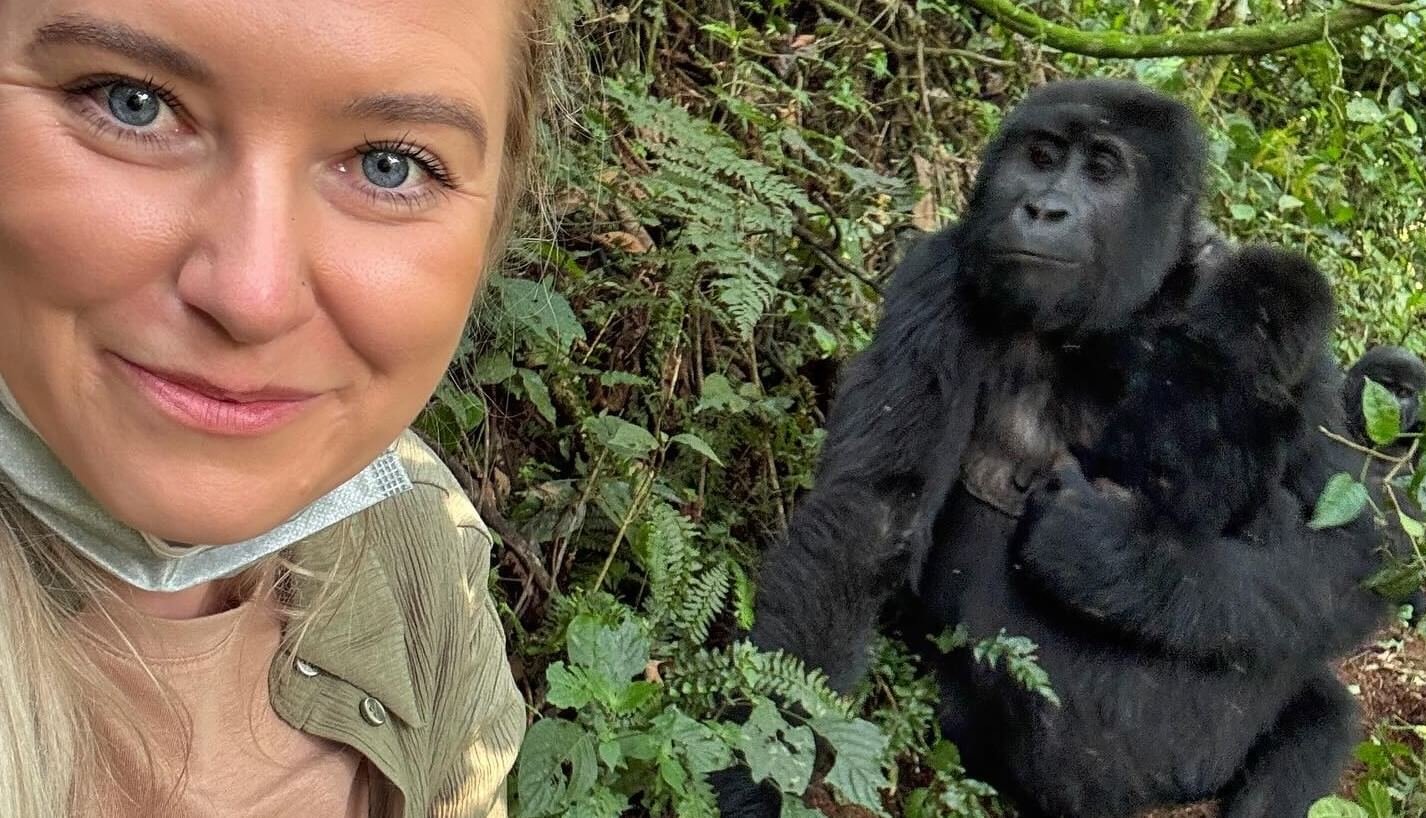
He reviews the rules: seven metres minimum distance at all times, no flash photography, no eating near the gorillas, masks on if you feel a cough coming, and if a gorilla charges, you crouch, you avert your gaze, and you do not run.
He says the last part without drama. It is simply information. You write it into your memory anyway.
He asks if there are any questions. There are a few. Then he shoulders his radio, nods at the two other rangers flanking the group, and says: “Okay. We go.”
8 am: Into the Forest

The first ten minutes of the walk are on a clear path through cultivated land at the park boundary, and you notice the exact moment the forest closes around you. One step, you are in the open air with a view of the hillside.
The next step, the canopy is overhead, and the light has changed completely, gone green and filtered and lower in temperature, and the sounds of the clearing behind you have disappeared as if a door shut.
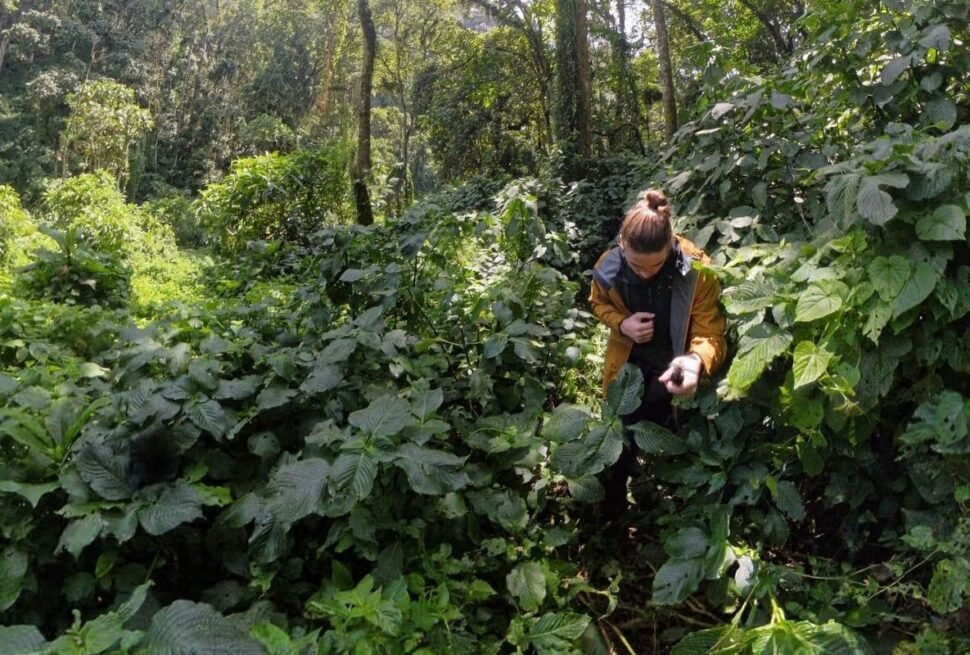
Bwindi Impenetrable Forest earns its name quickly. The vegetation is layered and dense, pushing in from both sides of the narrow trail, and the ground underfoot is roots and mud and moss-covered rock in a combination that requires your full attention if you are going to stay upright.
The ranger sets a pace that is manageable but purposeful. You walk in single file, mostly in silence.
The silence is not awkward. It is functional. The rangers are listening. They communicate with the trackers ahead via radio in short bursts, cross-referencing movement and position.
Every few hundred metres, your lead ranger pauses, holds up a hand, and stands very still for a few seconds. You stand still with him. Then he moves again.
You notice things in these pauses. A hornbill is working on a branch overhead. The way the mist sits in the upper canopy. The sound of water somewhere to the left that you never find the source of.
The forest has a quality that is difficult to name, something between stillness and aliveness, and you understand in these pauses why it has remained largely undisturbed for 25,000 years. It does not feel like a place that welcomes casual intrusion.
Forty minutes in, on a slope that is steeper than anything in the first section, you are grateful for the porter walking behind you.
You hired him at the gate, handed him your day pack with the mild self-consciousness of someone who has never hired a porter before, and within twenty minutes understood why every experienced trekker considers it non-negotiable. He is also, it turns out, one of the reasons the walk is enjoyable rather than merely endured.
He knows the forest. He points things out without drawing attention away from the rangers, small observations about plants and birds that you would have walked past without registering.
The Middle: What Trekking Actually Feels Like

Here is the honest account of the middle section, the part between the gate and the gorillas that travel writing tends to compress into a sentence or two: it is a real hike.
On a straightforward day, you find the gorillas in under two hours, and the effort is moderate.
On a harder day, the family has moved to higher ground or denser vegetation, and the walk is longer and more demanding, with sections where you are pushing through undergrowth with both hands and the ranger ahead of you has become a voice rather than a visible figure.
Both versions are part of the experience. Neither diminishes it.
The hard days produce something that the easy days do not: the specific texture of earned arrival.
When you have been walking for three hours through a forest that resisted you at every steep section, and the radio crackles and the ranger turns and says, “They are close, maybe five minutes,” the feeling that moves through the group is different from anything a comfortable walk produces.
Something physical and focused and a little overwhelming.
On an easier day, that feeling arrives more quickly but is no less real.
Around the halfway point of the hike, whatever that turns out to be, there is usually a rest stop. You drink water. You eat something if you have it.
The rangers share brief exchanges, and the trackers’ latest radio update gets translated for the group.
The mood by this point has shifted from anticipatory nervousness to something more settled: you are in it, committed to the pace of the forest, and the part of your brain that was checking emails yesterday has gone quiet in a way that feels significant.
The Moment of Contact

There is no trumpet. No theatrical reveal. No orchestrated moment of discovery.
What happens is more ordinary and more extraordinary simultaneously. The ranger ahead of you slows without stopping and then stops completely.
He turns, raises a flat hand, and your group compresses into stillness behind him. He is looking at something in the vegetation to the left, maybe eight metres ahead, and you look too, and for a second you see only leaves.
Then the leaves move in a way that leaves do not move on their own, and there is a shape behind them that resolves, over the course of three or four seconds, into a face.
A gorilla face. Enormous, calm, specific. Looking at you.
The sound your group makes is not a gasp. It is smaller than that. A collective intake of breath that nobody planned and nobody notices, making. The ranger crouches, and you crouch.
The gorilla considers you for a moment with an expression that contains no category of human emotion you can accurately map, and then looks away, back toward whatever it was doing before you arrived.
And then the clock starts. You have one hour.
The Hour

The ranger signals your group to spread slightly, keeping the seven-metre arc, and you begin to see more of the family. A female moving through the undergrowth ten metres to the right.
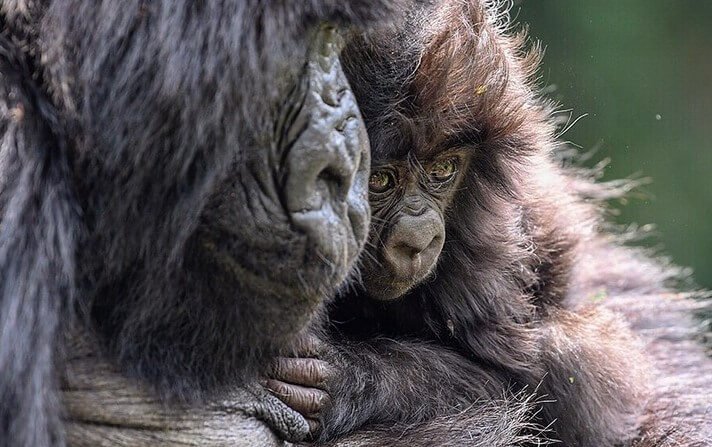
Two juveniles in a tree above you who are more interested in each other than in your group. An older female sitting with a very young infant, so small it seems impossible, pressed against her chest.
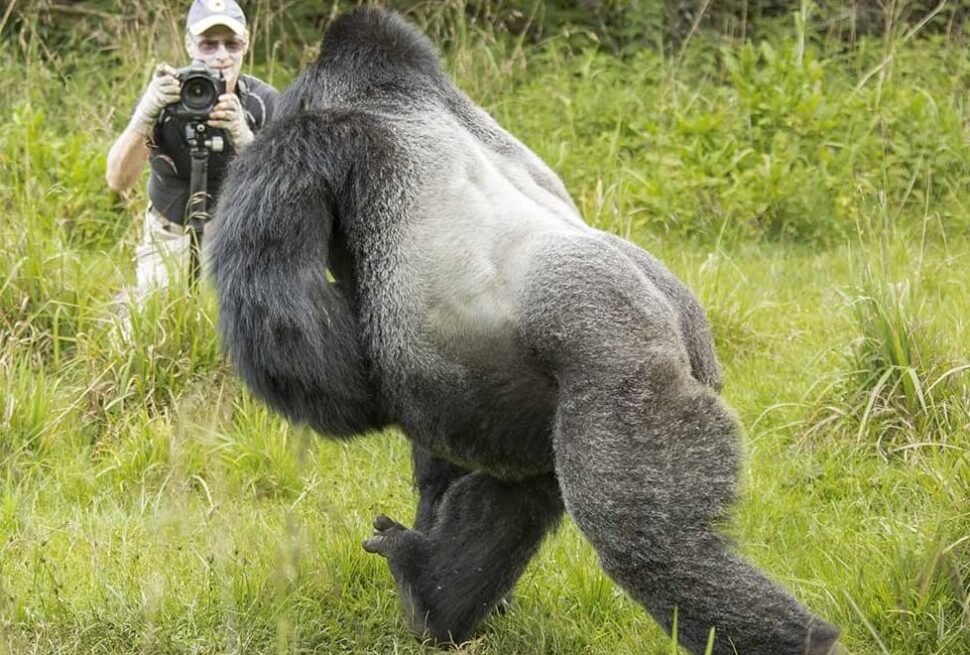
And then, a little further into the vegetation, the silverback.
He is larger than you were prepared for. Not in a way that triggers fear, exactly, but in a way that recalibrates your sense of scale.
He is resting against a fallen tree, his silver back catching the available light, and he is watching your group with the patient attention of someone who has assessed you and decided you are not worth significant concern.
Occasionally, he shifts position. Once he stands fully upright to reach a branch, and you see the full measure of him against the forest, and something in your chest does something you were not expecting.
Your camera is in your hand, and you take photographs, but you also spend stretches of the hour simply watching without the frame of the lens.
The photographs matter, and they do not matter. What is happening in front of you is not a scene that survives reduction to an image, and you understand that even while you keep shooting.
The juveniles in the tree above you start a rolling, tumbling game that brings them closer to the group’s edge than the seven metres, and a ranger quietly repositions the nearest trekkers without urgency. This happens more than once. The gorillas do not read the rules.
A female with an infant on her back moves close enough that you can hear her breathing.
You can see the infant’s fingers, wrapped in a grip around the fur on her shoulder, and the infant is looking directly at you with enormous amber eyes, and the thought that arrives in your head is not poetic or composed: it is simply that this animal is unmistakably, disconcertingly present in a way that nothing in your experience of wildlife has prepared you for.
The silverback, at some point in the middle of the hour, produces a sound. Low, resonant, settling from his chest into the ground.
Not a roar. More like a declaration of continued presence. The forest absorbs it. Your group stays still. The hour continues.
When the Hour Ends

The ranger’s voice, when it comes, is quiet and not unkind. “We must start to go now.”
Nobody argues. You knew the rule before you came, and you understand it in a different register now that you are standing inside it.
You begin to back away slowly, facing the gorillas as you retreat, which the rangers have instructed. The silverback watches your departure with the same calm assessment he brought to your arrival.
You do not look away from him until the vegetation closes between you.
The walk back to the gate is different from the walk in. Quieter among the group in a way that is not subdued but concentrated, as if everyone is holding something they do not want to spill by talking too fast.
The conversations that do happen, at the gate, in the vehicle back to the lodge, over whatever meal arrives in the middle of the afternoon, have a particular quality.
Unguarded. Specific. People keep remembering small moments from the hour and saying them aloud like they need verification that someone else saw the same thing.
You compare images on phones and cameras and find, as most people find, that the photographs are good but do not contain the hour. They are evidence that you were there. They do not replicate what being there was.
What the Day Teaches You

Gorilla trekking is sometimes described as a bucket list experience, which is technically accurate and misses the point entirely.
A bucket list experience is something you complete. This is something that happens to your sense of scale.
The encounter with a habituated gorilla family, specifically the moment of sustained eye contact with an animal that is not domesticated, not performing, and not especially interested in your emotional response to it, does something to the assumption that humans occupy a category separate from the rest of the living world. It does not do this through drama.
It does it through ordinariness. The gorillas are simply living in a forest, in a family, and you are briefly present at the edge of that, and then you are not.
The one hour is the centre of the experience.
The hours around it, the pre-dawn alarm, the layers of clothing in the dark, the gate, the briefing, the forest closing overhead, the earned walk, the crouching stillness of contact, the backward retreat, the quiet return, those hours are what the one hour lives inside.
They are not the frame around the picture. They are the picture.
Practical Details at a Glance

The following logistics apply to gorilla trekking in Uganda specifically, at Bwindi Impenetrable Forest and Mgahinga Gorilla National Park.
- Wake-up time. Between 5 am and 6 am depending on your lodge’s distance from the sector gate. Your operator confirms this the evening before.
. - Briefing time. 7:30 to 8 am at the sector gate. Arrive with a few minutes to spare. The briefing starts when the ranger is ready, not when the last trekker arrives.
. - Duration of the trek. Variable. Forty-five minutes to four or five hours to reach the family, depending on where they have moved. Budget the full morning. The return walk from the encounter is typically faster than the approach.
. - The encounter itself. One hour, timed from first clear visual contact. Non-negotiable and consistently enforced.
. - What to bring. Sturdy, waterproof hiking boots. Long trousers and long sleeves in neutral colours (avoid black, which can agitate gorillas and attracts insects).
Rain poncho. Two litres of water minimum. Snacks for the trail. Camera with flash disabled. Gardening gloves are useful for grabbing vegetation on steep sections.
. - Porter hire. Available at all four Bwindi sectors and at Mgahinga. Cost is $20 to $30, paid directly to the porter at the gate. No version of this advice recommends against hiring one.
. - The return. You are typically back at your lodge by early to mid-afternoon. Most people find that they do not do much for the rest of that day, not out of exhaustion, but because the morning has been sufficient.

Frequently Asked Questions
1. What time does gorilla trekking start?
The sector gate briefing begins at 7:30 to 8 am. You should arrive at the gate by 7:15 at the latest.
Lodge wake-up times range from 5 am to 6:30 am depending on how far you are staying from the gate. Your operator or lodge will brief you the evening before on your specific departure time.
2. What if the gorillas cannot be found on the day of my trek?
This is extremely rare with fully habituated families. UWA trackers enter the forest before dawn and use the gorillas’ night nest location to follow their morning movement, radioing the lead ranger before the trekking group departs.
In the very unlikely event that a habituated family cannot be safely approached, UWA’s policy is to offer an alternative date or a refund. Your operator manages this process on your behalf.
3. Is the one-hour encounter really only one hour?
Yes. One hour from the moment of first clear visual contact with the gorilla family. Rangers enforce this consistently, and the policy is universal across Uganda and Rwanda.
The hour is the conservation mechanism that makes habituation sustainable, because limiting human contact time is central to keeping the gorillas’ behaviour natural and their stress levels low.
4. Can I go back for a second trek the following day?
Yes, subject to permit availability. Some travellers book consecutive days with different gorilla families at different sectors, particularly those staying near Bwindi for several nights.
Each day requires a separate permit at the full $800 cost. The gorilla permit availability page maps out how to plan consecutive or multiple-day trekking.
5. How should I prepare physically for the trek?
Basic cardiovascular fitness is sufficient for most sectors. Walking on uneven terrain for two to four hours, including sections with meaningful elevation gain, is the realistic physical demand.
Nkuringo and Ruhija sectors in Bwindi are the most demanding; Buhoma and parts of Rushaga are more accessible.
If you have specific mobility or health concerns, discuss them with your operator before booking. Porters are available at every sector and recommended regardless of fitness level.
The experience described above happens every morning at sector gates across southwestern Uganda.
If you are ready to be part of one of those mornings, plan your gorilla trekking safari here and we will take care of everything between the permit and the alarm clock.