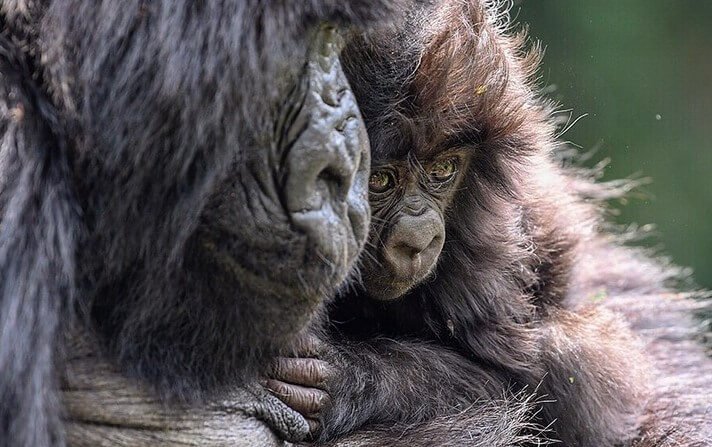

There are fewer than 1,100 mountain gorillas left on earth. Every single one of them lives within a corridor of forest spanning three countries in central Africa.
You cannot see them in a zoo. You cannot find them in captivity anywhere in the world. If you want to sit in the presence of a wild mountain gorilla, there is only one way to do it: you go to the forest, and you trek to find them.
That is what gorilla trekking is. Not a zoo visit with a jungle backdrop. Not a safari where the viewing distance is measured in hundreds of metres.
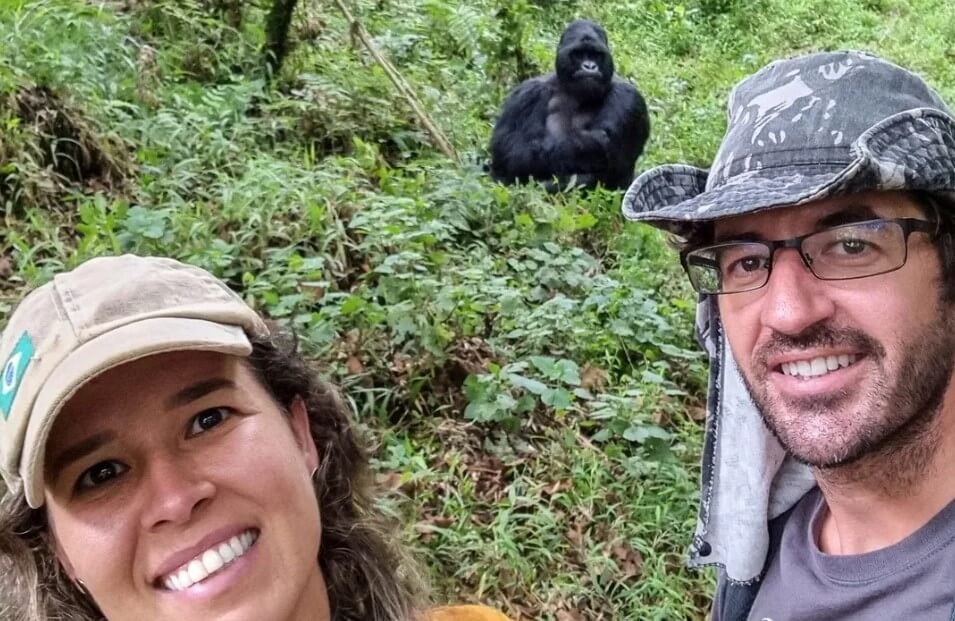
A guided walk through dense tropical forest, following trackers who have been locating the same gorilla families for years, until you find them, and then you stop, and you stay, and for one hour you exist in the same space as an animal that shares 98.3% of your DNA.
Nothing about that hour is scripted.

Key Takeaways
- Gorilla trekking means hiking through the wild forest with a small group to observe a habituated mountain gorilla family in its natural habitat, typically for one hour.
. - Mountain gorillas exist only in Uganda, Rwanda, and the Democratic Republic of Congo — no captive population exists anywhere in the world.
. - The experience is structured around conservation: permit revenue funds the anti-poaching operations and community programmes that have helped gorilla populations recover from near-extinction.
. - Trek difficulty ranges from moderate to strenuous, depending on location, terrain, and where the gorillas have moved overnight. Travellers researching fitness expectations should also read about how hard gorilla trekking is.
. - Uganda offers the widest range of gorilla trekking options, the most habituated families, and the only Gorilla Habituation Experience in the world, at a permit price significantly lower than Rwanda’s.
.
What “Trekking” Actually Means

The word trekking is doing real work in the name of this experience, and understanding it sets accurate expectations before anything else.
Gorilla trekking is not a transfer to a viewing platform. There is no enclosure, no feeding station, and no guaranteed sighting at a fixed time.
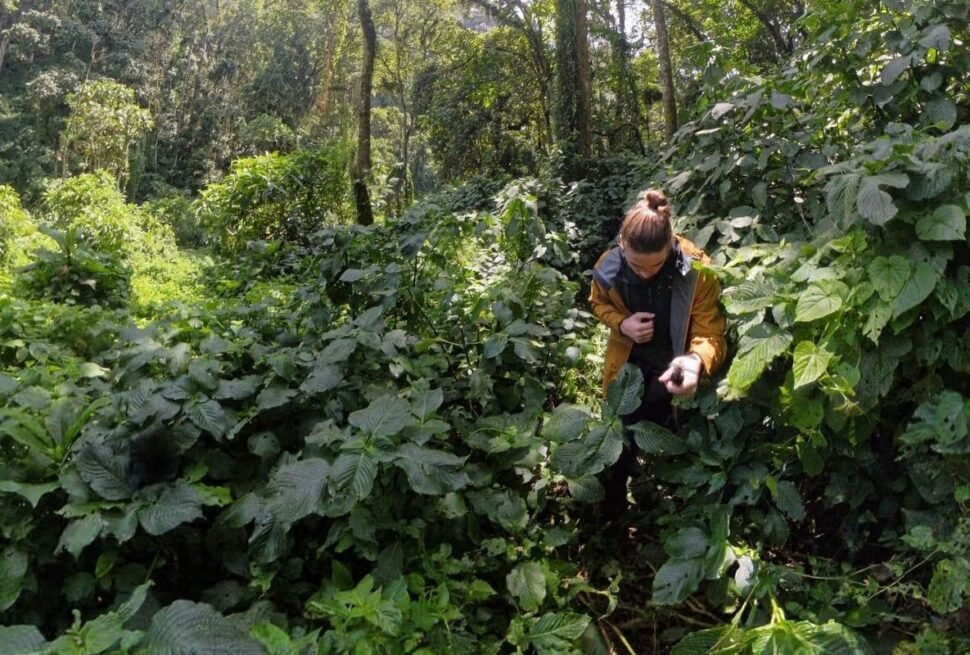
You begin at a sector gate in the early morning, attend a briefing from Uganda Wildlife Authority rangers, and then walk into the forest with a small group of up to eight people, a lead ranger guide, and sometimes armed escorts, depending on the park and the sector.
Ahead of you, trackers have already entered the forest before dawn to locate where the gorilla family sheltered overnight and where they are moving.
The walk to find them takes anywhere from 30 minutes to the better part of a day. Most treks fall between one and four hours of walking before contact. For a fuller breakdown of timing expectations, see how long gorilla trekking takes.
The terrain varies enormously: gentle forest paths in some sectors, steep muddy slopes and dense undergrowth in others. The forest does not accommodate you. You move through it on its terms.
When the trackers radio in the family’s position and your group reaches them, the trekking stops. From that moment, the clock starts on your one hour with the gorillas. After an hour, you leave. The gorillas stay.
That asymmetry matters. You are a visitor in their space, not the other way around.
The rules that govern the entire experience, including the:
- One-hour limit,
- Seven-metre minimum distance,
- Prohibition on flash photography,
- Requirement to mask if you are ill,
all exist to preserve that relationship.
Travellers concerned about close encounters should read what to do if a gorilla charges at you and other safety guidelines while on the trek.
Where Gorilla Trekking Happens

Mountain gorillas (Gorilla beringei beringei) occupy a remarkably small geographic range. The entire global wild population lives across two separate forest systems in East and Central Africa.
a) The Virunga Massif
The Virunga volcanoes form a chain of eight peaks straddling the borders of Uganda, Rwanda, and the Democratic Republic of Congo.
Approximately half the world’s mountain gorilla population lives in this volcanic landscape, and gorilla trekking is available on all three sides of the border.
1. Rwanda’s Volcanoes National Park

This has become the most internationally recognised gorilla trekking destination, partly because Kigali is well-connected by air and partly because Dian Fossey’s research at Karisoke brought Rwanda’s gorillas to global attention.
Trekking here is well-organised and logistically polished. The permit costs $1,500.
Explore the practical differences between gorilla trekking in Rwanda vs Uganda.
2. Uganda’s Mgahinga Gorilla National Park

This shares the Virunga range on the Ugandan side of the border, where one habituated gorilla family, the Nyakagezi group, is accessible for trekking.
Mgahinga’s volcanic setting is dramatic and relatively little-visited, which gives it a quieter atmosphere than either Rwanda’s park or Bwindi.
The Mgahinga gorilla trekking experience also includes golden monkey trekking, a primate encounter available nowhere else in Uganda.
3. The DRC’s Virunga National Park

This was historically the origin of all mountain gorilla trekking, and it holds extraordinary ecological significance. It has also been subject to periodic closure and genuine security risk due to instability in eastern DRC.
When open, it offers a raw and comparatively unpolished experience at lower permit costs.
It is not currently recommended by major travel advisories for most travellers, and the situation is worth checking against your government’s current guidance before considering it.
Anyone considering the DRC route should also read about the safety of gorilla trekking in DRC.
b) Bwindi Impenetrable Forest

The second and larger gorilla population lives in Bwindi Impenetrable National Park in southwestern Uganda, and in the adjacent Sarambwe Reserve across the border in the DRC.
Bwindi is a UNESCO World Heritage Site and one of Africa’s oldest and most biologically rich forests, largely undisturbed for over 25,000 years.
Bwindi is the centre of gravity for gorilla trekking. It holds approximately 19 habituated gorilla families across four trekking sectors, more than any other single park in the world.
It is where the most trekking options exist, where the most research has been conducted, and where the full spectrum of gorilla trekking experiences, from standard one-hour treks to the extended Gorilla Habituation Experience, is available.
Travellers deciding between the two Ugandan parks should compare Bwindi vs Mgahinga, while those choosing a trekking sector can read all four Bwindi sectors explained.
The two populations, Virunga and Bwindi, are geographically separated and genetically distinct at the subspecies level, though both are classified as Gorilla beringei beringei.
Encountering a Bwindi gorilla and a Virunga gorilla are both encounters with mountain gorillas. The forest contexts are different; the animals are similarly extraordinary.
What a Gorilla Family Group Is

Gorillas live in stable social units called troops or family groups, typically led by a dominant adult male known as a silverback.
The silverback is named for the saddle of silver-grey hair that develops across his back as he matures, usually around 12 years of age.
A typical family group contains one dominant silverback, sometimes one or more subordinate males (called blackbacks), several adult females, and their offspring across various ages.
Group sizes range from as few as 5 to over 40 individuals, though 10 to 20 is the most common range for habituated trekking families.
The social dynamics within a group are complex and observable: the silverback makes decisions about movement and rest, females maintain close bonds with their offspring, and juveniles play with a physical exuberance that regularly surprises first-time trekkers who expect more gravitas.
For a deeper look at behaviour and group structure, see mountain gorilla facts and why gorillas beat their chests.
The gorillas you encounter on a trek are habituated. This is an important word, and it deserves unpacking.
What Habituation Means

A wild gorilla that has never seen a human will retreat, display, or charge in response to your presence.
Habituation is the multi-year process by which researchers and rangers expose a gorilla family to humans gradually, consistently, and non-threateningly until the group becomes accustomed to a small number of observers and simply continues its normal behaviour in their presence.
The habituation process takes two to four years per family group. Teams visit daily, maintaining a respectful distance, allowing the gorillas to set the pace of tolerance.
Only when a family is fully habituated, meaning it reliably continues eating, resting, playing, and moving without significant behavioural change in the presence of eight quiet humans at seven metres distance, is it opened to trekking.
This matters for your experience in two ways. First, you are observing natural behaviour, not a stress response. The gorillas you see are doing what they would do if you were not there.
Second, the habituation itself required years of human investment, and that investment continues in the form of daily health monitoring, family tracking, and veterinary care through programmes like Gorilla Doctors. Your permit fee funds all of it.
According to the International Union for Conservation of Nature, mountain gorillas remain classified as Endangered, though their population trend is currently increasing, an outcome directly linked to conservation-funded protection across the range states.
What Happens During the One Hour

You smell them before you see them sometimes. A warm, musky, distinctly animal presence in the air that tells you the trackers have found the right place.
Then the forest opens slightly, or the ranger raises a hand, or you hear a branch break fifteen metres to your left, and there they are.
What happens next is governed by rules, but experienced inside something that feels nothing like a rule-bound situation.
The ranger signals your group to stop. You crouch or stand quietly while the gorillas adjust, if they need to at all, to your presence. Often they do not.
The silverback may be resting against a tree, half-watching you with the mildly irritated patience of someone who has tolerated this before. Females move through the undergrowth nearby.
An infant, if you are lucky, slides off its mother’s back and tumbles toward your direction before being retrieved. A juvenile in a tree above you shakes a branch, which may be play or may be a minor display, and nobody is entirely certain which.
You stay at seven metres. You keep your voice low. You do not point directly at the animals. You do not eat. You do not use flash. You do not move toward them if they approach; you hold still and let the rangers manage the encounter.
These rules are not a bureaucratic imposition on the experience. They are what make the experience safe for the gorillas and sustainable for future trekkers.
The hour runs from the moment of first clear visual contact with the family. In practice, it passes faster than any other hour you will spend outdoors in your life.
Experienced trekkers report this unanimously, and it remains surprising every time, regardless of how many times you have been told to expect it.
A fuller breakdown of the emotional and practical reality of the encounter is covered on the gorilla trekking experience.
When the ranger signals the end of the hour, you leave. Not reluctantly, not with a guide nudging you, but because you understand by then what the hour costs in terms of conservation effort and what protecting it means for the families that follow yours.
Photography During the Trek

Cameras and phones are permitted.
Video is permitted. Flash is not, under any circumstances. Long lenses are helpful given the minimum distance requirement, but most modern smartphone cameras produce usable images at seven metres in reasonable light.
The forest canopy filters light variably, and morning treks in dense sectors like Bwindi can be darker than you expect, which is worth factoring into your equipment choices.
The realistic expectation is that your best images will be incidental rather than posed, and that some of the most vivid memories from the hour will not be captured at all. That is not a failure of the experience. It is the experience.
Why Gorilla Trekking Exists as a Conservation Tool

This is the part of gorilla trekking that most travel writing skips past on the way to describing the silverback’s eyes, and it is arguably the most important part.
In the 1980s, mountain gorilla populations had declined to approximately 620 individuals.
Habitat loss, poaching for bushmeat and the illegal pet trade, civil conflict across the range states, and disease transmission from humans had pushed the subspecies toward a trajectory that conservation biologists were not optimistic about.
The response was a combination of anti-poaching enforcement, veterinary intervention through Gorilla Doctors, community engagement, and the development of regulated gorilla trekking as an economic model for conservation.
The logic was direct: if the communities adjacent to gorilla habitat could derive more income from live gorillas accessible to paying tourists than from habitat conversion or hunting, the economic incentive structure shifted from extraction to protection.
That model has worked. The mountain gorilla population crossed 1,000 individuals in 2018, the first time a great ape subspecies had moved off the critically endangered list in living memory, and population growth has continued since. Gorilla trekking is not incidental to that recovery. It is central to it.
Readers interested in population recovery data can also read about how many mountain gorillas are left.
Uganda Wildlife Authority directs approximately 20% of gorilla permit revenue to the communities living adjacent to Bwindi and other national parks through its Revenue Sharing Programme.
Local schools, health centres, and infrastructure in the communities around the parks have been funded in part by that distribution.
The rangers who guide you, the trackers who locate the family before dawn, the community staff at the park gates, these are not tourism workers imported from a capital city. They are members of the communities whose relationship with the forest the conservation model depends on.
This is also why the permit price is what it is. Uganda’s $800 permit and Rwanda’s $1,500 permit are not luxury pricing for the sake of it.
They are the financial engine of a conservation system that has produced the most significant great ape population recovery in modern history. Understanding that does not make the cost easier to absorb, but it does change what the cost means.
The why gorilla trekking is so expensive article breaks down the economics in detail.
The Rules Every Trekker Follows

Uganda Wildlife Authority sets the rules for all gorilla trekking permits in Uganda. Rwanda’s Rwanda Development Board and the DRC’s ICCN operate under similar frameworks.
The specific regulations vary slightly by country, but the core rules are consistent across all three.
- Minimum age of 15. Children under 15 are not permitted to trek.
The rule exists because younger children are more likely to carry contagious illnesses, less reliably able to stay quiet and still during an encounter, and more likely to elicit a protective response from gorilla family members. There are no exceptions.
. - Maximum group of 8. No more than 8 tourists per gorilla family per day. This is the foundation of the whole system’s sustainability.
. - One hour maximum. Timed from the first clear visual contact. Non-negotiable.
. - Seven-metre minimum distance. Enforced by rangers throughout the encounter. If a gorilla approaches closer, you do not move toward them. You stay still.
. - No flash photography. Enforced immediately and without exception.
. - Face masks if unwell. Gorillas are highly susceptible to human respiratory infections. If you are showing any cold, flu, or respiratory symptoms on the morning of your trek, you must wear a face mask. Rangers carry them, but bringing your own is better preparation.
. - No food or drink near the gorillas. Eating within the encounter zone is prohibited.
.
Uganda’s Position in the Gorilla Trekking World
Threading Uganda’s advantages naturally throughout this guide has been intentional rather than an afterthought, but it is worth being direct about why Uganda deserves particular attention.
Uganda offers more gorilla trekking options than any other country.
Bwindi’s approximately 19 habituated families across four sectors, the single family at Mgahinga, and the GHEX at Rushaga together create the most varied gorilla trekking programme in existence.
The permit price at $800 is significantly lower than Rwanda’s $1,500 for the same one-hour encounter with the same mountain gorilla subspecies.
The Gorilla Habituation Experience, which grants four hours with a partially habituated family and exists only at Rushaga sector, is available nowhere in Rwanda or the DRC.
For travellers arriving via Kigali, Uganda’s southern sectors are only three to three and a half hours away via the Gatuna border crossing, barely more than the drive from Kigali to Volcanoes National Park.
The gorilla trekking route from Kigali makes Uganda accessible to almost any traveller routing through Rwanda, and the savings on the permit more than cover the additional journey time.
The full Uganda versus Rwanda comparison covers every variable in detail for anyone still deciding between the two countries.
Practical Orientation for First-Time Trekkers

A few things worth knowing before you start researching itineraries.
1. Book the permit before you book anything else
Peak season permits (June to September, December to February) sell out 3 to 6 months in advance. The permit is the constraint around which everything else is built.
Our Uganda gorilla trekking permits page covers the booking process in full, and the permit availability guide maps out current booking windows by sector and season.
Travellers planning close to departure dates should also check out last-minute gorilla permits.
2. Prepare for the full day, not just the hour
Getting to the park, the briefing, the trek to find the family, and the return journey all sit around the one-hour encounter.
A gorilla trek is a full day, regardless of whether the family is found quickly or takes several hours to reach.
Wear layers, bring sufficient water, carry a rain poncho, and hire a porter. The porter hire costs $20 to $30 and is worth every cent on terrain that ranges from uneven to genuinely steep.
If you are still figuring out transport logistics in southwestern Uganda, how to get to Bwindi and how to get to Uganda, cover the main routes in detail.
3. Understand the cost structure before you budget
The permit is the foundation, but transport, accommodation, and operator fees are additional.
The full cost of gorilla trekking page provides a complete breakdown across budget, mid-range, and luxury tiers.
4. Safety is not a concern for the trekking regions
Uganda’s gorilla parks in the southwest carry no current security concerns for tourists. The Is Uganda Safe page covers safety by region, health requirements, and practical travel information for the country as a whole.
Planning Your First Gorilla Trek

The structure of your trip determines much about the experience you have.
A one-day trek from Kigali and a three-day itinerary based near Bwindi are both gorilla trekking, but they produce quite different travel experiences around the same central hour.
For travellers with limited time, the 1-day Bwindi gorilla trek and the 2-day Bwindi trek from Kigali are the most efficient structures.
For those who want to settle into the forest environment before and after the trek, the 3-day Bwindi and Lake Bunyonyi safari adds a night at one of Uganda’s most beautiful crater lakes and gives the trip room to breathe.
For travellers who want the deepest possible encounter, the 3-day Gorilla Habituation Experience at Rushaga offers four hours with a partially habituated family, which is categorically different from a standard trek and available nowhere else on earth.
Longer itineraries that combine gorilla trekking with chimpanzees, game drives, and Uganda’s broader wildlife are covered on the 5-day Primates Safari, 8-day Uganda Wildlife Safari, and 10-day Uganda Primate and Wildlife Safari pages.
Frequently Asked Questions

1. Is gorilla trekking worth the cost?
The short answer is yes, for most people who do it.
The longer answer is that $800 is the most expensive single experience many travellers will ever book, and whether it is worth it depends partly on your relationship with wildlife and wild places, and partly on understanding what the money does.
The gorilla families you spend an hour with exist because permit revenue has funded their protection for over three decades.
The hour itself is singular in a way that is difficult to describe before you have had it and unnecessary to describe afterwards.
A fuller treatment of this question is on the is gorilla trekking worth it page.
2. How physically demanding is gorilla trekking?
It ranges from moderately challenging to strenuous depending on the sector, the terrain, and where the gorilla family has moved.
The Buhoma sector in Bwindi is the most accessible. Ruhija is the most demanding. All sectors involve uneven, forested terrain and the possibility of a multi-hour walk before the family is located.
Standard fitness, comfortable hiking boots, and a porter for your day pack are the practical requirements for most trekkers.
3. Can I choose which gorilla family I trek with?
You can state a preference when booking, and operators can often accommodate requests for a specific sector or family when booking well in advance.
The final allocation is controlled by UWA based on availability on your date.
What you cannot guarantee is a specific family; what you can guarantee, by booking early and being specific with your operator, is a strong chance of getting what you ask for.
4. How long does a gorilla trek take in total?
The full day runs from approximately 7 am to early or mid-afternoon for most treks, though this varies significantly based on how long it takes to locate the family.
The one-hour encounter with the gorillas is the fixed core; the surrounding journey through the forest is variable.
Budget for a full day and treat any time remaining afterwards as a bonus.
5. What is the best time of year to go gorilla trekking?
The dry seasons (June to September and December to February) offer the most reliable trail conditions and the clearest light for photography.
The wet seasons (March to May and October to November) carry better permit availability, fewer trekkers on the trail, and a lush forest environment that has its own genuine appeal. Neither is categorically better; they are different experiences with different trade-offs.
The permit availability guide maps availability patterns by season and sector in detail.

Gorilla trekking is one of those experiences that changes the frame of what travel is capable of.
If you are ready to start planning, request a custom safari quote here, and we will build the right itinerary around your dates, your entry point, and the kind of experience you are looking for.