
Uganda holds roughly 5,000 chimpanzees, the largest national population anywhere in Africa, and the most reliable place to encounter them in the wild is a 795-square-kilometer forest in the country’s west.
Kibale National Park has been quietly outperforming its reputation for years. Most travelers arrive expecting a good primate walk. Many leave, reconsidering what wildlife encounters are actually supposed to feel like.
That reaction isn’t accidental. It has everything to do with how Kibale works, what the forest contains, and why chimpanzee trekking here operates differently from the experience most people imagine beforehand.
Key Takeaways
- Kibale National Park holds the highest density of primates in Africa, with 13 species, including an estimated 1,500 chimpanzees in the forest’s habituated and wild populations
. - Trekking departs from Kanyanchu Visitor Centre twice daily at 8 am and 2 pm, with morning sessions generally favored for longer viewing windows
. - Permits cost $250 per person for non-residents (subject to change by the Uganda Wildlife Authority) and should be secured well in advance during peak season
. - Kibale pairs naturally with gorilla trekking in Bwindi to form Uganda’s definitive primate circuit, with both parks sitting in the country’s western corridor
. - Children under 12 are not permitted to trek, and anyone with a respiratory illness is required to stay out of the forest to protect the chimpanzees from human-transmitted disease
.
What Makes Kibale Different

Most visitors to East Africa treat chimpanzees as a secondary objective. A morning activity added to fill time between bigger-ticket encounters. Kibale challenges that framing directly, and the forest makes the case before the trek has properly begun.
Walking in at dawn, before the light has fully reached the canopy floor, you hear them.
Pant-hoots carry extraordinary distance through the forest, and the call of a habituated community in full morning chorus carries a kind of intensity that no briefing really prepares you for.
By the time you see your first chimpanzee, the forest itself has already done most of the work.
Part of what separates Kibale from other chimpanzee destinations in the region is density.
The park holds an estimated 1,500 chimpanzees across several habituated and wild communities, meaning that encounter rates are high and the guides operate with a level of confidence that comes from spending years with the same family groups.
These aren’t occasional sightings. On most mornings at Kanyanchu, you’re spending an hour or more with a community that knows this forest as well as you know your neighborhood.
That familiarity, built through decades of careful habituation work, changes everything about the experience.
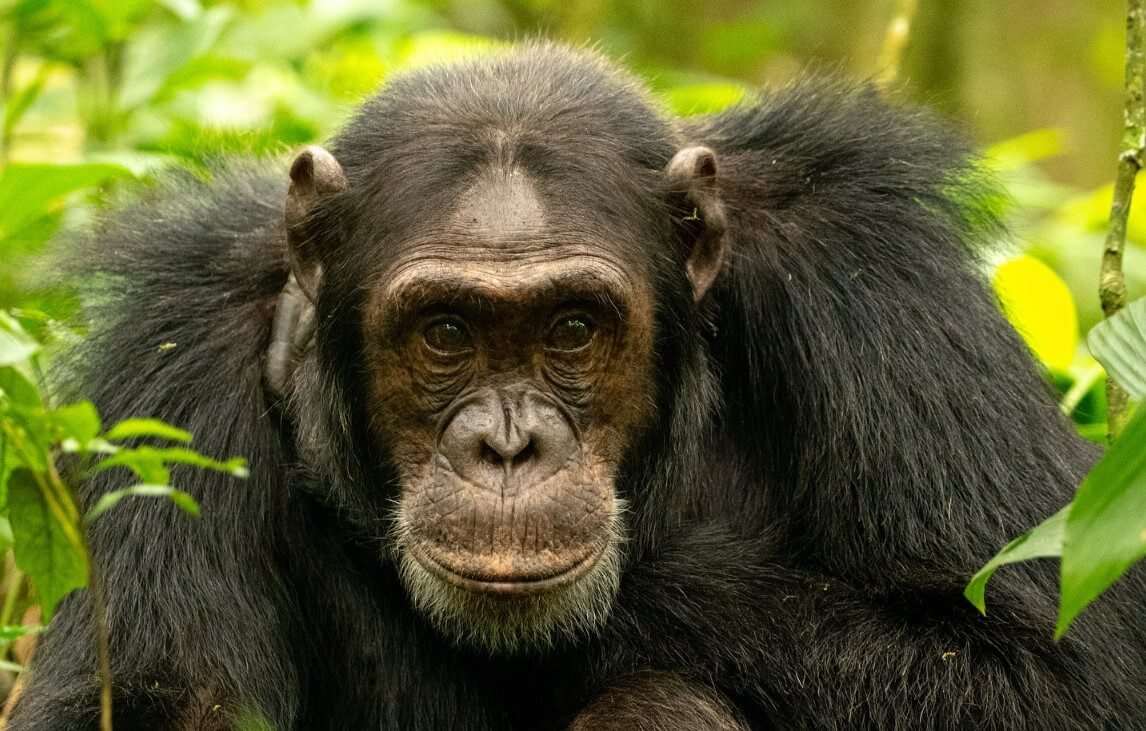
Chimpanzees are intensely social and genuinely curious. Younger individuals sometimes approach unprompted. The alpha male may walk past close enough that you notice the texture of his knuckles.
These are not zoo conditions, and they’re not managed spectacle. The encounters are real, which also means they’re unpredictable.
The Forest Itself

Kibale contains one of the most intact stretches of moist montane forest remaining in East Africa.
Altitude ranges from 1,100 to 1,590 meters across the park, creating temperature and vegetation gradients that support an unusual diversity of species across a relatively compact area.
The forest corridor that connects Kibale to Queen Elizabeth National Park to the south forms one of Uganda’s most important conservation linkages, allowing elephant and buffalo populations to move between the two protected areas.
Thirteen primate species share the park, making it the most primate-rich forest on the continent.
- Red colobus monkeys
- L’Hoest’s monkeys
- Grey-cheeked mangabeys
- Olive baboons
These appear regularly along trekking trails, sometimes in the same viewing window as the chimpanzees
Over 375 bird species have been recorded, including the African pitta, the black bee-eater, and several hornbill species that appear with some reliability in the canopy above the main trail system.
The Bigodi Wetland Sanctuary, sitting just outside the park’s eastern boundary, adds another ecological layer entirely.
Community-managed and internationally recognized as one of Uganda’s best birding sites, Bigodi offers a half-day walk that most itinerary planners underestimate.
Sitatunga, a rarely-seen semi-aquatic antelope, lives in the papyrus margins. The experience rewards slow movement and genuine attention.
Trekking in Practice
1. The Kanyanchu Experience

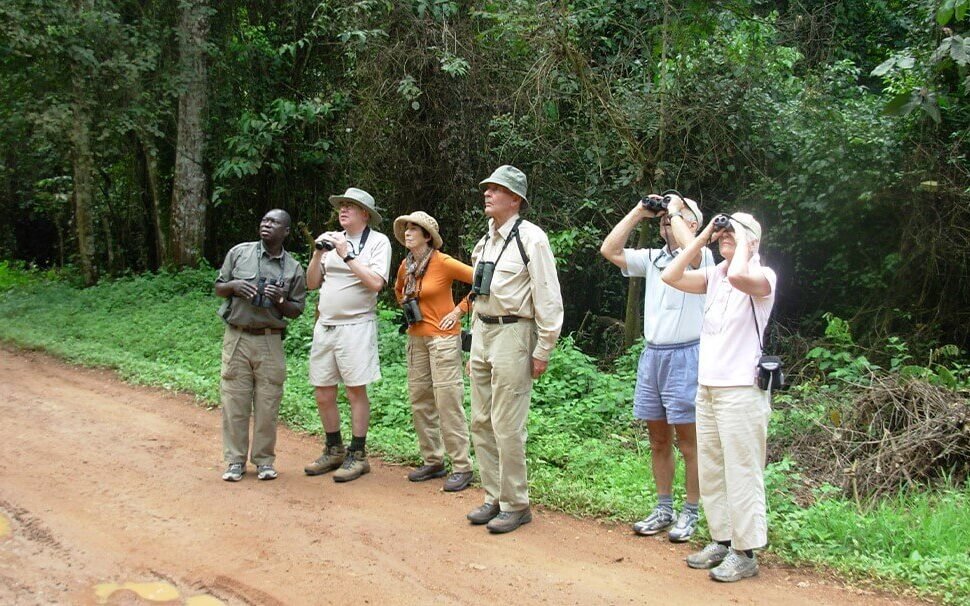
All chimpanzee treks in Kibale depart from Kanyanchu Visitor Centre, roughly 36 km south of Fort Portal town. Briefings begin at 7:45 am for the morning session and at 1:45 pm for the afternoon.
Groups are capped at six people per habituated community to minimize behavioral disruption, a constraint that tightens availability during peak months and underscores why permit timing matters.
Trek duration varies. On most days, trackers have already located the community before guests enter the forest, and active observation begins within 30 to 60 minutes of departure.
The hour spent with the chimpanzees moves quickly, and most visitors feel genuinely reluctant when the guides call time.
Afternoon sessions sometimes run shorter due to fading light, which is why morning permits are more sought-after and book out faster.
The trail is not technically demanding, but it isn’t flat. Roots, uneven ground, and occasional steep sections mean that trail footwear matters.
The full packing and clothing guidance written for Bwindi applies broadly here as well, with one difference: Kibale is generally wetter underfoot in the forest interior regardless of season, so waterproof boots earn their keep year-round.
2. Chimp Habituation at Kibale

Beyond standard trekking, Kibale offers a full-day habituation experience through the Kaniyo Pabidi area with a semi-habituated community.
The format mirrors the gorilla habituation experience available in Bwindi, in that you’re spending an extended day with research teams as they continue the habituation process rather than joining a single one-hour encounter.
This isn’t a premium upgrade in the conventional sense.
The forest time is longer, the behavior you witness is more varied, and the experience demands more physical and mental engagement from the participant. Some travelers find it more rewarding than the standard trek.
Others find the longer exposure to uncertain conditions challenging. The right choice depends on what you actually want from the encounter.
How Hard Is the Trek

The short answer is: moderate, but variable. Kibale’s forest floor is relatively navigable compared to the steep ridges of Bwindi, and the absence of altitude extremes makes the physical load more consistent.
The main challenge is the nature of forest walking itself.
Trails narrow, roots require attention, and the pace slows to a cadence that feels unfamiliar to people accustomed to hiking established paths.
Fitness requirements are similar to a moderately challenging day hike. Most travelers in reasonable health complete the trek without difficulty.
That said, genuinely flat terrain is rare inside the forest, and if you arrive expecting a casual stroll, the reality may surprise you. Going in with appropriate expectations and appropriate footwear makes a significant difference.
When to Go

Kibale receives visitors year-round, and chimpanzees are active in every season, but the two dry windows, June through August and December through February, are consistently favored.
Trails are firmer, driving conditions between Fort Portal and the park are more reliable, and the forest canopy opens slightly where deciduous sections have shed leaves, sometimes improving visibility.
The wet seasons bring their own advantages. Bird diversity peaks dramatically during the November and April migration periods.
Forest light on overcast mornings has a quality that photographers often prefer, and the green density of the forest at full saturation is genuinely extraordinary to walk through.
If gorilla trekking is part of your Uganda itinerary, the best seasonal windows for Bwindi align reasonably well with Kibale’s dry periods, which simplifies combined-trip planning considerably.
Permits, Costs, and Logistics
1. What Permits Cost

Standard chimpanzee trekking permits at Kibale cost $250 per person for non-resident adults at the time of writing, a fee set by the Uganda Wildlife Authority and subject to periodic revision.
The habituation experience costs $250 as well, though itinerary operators sometimes bundle this differently within packaged trips.
Permit fees contribute directly to park management and community programs in the surrounding area, a point worth understanding when the price generates sticker shock.
For context, the full cost breakdown for gorilla trekking in Uganda covers the broader fee structure across Uganda’s primate experiences.
The combined expense of a chimpanzee permit and a gorilla permit within a single Uganda trip is substantial, but both are priced far below comparable Rwanda experiences, a distinction the Uganda versus Rwanda comparison addresses directly.
2. Getting There

Fort Portal serves as the main gateway town, sitting roughly 300 km from Kampala, a five-to-six-hour drive depending on road conditions.
Daily bus services run from Kampala, though most visitors traveling to Kibale as part of a wider circuit use private transfers or operator-arranged vehicles.
If you’re traveling from Kigali into Uganda, the standard routing through Kabale and the southwest can be extended westward to include Kibale, though this adds meaningful distance and a longer transit day.
The visa and entry requirements for Uganda are worth confirming early, particularly for travelers combining Rwanda and Uganda on a single trip.
The road from Fort Portal to Kanyanchu takes roughly 45 minutes. Accommodation ranges from simple lodges near the park gate to mid-range properties in the forest margin, with a handful of high-end options closer to Fort Portal town.
Combining Kibale With Other Uganda Destinations
1. The Primate Circuit

The most natural pairing in Uganda’s safari calendar puts Kibale alongside gorilla trekking.
Both experiences sit in the western corridor, both involve habituated primates with decades of research behind them, and together they represent an encounter profile available nowhere else on the continent.
Spending time with chimpanzees in Kibale and mountain gorillas in Bwindi within the same trip creates a comparative experience that transforms how most travelers think about great ape intelligence and social behavior.
The 5-day Uganda primates safari is built specifically around this combination. It gives enough time at each destination without creating a sense of rushing between parks, and the routing is structured to minimize unnecessary driving.
For travelers who want a fuller picture of Uganda’s western wildlife corridor, the 4-day Uganda safari offers a tighter circuit that includes Kibale alongside Queen Elizabeth National Park.
2. Adding Queen Elizabeth

Queen Elizabeth National Park sits roughly three hours south of Kibale by road. The Kazinga Channel boat cruise, the Ishasha tree-climbing lions, and 600-plus recorded bird species make Queen Elizabeth a compelling addition to any western Uganda routing that begins at Kibale.
The two parks together deliver a breadth of wildlife that most East African itineraries can’t match without covering far greater distances.
The 8-day Uganda wildlife safari builds this corridor properly, giving meaningful time at each destination.
For a more expansive view across Uganda’s primate and savanna wildlife, the 10-day Uganda primate and wildlife safari remains the most comprehensive option on the site.
What the Mainstream Conversation Misses

There is a version of the Kibale narrative that gets repeated in travel writing until it becomes scenery: dense forest, intelligent apes, transformative encounter. All of that is accurate. None of it grapples with the tensions underneath.
Chimpanzees at the forest edge increasingly raid crops on adjacent farms. Human-wildlife conflict around Kibale is real, documented, and not diminishing as human populations in the corridor continue to grow.
The conservation model that sustains the park depends on visitor revenue being channeled meaningfully into communities that bear the costs of living alongside wildlife, and not all operators or lodges manage this with equal transparency.
Chimpanzees are also susceptible to human respiratory diseases, a risk serious enough that the World Health Organization’s guidelines on great ape tourism informed Uganda Wildlife Authority protocols requiring health screening before trek access.
The 8-meter minimum distance rule exists for the same reason. These aren’t bureaucratic formalities.
They reflect the genuine fragility of habituated populations that have been made comfortable with human presence and, as a result, are no longer able to retreat from it.
Research published through bodies like the Jane Goodall Institute has shaped how habituation is conducted across Africa, and Kibale’s chimpanzee communities benefit directly from decades of behavioral science conducted in situ. Understanding that lineage changes the quality of attention you bring to the encounter.
Frequently Asked Questions

1. How long does a Kibale chimpanzee trek take?
The morning session begins with a 7:45 am briefing and typically runs until midday, though actual time in the forest varies. Once you reach the chimpanzees, you spend one hour with the group before returning to Kanyanchu.
Trek-in and trek-out time depends on where the community has moved overnight, but most visitors complete the full experience in three to four hours.
2. Is chimpanzee trekking in Kibale safe?
It is, with appropriate preparation and attention to briefing guidelines. Chimpanzees are large, fast, and occasionally unpredictable, particularly adult males asserting dominance.
Following the rangers’ instructions and maintaining the required distance manages risk effectively.
The safety considerations around primate encounters written for gorilla trekking apply broadly to chimp encounters as well.
3. Can children do the Kibale trek?
Children under 12 are not permitted on chimpanzee treks in Kibale, primarily to protect the chimpanzees from respiratory illnesses that young children carry more readily.
The age requirements for primate trekking in Uganda cover the full picture across both Kibale and Bwindi.
4. Do I need to book a Kibale permit in advance?
Yes, particularly for June through August and the December holiday period. Daily trek capacity is tightly limited, and popular dates book out weeks or months ahead.
Your operator should secure permits as part of trip confirmation rather than on arrival. If your dates are flexible, last-minute permit availability for Bwindi operates on principles similar to Kibale’s permit system.
5. What should I bring on the trek?
Long-sleeved clothing in neutral colors, waterproof hiking boots, insect repellent, sunscreen, and a rain layer are the practical essentials. Cameras with telephoto capability improve your chances of good photographs without requiring you to move closer than the guidelines allow.
A more complete kit list appears in the Bwindi packing guide, which transfers almost entirely to Kibale.
Kibale rewards travelers who arrive with genuine curiosity and the patience to let the forest set its own pace.
The chimpanzees are compelling enough on their own. Still, the full experience draws from every layer of the forest: the birdsong before the trek begins, the wetland walk at Bigodi, the sound of a community on the move through the canopy overhead.
Whether you’re building a primate-focused Uganda itinerary or combining Kibale with savanna wildlife and gorillas, the planning conversation starts with understanding what the options actually look like in practice.
Start putting your trip together here, or if gorilla trekking is part of the picture, secure your permit before your preferred dates fill.