
For tens of thousands of years, the Batwa lived inside the forest. Not at its edge. Not nearby. Inside it, in a relationship with the ecosystem so complete that the forest itself shaped their language, their medicine, their spiritual world, and their understanding of what it means to be human.
Then, in 1991, Uganda gazetted Bwindi Impenetrable National Park. The Batwa were evicted. No consultation. No compensation. No plan.
That eviction is now more than three decades old, and the Batwa remain one of the most economically marginalized communities in Uganda.
Their story is inseparable from gorilla conservation, and anyone who treks in Bwindi or visits Mgahinga without knowing it is missing something essential about the place they’ve traveled to.
This post is an attempt to tell that story honestly.

Key Takeaways
- The Batwa are Uganda’s oldest indigenous community, likely the oldest on the African continent, with an estimated history in the Great Lakes forest region spanning over 60,000 years.
. - They were forcibly displaced from Bwindi and Mgahinga in 1991 when both forests were gazetted as national parks, with no legal recognition, land title, or formal compensation provided.
. - Today, many Batwa live in extreme poverty on the periphery of the parks that contain their ancestral land.
. - The Batwa Trail at Mgahinga and community experiences near Bwindi offer genuine cultural engagement, but the ethical quality of those experiences varies significantly.
. - Visiting Batwa communities can be a meaningful and responsible part of a Uganda safari when approached with the right operator, the right questions, and a willingness to sit with a difficult history rather than package it into something comfortable.
.
Who the Batwa Are

The Batwa, sometimes referred to as Twa or, in older literature, as pygmies (a term now widely considered offensive and rejected by the communities themselves), are the indigenous forest-dwelling people of the Great Lakes region.
Their presence in the montane forests of southwest Uganda, Rwanda, Burundi, and the Democratic Republic of Congo predates every other community in the area by a significant margin.
Anthropological and genetic research suggests the Batwa have lived in and around these forests for somewhere between 60,000 and 70,000 years.
That figure is not decorative. It means that when the mountain gorilla was first formally described by Western science in 1902, the Batwa had already been sharing the forest with them for longer than most human civilizations have existed.
Their traditional way of life was built around what the forest provided.
They were hunter-gatherers who moved fluidly through the trees, using intimate ecological knowledge passed across generations to find food, medicinal plants, shelter, and spiritual meaning.
They did not own the forest in the western legal sense. But they belonged to it in every way that matters.
A Culture Shaped by the Forest

Understanding Batwa culture requires setting aside the assumptions that surround hunter-gatherer societies.
Their knowledge was not primitive. It was precise, cumulative, and functionally sophisticated in ways that modern ecology is only beginning to document properly.
1. Plant Knowledge and Forest Medicine
Batwa elders carried pharmacological knowledge that no textbook has fully recorded. Specific bark, root, leaf, and sap combinations addressed everything from wound infections to difficult births to snake venom.
Much of this knowledge existed only in oral form, transmitted through practice rather than instruction. When displacement severed that practice, a significant portion of the knowledge went with it.
What has been lost in the last three decades of disconnection from the forest is genuinely difficult to quantify.
2. Spiritual Life and Forest Identity
The forest was not a setting for Batwa spiritual life. It was the substance of it.
Their understanding of the divine, of the afterlife, of human obligation, was located in specific trees, clearings, animals, and seasonal rhythms that no longer exist within reach.
Displacement was not only economic dispossession. It was a severing of the structures through which meaning itself was organized.
3. Language and Oral Tradition
The Batwa language, Kinyabwisha in some communities and Kitwa in others, carries embedded ecological and cultural information that exists nowhere else.
Across Uganda and the wider region, many Batwa have shifted to dominant local languages out of necessity, and with each generation that transition becomes more complete.
What disappears with a language is rarely fully visible until it is gone.
The 1991 Eviction and What Actually Happened

Bwindi Impenetrable Forest and Mgahinga Gorilla National Park were both gazetted in 1991, a decision driven largely by international conservation pressure and the urgent need to protect the mountain gorilla population, which had declined to critical levels.
That conservation goal was real, and the stakes were high. None of that changes what happened to the people who lived inside those forests.
The Batwa were removed without prior consultation, without legally recognized land rights, and without any formal resettlement program or compensation structure in place.
In the language of international human rights frameworks, it was forced displacement.
The Ugandan government did not acknowledge the Batwa as indigenous peoples with specific land rights, and no mechanism existed to challenge the eviction.
Families who had lived inside the forest for generations were suddenly outside it, landless, and expected to adapt to an agricultural economy for which they had no land, no tools, no seeds, and no cultural framework.
The transition was not a transition. It was a rupture.
The Conservation Paradox
The conservation community has, in recent years, grown more willing to examine the displacement model that dominated protected area policy through the latter half of the 20th century.
The assumption that nature is best protected by removing human communities from it has been challenged by evidence that indigenous forest management often produces better ecological outcomes than exclusion-based conservation, because indigenous communities have a practical and spiritual stake in ecosystem health that no external management structure can fully replicate.
The Batwa case is a particularly clear example of this paradox. The people with the deepest knowledge of Bwindi’s ecosystem were removed to protect it.
Three decades later, poaching still occurs, invasive species are a growing challenge, and the communities most capable of monitoring forest health from the inside are surviving in poverty on the periphery.
The Minority Rights Group International has documented this pattern across multiple countries and multiple communities with damning consistency.
Where the Batwa Are Now

Estimates vary, but Uganda’s Batwa population is generally placed between 6,000 and 7,000 people.
Most live in small communities on the edges of Bwindi and Mgahinga, on land that is either rented, informally occupied, or provided through NGO-funded programs. Very few own the land they live on.
Poverty levels are severe. Access to formal education, healthcare, and legal systems remains limited by language barriers, discrimination, and geographic isolation. Land disputes are common and rarely resolved in the Batwa’s favor.
A 2019 report by the Uganda Human Rights Commission noted that the Batwa remain one of the most structurally excluded communities in the country, facing discrimination not only from government institutions but from neighboring Bantu communities whose own historical relationship with the Batwa was already complex before 1991.
Children’s school attendance rates have improved through targeted programs, but secondary and tertiary education remain largely inaccessible.
Many Batwa men work as casual agricultural laborers on land that was their ancestors’ hunting ground.
The psychological and cultural dimensions of this loss rarely appear in economic statistics, but they are present in every conversation with Batwa elders about what the forest meant.
The Batwa Trail at Mgahinga

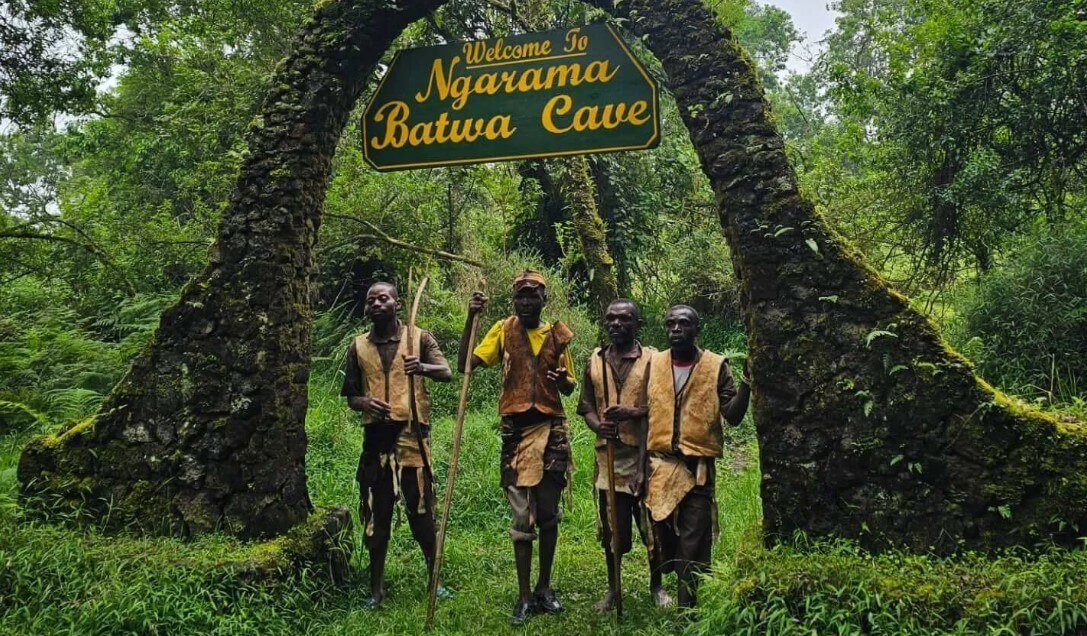
The most formal cultural tourism experience available is the Batwa Trail at Mgahinga Gorilla National Park.
Run in collaboration with the Uganda Wildlife Authority and community representatives, the trail is a guided walk led by Batwa guides through the forest, reconstructing the practices, rituals, and daily life of pre-displacement forest living.
Visitors observe traditional fire-making, honey gathering, medicinal plant identification, hunting techniques, and hear oral histories and songs that have survived the displacement.
The trail ends at the Garama Cave, a site of historical significance where the Batwa king once held court, and where the weight of what was taken tends to land differently than it did at the trailhead.
It is one of the more moving experiences available in the Mgahinga area, and it sits naturally alongside gorilla trekking in Mgahinga, which is why a combined Mgahinga itinerary that includes both tends to feel more complete than either experience alone.
The 5-day Mgahinga program that also covers golden monkey trekking and Lake Bunyonyi gives enough time for the cultural experience to settle rather than feel rushed.
Is It Ethical Tourism?

This question deserves a real answer rather than reassurance. The Batwa Trail is operated with community involvement, and a portion of revenue is directed to Batwa community funds.
Guides are Batwa community members. The narrative is, in large part, self-told. These are meaningful distinctions from extractive cultural tourism models, where communities are displayed rather than heard.
At the same time, no cultural experience that reconstructs forest life for visitors while the participants live in poverty outside the forest is without contradiction.
The most honest framing is that the Batwa Trail is among the more responsibly designed community tourism experiences in East Africa, operated by people who are aware of those contradictions and working within real structural constraints.
Visiting does contribute to community income and to keeping oral traditions alive in a form that carries cultural dignity.
But it should not be experienced as absolution for a conservation model that created the problem in the first place.
Batwa Community Experiences Near Bwindi

Around the Bwindi area, particularly near the Buhoma, Rushaga, and Nkuringo sectors, community-based organizations run Batwa village visits and cultural programs that are less formalized than the Mgahinga trail but often equally valuable.
These tend to be smaller, more intimate, and more conversational in format.
The quality and ethical structure of these experiences vary.
The questions worth asking before booking any Batwa community visit are: what percentage of the fee goes directly to the community, who designed the program and with whose input, and whether Batwa people lead the experience or support it.
The difference between those two roles is the difference between a cultural exchange and a performance.
If you’re planning time in the Bwindi area, particularly through the Rushaga or Nkuringo sectors, it is worth asking your operator specifically about Batwa community access.
For those combining gorilla trekking with a broader wildlife itinerary, the 10-day Uganda primate and wildlife safari creates enough space to include both Bwindi and Mgahinga cultural experiences alongside the national parks.
Responsible Engagement With the Batwa

There is a version of Batwa tourism that reduces a complex, living community to a heritage exhibit.
That version is unfortunately common in the broader region, and it tends to be recognizable by its choreography, its brevity, and its avoidance of difficult history.
Visitors leave feeling they have experienced something, without having understood anything.
Responsible engagement looks different.
- It means choosing experiences where the Batwa narrative is told by Batwa people, not interpreted by outside guides.
. - It means spending enough time for actual exchange rather than observation. It means understanding what happened in 1991 before you arrive, so that what you’re witnessing carries its proper weight.
. - And it means asking your safari operator directly about what community benefit structure is in place and whether any advocacy component supports Batwa land rights, because tourism income, while important, is not a substitute for the legal recognition that was never given.
At Gorilla Hike Uganda, any safari that includes a Batwa cultural experience is accompanied by a briefing on the community’s history.
We think arriving informed is the minimum standard for a visit that is genuinely respectful rather than symbolically so.
You can look at how we approach this across our custom gorilla safari options.
The Broader Gorilla Conservation Picture

It would be dishonest to discuss the Batwa without acknowledging that Bwindi’s mountain gorilla population has recovered significantly since 1991.
There are now over 1,000 mountain gorillas in the wild, a figure that represents genuine conservation success after decades of critically low numbers.
That success was achieved partly through the protected area model that displaced the Batwa, and the relationship between those two facts is one that the conservation community has not fully reckoned with.
The more rigorous question is whether that recovery required Batwa displacement, or whether a co-management model that kept the Batwa inside the forest as stewards could have achieved comparable or better results.
That question was never asked in 1991.
It is now being asked in the conservation literature, and evidence from other indigenous-managed ecosystems around the world suggests the answer is not as obvious as the original decision assumed.
Understanding this context is part of what makes gorilla trekking an ethical choice worth examining carefully, rather than accepting at face value.
The permits that fund conservation also fund ranger wages and community programs that benefit some Batwa communities.
The cost of gorilla trekking reflects that broader system. Whether that system is a separate question from whether it is functional, and the two are worth keeping distinct.
FAQs

1. Who are the Batwa people of Uganda?
The Batwa are Uganda’s indigenous forest-dwelling people, with a history in the Great Lakes montane forest region estimated at over 60,000 years.
They were traditionally hunter-gatherers whose culture, spiritual life, and ecological knowledge were built around forest living.
They are distinct from Uganda’s Bantu and Nilotic communities and are recognized internationally as an indigenous minority.
2. Why were the Batwa displaced from Bwindi?
Bwindi Impenetrable Forest was gazetted as a national park in 1991 primarily to protect the critically endangered mountain gorilla population.
The Batwa, who had lived inside the forest for generations, were evicted without consultation, legal recognition of their land rights, or formal compensation.
The decision reflected the dominant conservation model of the time, which prioritized wildlife protection over indigenous land rights.
3. Can I visit Batwa communities when trekking gorillas?
Yes. The Batwa Trail at Mgahinga is the most structured option, and various community visit programs operate near Bwindi’s different sectors.
These experiences range significantly in quality and community benefit structure, so it is worth asking your operator specific questions about how the program is designed and where revenue goes.
4. Is visiting a Batwa community appropriate or exploitative?
It depends entirely on the program.
Experiences led by Batwa guides, designed with community input, and structured so that a meaningful share of income reaches the community directly, are a different category from those that use community members as background scenery.
The Batwa Trail at Mgahinga sits closer to the former. Asking your operator the right questions before you book is the most reliable way to assess any specific experience.
5. What is being done to support the Batwa today?
Several NGOs and community organizations work on Batwa land rights, education access, and healthcare in southwest Uganda.
The Batwa Development Program and the United Organization for Batwa Development in Uganda are among the most active.
Tourism revenue, when well-structured, contributes to community income. The deeper structural issues around land rights and legal recognition remain unresolved.

The Batwa story does not have a tidy ending, and writing one would be dishonest.
What exists instead is a community navigating survival and cultural continuity simultaneously, in conditions created by decisions they had no part in making.
That context belongs to every gorilla trek in Bwindi and every morning on the Batwa Trail at Mgahinga. Knowing it does not diminish those experiences. It grounds them in something true.
If you’re planning a Uganda safari that takes this seriously, our team is glad to help you design it. Start with our safari planning page or go directly to gorilla permit booking if you already know your dates.