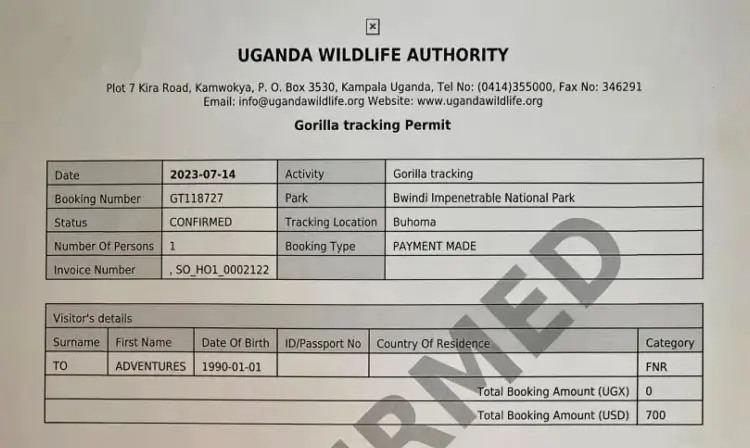
A gorilla trekking permit is not a ticket. It is the single most consequential document in your entire trip — the one thing that cannot be replaced, improvised, or obtained at the gate on the morning of your trek.
Understanding how permits work, what they cost, what they govern, and how to secure one is not an administrative detail. It is the foundation of the trip itself.
The Uganda Wildlife Authority (UWA) controls all permits issued for gorilla trekking in Uganda. The system is deliberately restrictive: a fixed number of permits per gorilla family group, per day, with strict rules governing who can hold one and how it can be used.
That restriction is not bureaucratic inconvenience — it is the mechanism that keeps the gorillas healthy, the experience genuine, and the conservation model financially sustainable.
This page covers everything you need to know about Uganda gorilla trekking permits before you book.
Key Takeaways
- Uganda gorilla trekking permits cost $800 per person; the Gorilla Habituation Experience permit costs $1,500
- UWA issues a maximum of 8 permits per gorilla family group per day — across all of Bwindi and Mgahinga combined, roughly 160 permits are available on any given day
- Permits are tied to a specific date, sector, and gorilla family group — none of these can be changed after booking without going through a formal amendment process
- Peak season permits (June to September, December to February) routinely sell out 3 to 6 months in advance
- Children under 15 years old are not permitted to trek; this is a UWA rule, not an operator policy
What a Gorilla Trekking Permit Actually Is
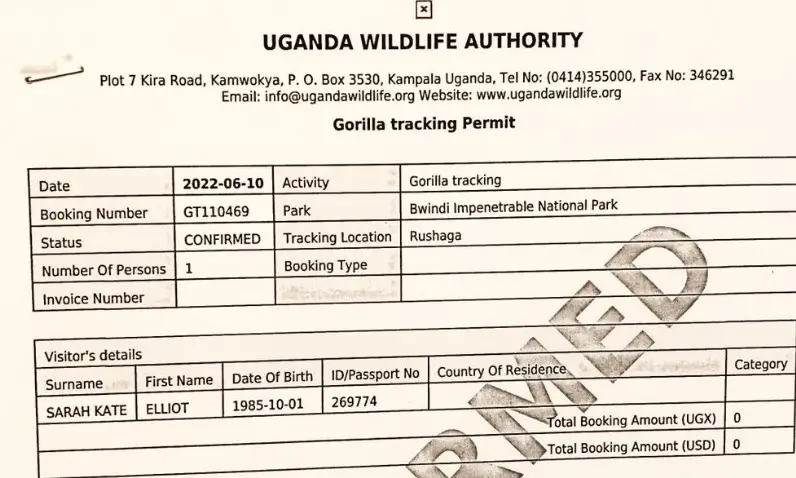
When UWA issues you a gorilla trekking permit, it assigns you to a specific habituated gorilla family group on a specific date at a specific sector gate.
The permit does not simply grant access to Bwindi or Mgahinga — it grants access to one hour with one particular gorilla family, in one location, on one day.
That specificity matters in practice. If you arrive at the wrong gate, you cannot trek. If you miss your date, the permit is void.
If the sector is different from the one on your documentation, you will be turned away regardless of how far you have travelled to get there. UWA rangers check every permit at the gate before the morning briefing begins.
The permit also functions as a conservation instrument. Revenue from each $800 permit is distributed across UWA’s park management budget, anti-poaching operations, and the communities living adjacent to Bwindi and Mgahinga.
Approximately 20% of UWA’s gorilla revenue goes directly to local communities through the Revenue Sharing Programme — a detail that is easy to overlook when you are focused on logistics, but worth knowing when you are standing inside the forest.

Current Permit Prices
| Permit Type | Price (Per Person) | Duration with Gorillas |
|---|---|---|
| Gorilla Trekking Permit | $800 | 1 hour maximum |
| Gorilla Habituation Experience (GHEX) | $1,500 | Up to 4 hours |
Both prices are set by Uganda Wildlife Authority and apply to all nationalities. They are denominated in US dollars and do not vary by operator, season, or sector.
An operator charging more than these base rates for the permit itself (as opposed to their service fee, transport, or accommodation) should be asked to explain the difference in writing.
Uganda’s $800 permit represents significantly better value than Rwanda’s $1,500 permit for standard gorilla trekking — the same mountain gorilla subspecies, the same one-hour encounter rule, at nearly half the price. This comparison is covered in full in our Bwindi gorilla trekking guide.
The Gorilla Habituation Experience
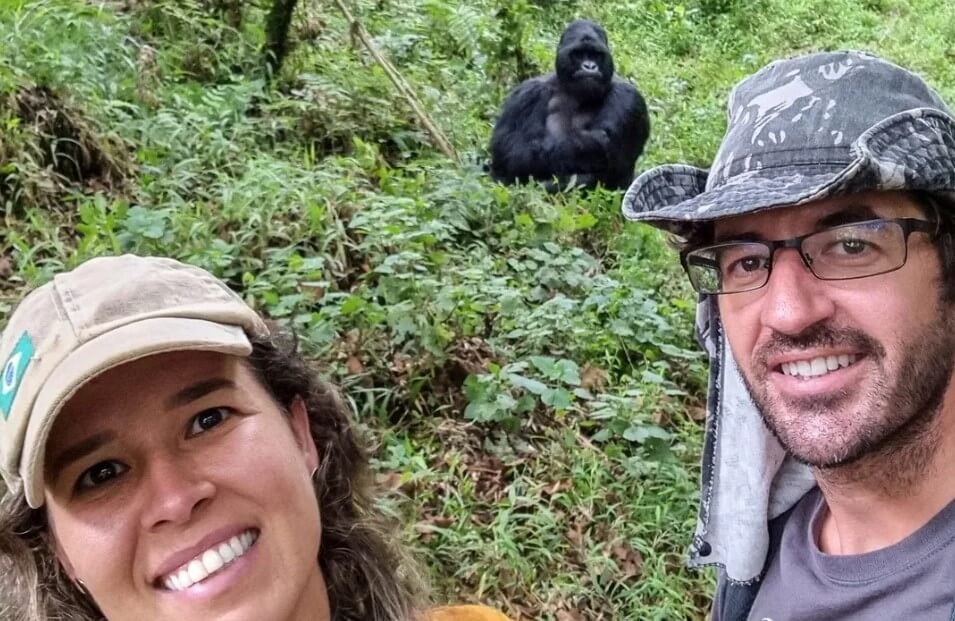
The Gorilla Habituation Experience is a separate permit category, available exclusively at Rushaga sector in Bwindi Impenetrable Forest.
It grants access to a partially habituated gorilla group — a family in the process of becoming accustomed to human presence — for up to four hours rather than the standard one.
This is a fundamentally different experience from a standard trek. The group behaves less predictably, moves more freely, and is observed over a longer period that captures a broader range of natural behaviours: foraging, play, dominance displays, and infant development.
Researchers and UWA trackers work with the group simultaneously, which means you are observing the habituation process itself alongside the gorillas.
The GHEX permit costs $1,500. Group size is limited to 4 people rather than the standard 8. It is available year-round, subject to availability, but the limited group size means it books up faster on a per-permit basis than standard trekking slots.
The 3-day Gorilla Habituation Experience safari is the natural itinerary for anyone considering this option.

How Many Permits Are Available
The permit cap is straightforward: 8 people per habituated gorilla family group per day. What varies is the number of habituated families available across Uganda’s two gorilla parks.
a) Bwindi Impenetrable Forest
Bwindi currently has approximately 19 habituated gorilla families across its four sectors. The distribution across sectors is not even — Rushaga has the most families, followed by Buhoma, then Nkuringo, then Ruhija.
On any given day, Bwindi offers roughly 150 standard trekking permits across all sectors combined, in addition to the GHEX slots at Rushaga.
b) Mgahinga Gorilla National Park
Mgahinga has one habituated gorilla family: the Nyakagezi group. This means a maximum of 8 permits per day at Mgahinga — making it one of the most limited and, in some ways, most intimate trekking experiences available.
When those 8 permits are gone, the day is full. Full details on the Mgahinga experience are on our Mgahinga gorilla trekking page.
Across Uganda as a whole, approximately 160 gorilla trekking permits are available on any given day. That sounds like a meaningful number until you factor in the global demand concentrated into two dry-season windows each year.
When Permits Sell Out and How Far Ahead to Book
Peak season in Uganda’s gorilla parks runs from June through September and from December through February. These months align with the drier weather windows that make trekking more comfortable and forest trails more navigable.
They also align with school holidays and the travel calendars of most international visitors.
During peak season, permits at popular sectors sell out 3 to 6 months in advance. During the quieter months (March to May, October to November), availability is generally better — though “better” is relative. Even in the low season, Buhoma and Rushaga can book up several weeks ahead.
The practical guidance is simple: once your travel dates are set, the permit should be the next thing you confirm — before flights, before accommodation, before anything else.
Itineraries built around a permit that is already secured are far more straightforward to arrange than itineraries built speculatively around an assumed availability.
A specific note on Mgahinga: because only 8 permits are available per day, it books out faster on a proportional basis than any Bwindi sector.
If Mgahinga is where you want to trek, treat the booking lead time as longer than for Bwindi, regardless of the season.

UWA Rules Every Permit Holder Must Follow
These are Uganda Wildlife Authority’s rules for all gorilla trekking permit holders. They are enforced by rangers at the gate and inside the forest. Understanding them in advance avoids unpleasant surprises on the day.
1. Age minimum.
No one under 15 years old may trek with gorillas. This is a firm UWA policy with no exceptions. It exists to protect the gorillas from diseases to which young children are more susceptible, and to ensure the group can maintain the pace and silence the trek requires.
Families with younger children should consider Mgahinga’s golden monkey trekking, which carries no age restriction.
2. Group size
A maximum of 8 people per gorilla family group per trekking session. This is not a guideline — UWA enforces it strictly, and no exceptions are made regardless of group relationships or booking circumstances.
3. One-hour maximum
Once your ranger guide signals that the hour has begun — typically when the first clear visual contact with the gorilla family is established — the clock runs.
You have sixty minutes. When time is called, you leave. There is no negotiation on this, and the rule exists specifically to minimise stress on the animals.
4. Minimum distance
Trekkers must maintain a minimum of 7 metres from the gorillas at all times. In practice, the gorillas do not always respect this from their side — infants and juveniles sometimes approach.
In those moments, you do not move toward them; you stay still, crouch if instructed, and let the rangers manage the encounter. Do not attempt to touch a gorilla under any circumstances.
5. No flash photography
Cameras and phones MUST NOT USE FLASH inside the gorilla’s range. Flash startles the animals and is one of the fastest ways to end an encounter early.
Switch your flash off before the trek begins, not when you are standing in front of a silverback.
6. Face masks
If you are sick or showing any respiratory symptoms on the morning of your trek, you must wear a face mask. Rangers carry them if you do not have one, but bringing your own is preferable.
Gorillas share approximately 98% of human DNA and are highly susceptible to human respiratory infections. This is not optional hygiene theatre — it is genuine disease prevention for animals with no immunity to common human pathogens.
7. No eating or drinking near gorillas
Food and drink must be consumed outside the minimum distance zone. If you need to eat during the approach hike, do so during a trail rest stop — not during the encounter itself.
8. Noise
Keep your voice low throughout the approach and the encounter. Loud conversation disturbs the gorillas and can cause the family to move, shortening your time with them. Rangers brief on this at the gate, but internalising it beforehand helps.

How Gorilla Permits Are Assigned
When you book a permit, UWA assigns you to a gorilla family group based on availability within your chosen sector and date.
In most cases, travellers specify a preferred sector — or their operator specifies it based on their accommodation location and itinerary routing — and UWA allocates the nearest available family within that sector.
You will receive documentation confirming your permit number, date, sector, and gorilla group name before departure. Keep a copy of this document.
Your operator will hold the primary copy for presentation at the gate, but having a personal copy on your phone or in your bag is sensible redundancy.
Gorilla family names in Uganda include groups like Mubare, Habinyanja, Rushegura, and Mishaya in Bwindi, and the Nyakagezi family in Mgahinga.
These are distinct social units with different group sizes, silverback compositions, and characters. Some trekkers develop preferences based on research — younger silverbacks behave differently from mature dominant males; larger family groups offer more to observe.
In practice, every group offers a complete and genuine encounter, and most trekkers report that whatever group they were assigned delivered the experience they came for.

Booking a Permit: Your Options
a) Through a Licensed Ugandan Tour Operator
This is the standard approach for international travellers, and the one most permit holders use.
A licensed Ugandan operator with an established UWA relationship can secure your permit directly, confirm the specific gorilla family and sector in advance, and bundle the permit into a complete itinerary that includes transport, accommodation, and park logistics.
The practical advantages are real: operators know availability patterns across sectors and dates, can advise on the best sector for your arrival route, and handle the UWA documentation in a way that reduces the administrative load on you substantially.
If a date or sector becomes unavailable, a good operator already knows the alternatives.
At Gorilla Hike Uganda, we are licensed UWA permit agents. You can book your gorilla permit here directly, or plan a full safari, and we will handle the permit as part of the overall arrangement.
b) Through the UWA Portal Directly
Uganda Wildlife Authority operates an online booking portal where international travellers can apply for permits directly.
The portal works, but it has limitations:
- Availability shown online does not always reflect real-time allocations held by licensed operators
- The process is slower for international applicants than the operator channel
- Customer support in the event of a booking issue is limited.
For travellers who have already arrived in Uganda, the UWA offices in Kampala (Plot 7, Kira Road, Kamwokya) can handle permit bookings in person.
This is sometimes the fastest route for last-minute availability — operators and the UWA office occasionally have permits that are not visible through the online portal because they have been returned or released from a cancelled booking.

Permit Amendments and Cancellations
Permits are non-transferable to another person. The name on the permit must match the passport presented at the gate. Rangers check, and discrepancies are not waved through.
Date changes are possible through UWA but are subject to availability and an amendment process that takes time. If you need to change your trek date, contact your operator or UWA as early as possible. Last-minute date changes are difficult and sometimes impossible.
Cancellations are generally non-refundable. UWA’s policy on permit refunds is strict, and operators have limited ability to recover permit costs on behalf of clients who cancel.
Travel insurance that covers trip cancellation is strongly advisable for this reason alone — $800 is a significant sum to lose to an unforeseen circumstance. Confirm that your policy explicitly covers permit costs, not just flights and accommodation.
Frequently Asked Questions
- Can I buy a gorilla trekking permit at the park gate on the day?
No. Permits must be booked in advance through UWA or a licensed operator.
There is no walk-up permit system at any sector gate. Arriving at the gate without a permit means you will not trek, regardless of circumstances.
. - Do children pay the same price for a permit?
Yes, the $800 fee applies to all permit holders regardless of age. Since the minimum age is 15, all permit holders are in the same pricing bracket. There are no youth discounts.
. - What happens if a gorilla family cannot be found on my trek day?
This is extremely rare with fully habituated families — UWA trackers begin locating the group before dawn and radio the sector gate with the family’s position before trekkers depart.
In the unlikely event that a habituated group cannot be safely located and approached, UWA’s policy is to offer an alternative date or a refund. Your operator will manage this on your behalf.
. - Is the permit price the same for Ugandan residents and foreign nationals?
No. East African Community residents and Ugandan nationals pay a lower permit fee.
The $800 price cited throughout this page applies to international visitors. If you hold EAC citizenship, ask your operator about the applicable rate.
. - Can I choose which gorilla family group I trek with?
You can state a preference, and operators can often accommodate specific requests when booking well in advance.
However, final allocation is controlled by UWA and depends on availability on your date.
No operator can guarantee a specific family group, only a specific sector. That said, booking early substantially increases the chance of getting what you ask for.
. - How long is a permit valid?
A permit is valid for one specific trek session on one specific date. It does not carry over and cannot be used on a different day. There is no multi-day permit option.
When you are ready to secure your permit, the earlier you move, the better – particularly if your dates fall between June and September or in December.
Book your gorilla trekking permit here, or get in touch, and we will confirm availability for your dates before you commit to anything else.