
Of the roughly 1,080 bird species recorded in Uganda, around 350 live in or pass through a single ancient forest covering just 331 square kilometers.
Bwindi Impenetrable National Park holds more bird species per unit area than almost any comparable forest in Africa, and the reason has everything to do with age.
Bwindi survived the last Ice Age glaciation intact while forests across the continent contracted dramatically, creating a refugium where species evolved in isolation over tens of thousands of years. Many of them never left.
The result is a concentration of endemism, rarity, and sheer avian density that makes birding in Bwindi a different kind of experience from anywhere else in East Africa.
Most people who visit Bwindi come for the mountain gorillas. The birds are, at least in marketing terms, secondary. Among serious birders, this framing is reversed.

Key Takeaways
- Bwindi holds over 350 bird species, including 14 Albertine Rift endemics, more than any other single forest in the Rift
. - The African Green Broadbill, arguably the most sought-after bird in Africa, is found in Bwindi and virtually nowhere else accessible to visiting birders
. - Bwindi’s Ice Age history as a forest refugium directly explains its extraordinary endemism; species that evolved here remained here because the conditions that created them stayed stable
. - The Ruhija sector offers the most reliable access to high-altitude endemics, including Shelley’s Crimsonwing, the Short-tailed Warbler, and Grauer’s Rush Warbler
. - Dedicated birding in Bwindi requires a specialist guide and at least three to four days across multiple sectors; a single sector visited briefly will miss the majority of what the forest holds
.
Bwindi’s Ecological Uniqueness

The term “ancient forest” gets applied loosely across Africa. In Bwindi’s case, it carries real scientific weight.
Pollen core analysis and botanical surveys have confirmed that this forest has existed continuously for more than 25,000 years, through climate swings that eliminated or fragmented most of the continent’s lowland and montane forest cover.
The Albertine Rift, the mountain arc running from Uganda through Rwanda, Burundi, and the Democratic Republic of Congo, acted as a thermal buffer that kept Bwindi’s microclimate stable when surrounding landscapes dried out.
The consequence is a forest with an evolutionary history longer and less interrupted than almost anywhere in Africa.
Species that found themselves isolated in Bwindi during glacial periods evolved unique characteristics over millennia.
When wetter climates returned and forest cover expanded again, those species were already distinct from their counterparts elsewhere.
This is the mechanism behind Albertine Rift endemism, and Bwindi, sitting at the rift’s northern end, is where that process produced its densest results.
Fourteen of those endemic species occur in Bwindi. No other single forest in the Albertine Rift contains as many. For a birder trying to complete the endemic suite, Bwindi is therefore not optional. It’s the location.
The Target Species
1. The African Green Broadbill

If one bird defines what makes Bwindi significant in global birding terms, it is the African Green Broadbill (Pseudocalyptomena graueri).
A small, jewel-green bird with a vivid turquoise throat patch and a short, hooked bill, it looks almost implausible against the dark interior of the forest.
It is classified as Vulnerable on the IUCN Red List, with a global population estimated at fewer than 10,000 individuals.
Its range is effectively Bwindi and a few pockets of forest in the Albertine Rift’s DRC sector, most of which are difficult or impossible to access safely.
For practical purposes, Bwindi is where you see this bird. And seeing it requires genuine effort.
The broadbill favors the mid-canopy and upper interior of old-growth forest, most reliably in the Ruhija sector, where altitude and forest structure align with its habitat preferences. It is not a bird that appears on the trail edge.
Finding it typically involves moving slowly through dense vegetation with a guide who knows specific feeding trees and fruiting patterns, listening for a soft descending call that is easy to miss against the general noise of a productive forest morning.
When you do find one, and the light catches that green at the right angle, the experience tends to settle into memory permanently.
2. Shelley’s Crimsonwing

The crimsonwings are among the most beautiful birds in Africa, and Shelley’s Crimsonwing (Cryptospiza shelleyi) is the one that draws listers to Bwindi in numbers approaching those chasing the broadbill.
The male carries deep crimson on the back and wings against a dark olive body, a combination that makes poor light photography both inevitable and frustrating.
It forages in dense undergrowth at forest edges and bamboo zones, making it genuinely difficult to observe in good light even when it’s present.
Ruhija again offers the most reliable access. Early morning, in the hour after first light, when activity peaks in the undergrowth, is when most successful observations happen.
3. Handsome Francolin

The Handsome Francolin (Pternistis nobilis) is one of the more boldly named birds in the Albertine Rift, and the description holds.
A large, richly patterned forest francolin with streaked chestnut plumage, it calls from the forest floor and lower slopes at dawn with a loud, carrying series of notes that sounds almost mechanical.
It’s heard far more often than it’s seen, and a patient waiting near a known calling area in the Buhoma or Nkuringo sectors can be more productive than active searching.
4. Grauer’s Rush Warbler and Short-tailed Warbler

These two species occupy specific microhabitats that birders need to target deliberately.
Grauer’s Rush Warbler (Bradypterus graueri) is critically endangered and restricted to highland marshes and sedge beds at altitude in the Albertine Rift.
The Ruhija marsh, a small wetland area accessible from the sector’s main tracks, is the most accessible location in the world to search for this bird.
Population estimates place the global total at under 10,000 individuals, and the Bwindi subpopulation represents a meaningful portion of that.
The Short-tailed Warbler (Hemitesia neumanni) lives in the dense undergrowth of montane forest and bamboo zones at Ruhija, creeping through vegetation like a mouse, occasionally flitting to exposed perches long enough to confirm an identification before vanishing again.
Both species reward patience more than any technique.
5. Chapin’s Flycatcher

Chapin’s Flycatcher (Muscicapa lendu) was not confirmed as a resident Bwindi species until relatively recently, and it remains one of the less frequently encountered of the endemic suite.
It favors old-growth forest interior with high canopy, foraging by sallying from exposed perches at the middle height of the forest.
It resembles several other flycatcher species superficially, which means confident identification requires both good views and genuine familiarity with the relevant comparison species.
A specialist guide who has seen this bird regularly is effectively a requirement.
6. The Broader Endemic Suite

Beyond the marquee species, Bwindi’s full Albertine Rift endemic list includes the:
- Stripe-breasted Tit
- Blue-headed Sunbird
- Rwenzori Batis
- Archer’s Robin-Chat
- Strange Weaver
- Collared Apalis
- Yellow-eyed Black Flycatcher
- Rwenzori Nightjar.
Some of these are reliably encountered on almost any productive morning in the right sector.
Others demand specific habitat, specific timing, and the kind of local knowledge that only comes from a guide who has spent years in the same forest.
Understanding the Sectors for Birding
Bwindi is administratively divided into four sectors: Buhoma, Ruhija, Rushaga, and Nkuringo. Each has a different altitude range, forest structure, and species profile.
Understanding how the sectors differ before you plan a birding itinerary is not optional; it determines whether you access the species you’re targeting.
1. Ruhija

Ruhija sits at roughly 2,350 meters, making it the highest of the four sectors and the most important for altitude-dependent endemics.
The African Green Broadbill, Shelley’s Crimsonwing, Grauer’s Rush Warbler, and Short-tailed Warbler are all most reliably found here.
The road approaching Ruhija passes through some of the most productive birding in the entire park, particularly in the early morning, and birders with only a single day in the sector often produce their best sightings on the drive in rather than on designated trails.
The sector is quieter in terms of visitor numbers than Buhoma, which means more time in fewer vehicles on the tracks.
2. Buhoma

Buhoma is Bwindi’s main entry point and the sector most visitors know.
It sits lower than Ruhija, and the species assemblage reflects that, with more mid-altitude forest birds and somewhat fewer of the high-altitude endemics.
It is, however, an excellent birding base for the broadbill in fruiting seasons, for the Handsome Francolin in the forest margins, and for a wide range of sunbirds, weavers, and flycatchers that reward slower walking.
The forest edge near the village holds a transitional zone with a different character from the interior, and birding both produces a broader daily list than focusing exclusively on either.
3. Rushaga and Nkuringo

Both southern sectors offer productive birding with less coverage in published field accounts, meaning they can surprise visitors with species that the more heavily trafficked northern sectors have trained birders to overlook.
Nkuringo’s higher altitude and montane forest character bring it closer to Ruhija in terms of endemic potential. Rushaga’s lower elevation and forest edge habitat produce a different mix.
Neither sector is typically included in short birding itineraries focused purely on endemics, but both reward careful walking.
What Good Bwindi Birding Actually Requires

A morning walk with a standard gorilla trekking guide produces birds. It does not produce systematic, focused birding.
The distinction matters, and it is the source of most disappointment among listers who spend a morning in Bwindi and leave feeling they’ve only scratched the surface.
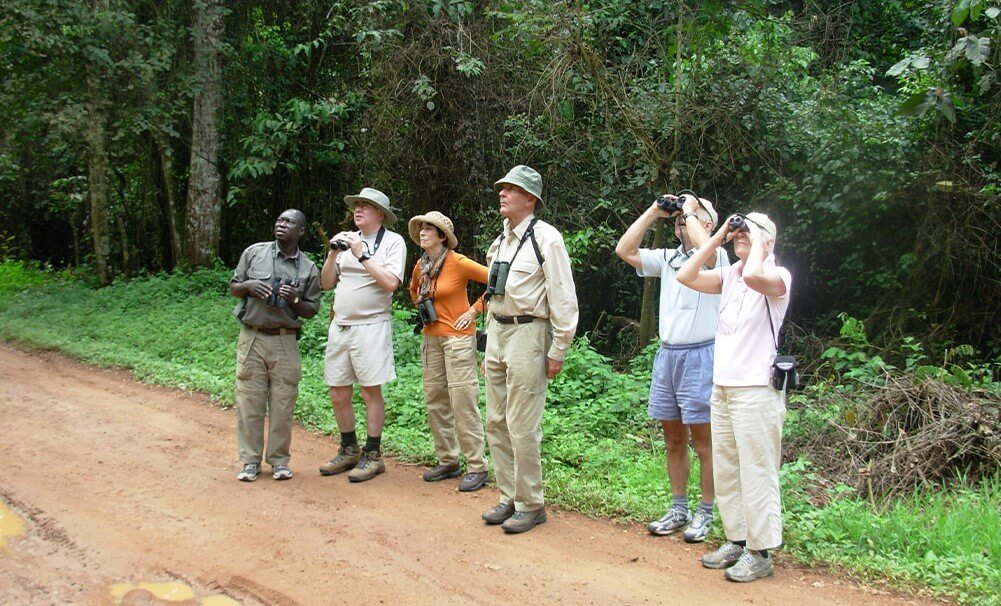
Dedicated birding in Bwindi requires a specialist guide with specific endemic experience.
The Uganda Bird Guides Club trains and certifies forest birding specialists who know call repertoires, reliable microhabitat locations, and the seasonal behavior of target species across all four sectors.
Booking through an operator who accesses these guides rather than redirecting a gorilla trekking guide toward a birding role is the single most important logistical decision you’ll make.
Time allocation is the second consideration. Three to four days across two sectors, ideally Ruhija plus either Buhoma or Nkuringo, gives a realistic opportunity to encounter the majority of the endemic suite.
A single morning is not a birding trip to Bwindi. It’s a pleasant walk in a remarkable forest that happens to have some birds.
The best season for Bwindi trekking follows the same general logic as wildlife viewing elsewhere in Uganda.
The dry months of June through August and December through February offer more stable conditions, firmer trails, and reduced rainfall interference with listening.
That said, Bwindi’s productivity in wet conditions can be extraordinary: post-rain activity in the forest understory, particularly on mornings that follow afternoon downpours, sometimes produces the most intense birding of the trip.
Flexibility matters more than perfect timing.
Birding, Gorillas & the Same Forest

Serious birders sometimes approach the gorilla experience as an interruption to their birding day.
That’s the wrong frame. The forest encountered during a gorilla trek in Bwindi is the same forest the birds live in, and the slow, listening quality that gorilla tracking requires aligns well with the attention birding demands.
Rangers who have spent years tracking specific habituated groups know the forest’s interior at a level of intimacy that most birding guides don’t access, and using that knowledge opportunistically during a trek, pausing to identify calls, noting what’s moving in the canopy overhead, produces a richer experience in both directions.
There is also an argument, made by conservation economists with data behind it, that diversifying the visitor profile to include serious birders strengthens the financial case for forest protection.
Gorilla permit revenue is the dominant driver of Bwindi’s conservation funding model. Birding tourism adds a second income stream that doesn’t require permit allocation and scales differently.
For a forest whose global significance rests on its uninterrupted integrity, every category of visitor who comes specifically because the forest exists in pristine condition is adding weight to the right side of the scale.
The Ethical Dimension

There is a version of Bwindi birding tourism that extracts the maximum species count and leaves.
There is another version that arrives with an understanding of what the forest represents ecologically, contributes meaningfully to the local economy through specialist guide employment and accommodation, and leaves with an accurate picture of the pressures the forest faces.
The pressures are real. Agricultural encroachment along the forest boundary is a continuous tension.
Climate change is altering the altitudinal distribution of some species, with high-altitude specialists facing a shrinking range as temperatures rise.
The Grauer’s Rush Warbler and Short-tailed Warbler, both restricted to narrow elevation bands, are among the species most vulnerable to this dynamic.
Research published through BirdLife International, which monitors Bwindi’s endemic species status through its African Biodiversity Alliance program, tracks these changes with the specificity the situation demands.
Choosing operators and guides with genuine community ties, supporting local birding guide associations, and treating specialist guide fees as conservation investment rather than a cost to minimize are choices that compound meaningfully across a birding tourism economy.
Combining Bwindi Birding With Other Destinations
1. Mgahinga and Golden Monkeys

Mgahinga Gorilla National Park, a short drive from Bwindi’s southern sectors, adds Afromontane and highland species to a Bwindi birding circuit.
The bamboo zone at Mgahinga holds its own species profile, and the combination of a golden monkey trek with morning birding in the forest margin produces a day that satisfies multiple interests simultaneously.
The Bwindi versus Mgahinga comparison covers the broader differences between the two parks, which are significant beyond just bird diversity.
2. Queen Elizabeth and the Western Circuit

For birders building a broader Uganda itinerary, Queen Elizabeth National Park adds savanna, wetland, and forest-edge species that don’t appear in Bwindi’s montane interior.
Over 600 species across two parks in the western corridor represent a genuine Big Year opportunity for Uganda-focused listers.
The 6-day Uganda safari moves through both parks at a pace that allows meaningful birding in each.
3. Kibale and Budongo

The chimpanzee forests of Kibale National Park and the Budongo Forest Reserve at Murchison hold mid-altitude species that complete the picture for listers targeting the full Albertine Rift endemic suite.
A Uganda birding circuit anchored in Bwindi and extending north through Kibale, Budongo, and Murchison Falls covers more of Uganda’s avian diversity than any single-park visit could approach.
The 10-day Uganda primate and wildlife safari creates the most complete arc across these destinations, though dedicated birding itineraries can be constructed around the same geography with greater time in the forest interior at each stop.
Practical Planning
1. Getting to Bwindi

The logistics of reaching Bwindi from Kampala are straightforward but time-consuming, requiring roughly eight to nine hours by road to Buhoma or up to ten hours to Ruhija via the southern approach.
Charter flights into Kihihi (for the northern sectors) or Kisoro (for the southern sectors) reduce travel time to under an hour from Entebbe and are worth considering seriously for itineraries that combine multiple destinations.
If you’re entering Uganda from Kigali, the southern approach via Kabale reaches Nkuringo and Rushaga before Buhoma, which may align better with a birding itinerary that prioritizes the southern sectors.
2. Safety and Health

Bwindi is well-managed and safe for visitors. The broader Uganda safety context is worth understanding for any Western Corridor itinerary.
The DRC border is close to several of Bwindi’s sectors, and while this doesn’t affect day-to-day safety inside the park, current conditions in the border zone are worth monitoring through your operator rather than relying on dated published advisories.
Health protocols in Bwindi include the same respiratory illness guidelines that govern gorilla trekking, extended to specialist birding experiences in habituated wildlife zones.
If you are unwell on arrival, the right choice is to delay entry into the forest regardless of permit timing.
3. What to Bring

Optics are not negotiable. A binocular of at least 8×42 specification with decent low-light performance makes a substantial difference in the forest interior, where light levels stay low most of the day.
A spotting scope is useful for canopy work, but it adds meaningful weight on a trail that may cover irregular ground.
The Bwindi gear and clothing guidance covers footwear, layering, and rain preparation, all of which apply equally to birding days.
Field guides: the Birds of East Africa by Stevenson and Fanshawe remains the most widely used regional reference, though more recent Albertine Rift-specific resources have improved coverage of the endemic suite considerably.
Your specialist guide will be a more reliable source than any published field guide for call identification in Bwindi’s specific conditions.
Frequently Asked Questions

1. How many Albertine Rift endemic bird species can I find in Bwindi?
Fourteen Albertine Rift endemic species occur in Bwindi, more than any other single forest in the rift.
A dedicated three-to-four-day visit with a specialist guide across two sectors gives a realistic opportunity to encounter the majority of the suite.
Some species, particularly Grauer’s Rush Warbler and Chapin’s Flycatcher, require specific timing and habitat knowledge to find reliably.
2. Is birding in Bwindi only for expert birders?
Bwindi rewards serious commitment, but expertise is not a prerequisite.
Travelers with a genuine interest in birds who are willing to walk slowly, listen carefully, and follow a specialist guide’s lead will have a productive and memorable experience regardless of their prior list length.
The forest is extraordinary enough that even a modest encounter with its birdlife leaves a lasting impression.
What expertise does change is efficiency: an experienced birder will use limited forest time more strategically.
3. Can I combine birding with gorilla trekking on the same trip?
Yes, and the combination works well both logistically and experientially. Gorilla trekking occupies a morning, leaving the rest of the day available for dedicated birding.
Many birders find the slow pace of a gorilla tracking excursion, moving quietly through old-growth forest interior with rangers who know the landscape intimately, produces incidental bird sightings that a standard trail walk would miss.
Structuring a Bwindi visit around one gorilla trekking day and two to three dedicated birding mornings is a natural format that most specialist itineraries use.
4. Which Bwindi sector is best for the African Green Broadbill?
Ruhija is the most reliable sector for the African Green Broadbill, particularly during fruiting periods when the bird’s movements become more predictable around specific food sources.
Your specialist guide will know current fruiting patterns and the microhabitat locations that have produced recent sightings.
A morning focused on this species alone, moving slowly and listening carefully through old-growth forest at altitude, is how most successful observations happen.
5. What should I budget for specialist birding in Bwindi?
Specialist birding guide fees are charged per day and vary by guide certification and sector. Uganda Bird Guides Club certified specialists typically charge between $50 and $150 per day, depending on experience.
Park entry fees apply daily. If gorilla trekking is part of your trip, permit costs add substantially to the total, though they’re a separate budget item from birding guide fees.
A full Bwindi birding circuit is an investment, but it’s modest relative to comparable specialist birding destinations in South America or Southeast Asia.
Plan Your Bwindi Birding Trip

Bwindi’s birds are not a secondary attraction. For a meaningful subset of the travelers who visit, they are the reason.
The African Green Broadbill, the Shelley’s Crimsonwing, and the full suite of Albertine Rift endemics represent an avian concentration that exists nowhere else in such density, and the forest that holds them has been intact long enough to qualify as something close to irreplaceable.
Whether you’re building a dedicated multi-sector birding itinerary or adding specialist birding days to a gorilla trekking trip, the planning conversation benefits from an operator who understands both the logistical and ecological details.
Start planning your Bwindi itinerary here, or if gorilla trekking is part of the picture, secure your permit well before your target dates.