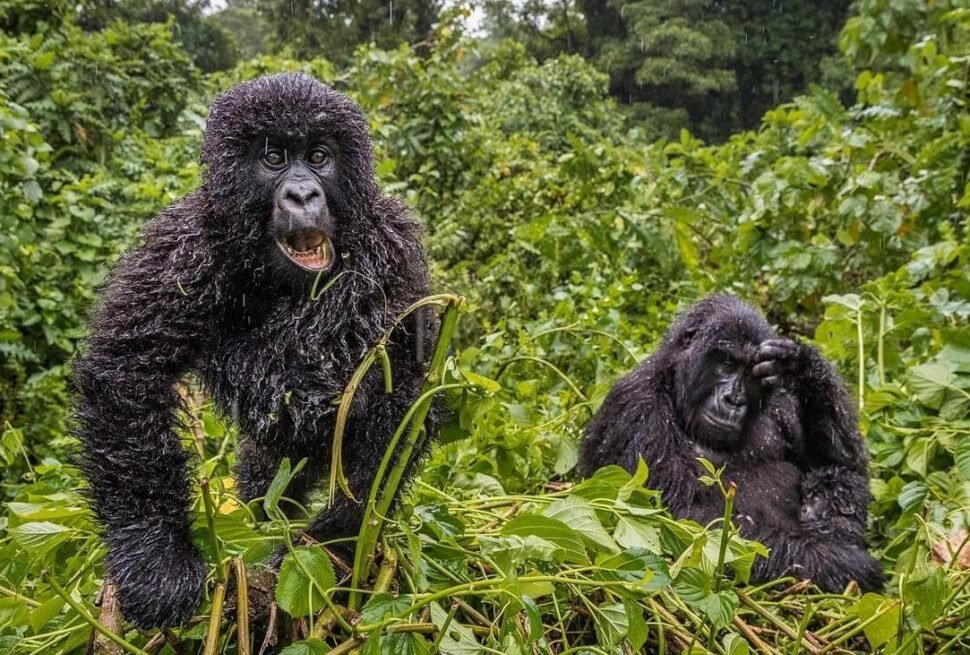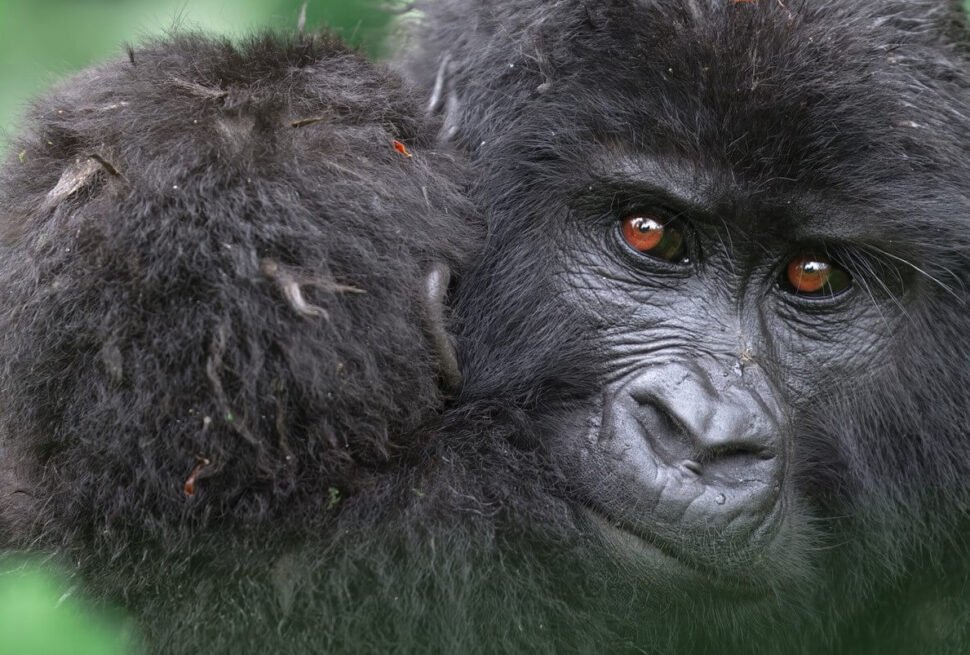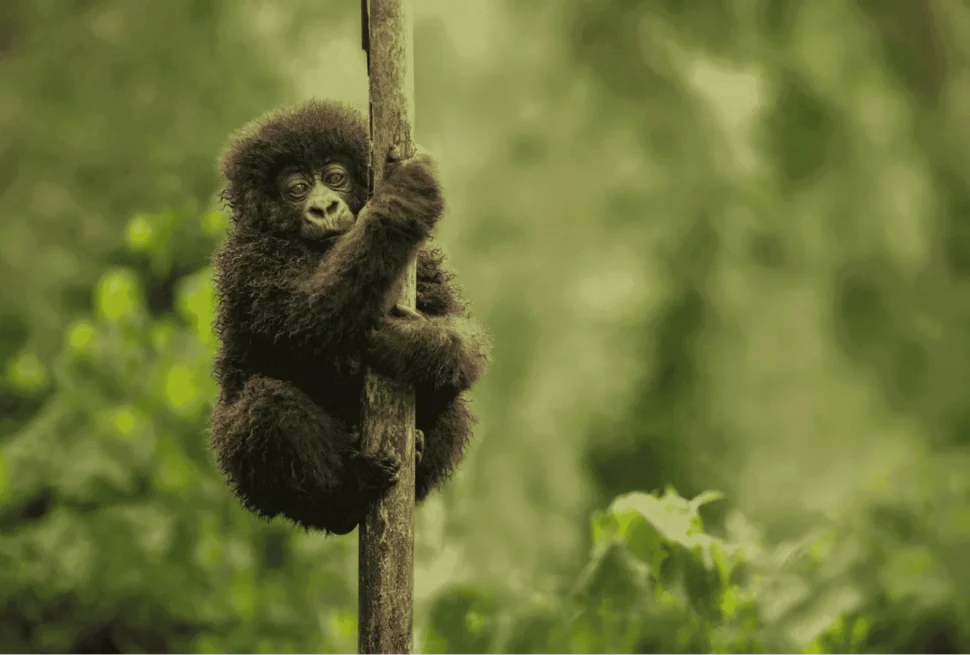

In 1981, there were approximately 254 mountain gorillas left in Bwindi Impenetrable Forest. The count for the entire species hovered around 620.
Researchers at the time were not optimistic. The trajectory was clear, the pressures were intensifying, and the resources available to counter them were minimal.
Today, there are more than 1,000 mountain gorillas. The population has not just stabilised.
It has grown steadily and measurably over four decades, making mountain gorillas one of the only great ape subspecies whose numbers are currently increasing. That recovery did not happen by accident, and it did not happen without gorilla trekking tourism.
Understanding the relationship between those two facts is the beginning of an honest answer to whether gorilla trekking is ethical.
The question deserves more than a defensive yes. It deserves the full argument, including the parts that are genuinely complicated.
Key Takeaways
- Mountain gorilla populations have grown from approximately 620 in the 1980s to over 1,000 today, a recovery directly linked to conservation funding generated by regulated tourism
. - The ethical concerns about gorilla trekking are real and worth taking seriously: disease transmission, habituation stress, and the commodification of wild animals are legitimate considerations
. - The alternative to regulated trekking tourism is not a gorilla population left in peace; it is inadequately funded parks, reduced ranger presence, and habitat encroachment driven by poverty
. - Uganda’s permit model distributes approximately 20% of gorilla revenue to communities adjacent to the parks, creating economic incentives for local populations to protect rather than exploit the forest
. - The ethical case for gorilla trekking rests not on the absence of any harm, but on a clear-eyed comparison between the costs of tourism and the costs of its absence
The Scepticism Worth Taking Seriously

Before making the conservation case, the criticisms deserve a fair hearing. Several of them are intellectually serious and should not be dismissed.
1. The Stress Argument
Gorillas are wild animals. Even habituated ones, those that have undergone years of graduated human exposure, experience measurable physiological responses to human presence.
Research has documented elevated cortisol levels in habituated gorillas during tourist visits, indicating a stress response that does not disappear simply because the animals have learned to tolerate humans without fleeing or charging.
This is real. It is not nothing. The ethical weight of knowingly placing a wild animal under even low-grade stress for the purpose of human recreation deserves honest acknowledgement rather than hand-waving.
2. The Commodification Argument
There is a version of the gorilla trekking critique that objects to the fundamental framing: the idea that wild animals should be made accessible to paying tourists at all, that attaching a price to wildlife encounters reduces animals to commodities in a way that is philosophically and ethically problematic, regardless of the conservation outcomes.
This argument has coherence. It is the position held by some serious conservationists and animal rights advocates, and it is not reducible to sentimentality.
3. The Disease Risk
Mountain gorillas share approximately 98.3% of human DNA and have no acquired immunity to many common human pathogens.
Respiratory infections, in particular, can move through a gorilla family with serious consequences for individuals whose immune systems have never encountered the pathogen.
Every trekking encounter carries some risk of transmission, regardless of the masking requirements and distance rules that mitigate it.
Several documented disease outbreaks in habituated gorilla groups have been linked to human contact. These are not hypothetical risks.
4. The Habituation Problem
Habituation is a one-way door. A gorilla family that has been habituated to human presence cannot be easily de-habituated.
The process of making gorillas comfortable around humans also makes them more vulnerable to poachers who exploit that comfort, to ill tourists who approach closer than they should, and to the ongoing presence of researchers and rangers whose daily visits are part of the same system that tourism depends on.
The question of whether habituation itself is in the gorillas’ interest, or whether it primarily serves human interests, is a legitimate one.
Why the Evidence Points Toward Yes

Having given those arguments their due, the case for gorilla trekking as an ethical activity rests on something more solid than good intentions: a four-decade record of outcomes in a context where the alternative is clearly understood.
a) What Actually Happened to the Population
The mountain gorilla population in the 1980s was declining.
The pressures were straightforward:
- Habitat loss as agricultural encroachment pushed into forest margins
- Poaching for bushmeat and the illegal wildlife trade
- Civil conflict across the range states that eliminated ranger presence and left parks effectively unprotected
- Disease from increasing human-wildlife contact in the absence of any management framework.
The reversal of that trajectory coincided with, and was substantially caused by, the development of regulated gorilla trekking tourism and the conservation funding it generated.
Uganda’s Bwindi population grew from 254 in 1981 to 459 in 2018. The Virunga population, shared across Uganda’s Mgahinga, Rwanda, and the DRC, grew from around 380 in the 1980s to over 604 by 2018.
Together, these populations now exceed 1,000 individuals, a figure that was considered aspirationally optimistic by field researchers thirty years ago.
According to the International Union for Conservation of Nature, mountain gorillas are the only great ape subspecies currently showing a population increase. That status is explicitly linked to conservation investment, much of it generated by tourism revenue.
b) The Permit Revenue Model
Every $800 gorilla trekking permit sold in Uganda generates revenue that funds the operations, keeping gorillas alive.
Uganda Wildlife Authority uses this revenue to:
- Pay ranger salaries
- Maintain park infrastructure
- Fund veterinary support through programmes like Gorilla Doctors
- Support research operations
- Finance anti-poaching patrols that actively intercept snares and deter incursions.
Approximately 20% of UWA’s gorilla-related revenue flows directly to communities living adjacent to Bwindi and other national parks through the Revenue Sharing Programme.
This is not charity. It is a deliberately designed incentive structure that makes the economic value of a living gorilla, accessible to tourists, greater than the economic value of bushmeat, agricultural land, or charcoal production.
That incentive structure is what converted communities that had historically viewed forest protection as an external imposition into stakeholders in conservation outcomes.
Rangers, trackers, porters, lodge staff, and community guides working in the gorilla trekking economy all have direct financial reasons to want the gorilla population to grow. Before tourism, they had direct financial reasons to want the opposite.
The Dian Fossey Gorilla Fund, which has maintained a continuous research presence with mountain gorillas since Fossey’s work in the 1960s, is explicit about this relationship.
Without the revenue generated by tourism, the conservation infrastructure that protects mountain gorillas cannot be sustained at the scale the population’s survival requires.
c) The Alternative Is Not Peace
This is the point that the anti-trekking position most consistently fails to address.
The ethical alternative to gorilla trekking tourism is not a world in which mountain gorillas live undisturbed in pristine forest. That world does not exist and has not existed for decades.
The alternative is inadequately funded parks with skeleton ranger teams unable to cover the terrain they are nominally protecting. It is communities with no economic stake in conservation reverting to land use patterns that encroach on habitat.
It is poachers operating in forests where no economic model has given local communities a reason to report incursions. It is the trajectory the population was on in 1981.
You cannot protect a forest that costs money to protect without a revenue source.
Donor funding alone, however generous, has never been sufficient and has never been reliable enough to replace the consistent annual revenue that regulated tourism generates. The choice is not between tourism and an ethical alternative.
The choice is between managed, regulated tourism with its real but mitigated costs, and the alternative, whose costs are species-level.
d) On the Stress Question
The cortisol research is real, and it matters.
What it does not do is settle the ethical question, because elevated cortisol during a trekking encounter must be weighed against the cortisol elevation of disease, food insecurity, habitat loss, and death from poaching that characterise the lives of unprotected gorilla populations.
Stress is not uniquely produced by tourists. It is produced by the conditions of survival in a world where humans dominate every adjacent landscape.
The relevant comparison is not between a habituated gorilla tolerating one hour of tourist presence per day and a wild gorilla living in stress-free freedom.
The relevant comparison is between a habituated gorilla in a well-funded, actively protected park and an unprotected wild gorilla in a forest whose rangers have been sent home because the park cannot make payroll.
That comparison is not close.
e) On Disease Risk
The disease risk is real, and it is managed. UWA’s masking requirement for symptomatic trekkers, the seven-metre minimum distance rule, the one-hour time limit, and the prohibition on any direct contact are not aesthetic preferences.
They are an epidemiological framework designed to reduce transmission probability to the lowest achievable level within a model that must also generate the revenue the conservation system depends on.
Research by the Mountain Gorilla Veterinary Project has documented disease outbreaks linked to human contact and also documented the capacity of veterinary intervention, itself funded by tourism revenue, to treat sick gorillas and limit mortality.
The risks are real. The mitigation infrastructure is also real.
Neither fact cancels the other, and the presence of disease risk within the model does not constitute an argument for abandoning the model when the alternative is a population without the protection the model funds.
Uganda’s Specific Conservation Model

Bwindi Impenetrable Forest and Mgahinga Gorilla National Park sit within a landscape where over 900,000 people live adjacent to the park boundaries.
These communities did not choose to live next to a protected area. In many cases, particularly the Batwa people, who were the original forest inhabitants, they were displaced by the park’s creation.
The ethical weight of gorilla conservation is not separable from the ethical weight of what conservation has cost the communities that live alongside it.
Uganda’s Revenue Sharing Programme is a partial, imperfect, and ongoing attempt to address that debt.
The funds distributed to community schools, health centres, and water infrastructure near Bwindi represent a real, if insufficient, acknowledgement that conservation has costs that do not fall equally.
Tourism-funded conservation in Uganda is also not purely extractive in the way that some critics characterise it.
The gorilla trekking economy employs rangers, trackers, porters, lodge staff, guides, and community tourism workers, most of them from the communities adjacent to the park.
The permit revenue that flows through UWA’s Revenue Sharing Programme is not hypothetical; it is documented in UWA’s annual reports and independently verified by conservation monitoring bodies.
This does not make the model perfect.
The 20% community revenue share has been criticised as insufficient, the distribution mechanisms have not always been transparent, and the communities most affected by conservation restrictions have not always been the ones who benefit most from tourism revenue.
These are legitimate ongoing criticisms of how the model operates, not arguments against the model itself.
What Ethical Gorilla Trekking Actually Requires

Accepting the conservation case does not mean accepting all gorilla trekking as equally ethical. The model works when it is operated with integrity. When it is not, the costs rise, and the benefits erode.
Ethical gorilla trekking requires a licensed operator with active Uganda Wildlife Authority accreditation, working within the permit system rather than around it.
It requires trekkers who follow ranger instructions without negotiation, stay at the required distance, do not trek while symptomatic, and do not attempt to interact with or touch the gorillas.
It requires honest education about what the permit fee funds are and why the rules exist.
Booking with an unlicensed operator, attempting to approach gorillas independently, trekking while ill, or treating the encounter as a photo opportunity to be maximised at the expense of the distance rules all shift the ethical calculation.
The conservation model works because the rules are followed consistently. Each individual who follows them is a functional part of the system that keeps it working.
Gorilla trekking through Gorilla Hike Uganda operates through UWA-licensed permits, professional ranger guidance, and pre-trek briefings that explain the rules and their rationale before anyone enters the forest.
The Uganda gorilla trekking permits page covers the regulatory framework in detail, and the Is Uganda Safe page addresses broader travel ethics for the country.
The Deeper Ethical Argument

There is a version of the ethical question that goes beyond conservation outcomes and asks something more fundamental: what does it mean to seek out wild animals for the purpose of observing them, regardless of the population-level effects?
This question is worth sitting with. The desire to be in the presence of mountain gorillas is a human desire, and like most human desires, it is not entirely separable from self-interest.
You go to Bwindi for what the experience gives you. The conservation justification is real, but it is also convenient, and intellectual honesty requires acknowledging that.
What grounds the ethical case most solidly is not the purity of the trekker’s motivation but the design of the system within which the motivation is expressed.
A well-regulated gorilla trekking encounter is one in which human desire is channelled through a framework specifically designed to produce conservation outcomes and distribute economic benefits to the communities whose cooperation is essential to those outcomes.
The desire is not noble by itself. The system it operates within can be.
That system is imperfect, ongoing, and dependent on the participation of trekkers who understand what they are part of.
The population of gorillas now exceeding 1,000 individuals is the most credible evidence available that participating in it, with integrity and within the rules, is the right side of a genuinely difficult ethical question.

Frequently Asked Questions
1. Does gorilla trekking harm the gorillas?
It carries real costs: measurable stress responses during encounters, disease transmission risk, and the long-term behavioural changes that habituation produces. These costs are genuine and are actively studied by field researchers.
They are also weighed against the conservation benefits that tourism funds, including the anti-poaching operations, veterinary care, and community programmes that have driven a population increase from 620 to over 1,000 individuals over four decades.
The honest answer is that trekking imposes costs on gorillas and that the alternative, inadequately funded parks without the conservation infrastructure that tourism sustains, imposes far greater ones.
2. Is gorilla trekking better for conservation in Uganda or Rwanda?
Both countries run legitimate conservation programmes, and both have contributed to the mountain gorilla population recovery.
Uganda’s permit model distributes a documented proportion of revenue to adjacent communities through a formal Revenue Sharing Programme, and Uganda’s lower permit price at $800 versus Rwanda’s $1,500 makes no difference to the gorilla’s experience of the encounter.
The Uganda vs Rwanda comparison covers the full picture for travellers deciding between the two countries.
3. What is the most ethical way to do a gorilla trek?
Book through a licensed operator with UWA accreditation. Follow every ranger instruction without modification.
Maintain the seven-metre minimum distance even when a gorilla approaches closer. Do not trek if you are symptomatic with any respiratory illness, regardless of what your permit costs.
Hire a porter who directly employs a community member. Tip your rangers, trackers, and porters.
Understand what the permit fee funds are before you spend them. None of these is difficult. Together, they constitute participation in the conservation system rather than extraction from it.
4. Is it ethical to habituate gorillas for tourism in the first place?
This is the hardest version of the question and the one with the least comfortable answer.
Habituation is a process that changes gorilla behaviour in ways that serve human access and, through the revenue that access generates, conservation outcomes.
It also exposes gorillas to disease risk and poacher exploitation in ways that wild, unhabituated gorillas are not exposed to. Field researchers continue to study these trade-offs.
The current consensus among conservation bodies, including the IUCN and the Dian Fossey Gorilla Fund, is that managed habituation within a regulated trekking programme is justified by its conservation outcomes, while remaining open to revision as evidence develops.
That is not a settled answer. It is the best answer the evidence currently supports.
5. Does visiting gorillas in the wild contribute meaningfully to their conservation?
Yes, directly. Your $800 permit funds Uganda Wildlife Authority’s operational budget, which includes ranger salaries, anti-poaching patrols, park infrastructure, and research support.
Twenty percent of that revenue flows to communities adjacent to the park through the Revenue Sharing Programme.
The gorilla families you observe are monitored daily by researchers and rangers whose salaries the permit system pays.
The connection between an individual trekking visit and the conservation system is not abstract or indirect. It is financial, immediate, and documented.

.
The ethical case for gorilla trekking is not a marketing position. It is the product of four decades of evidence from a conservation model that has produced the only great ape population increase in the world.
If you want to be part of that, plan your gorilla trek here, or book your permit and we will handle the rest.