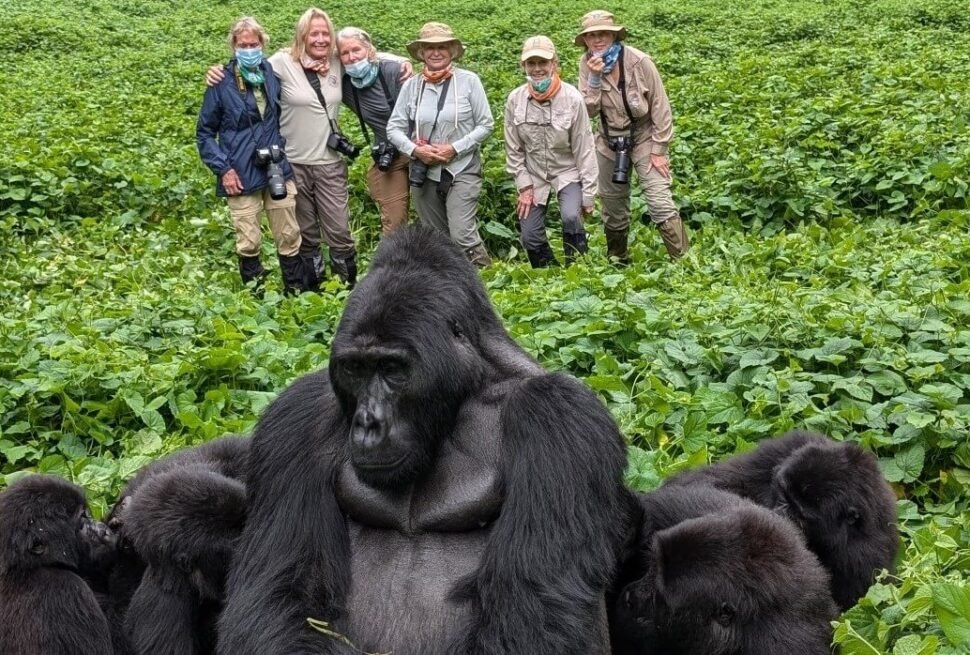

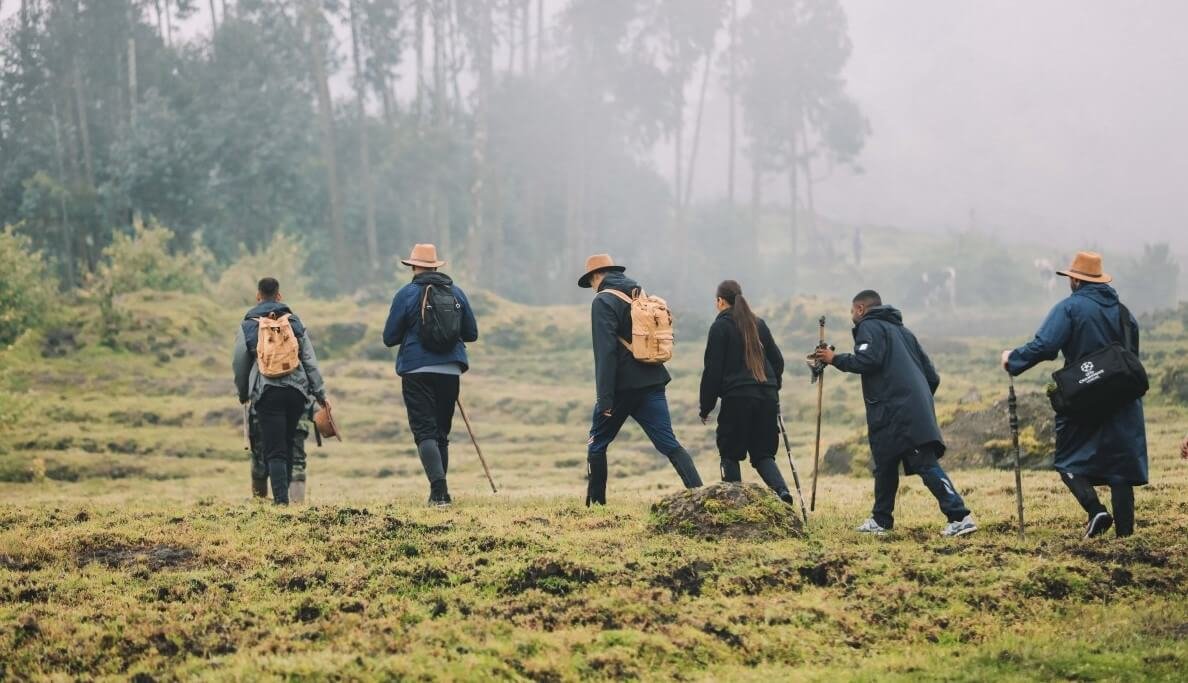
There is no bad month to trek gorillas in Uganda. That is not a marketing line. It is a practical observation from a country that straddles the equator, receives rainfall year-round, and protects gorilla families that do not particularly care what season it is.
What changes across the calendar is the character of the experience around the encounter.
The trail conditions, the light in the forest, the permit availability, the crowd levels at the lodges, and the ease or difficulty of the approach roads all shift meaningfully depending on when you go.
The gorillas are always there. Everything else is a trade-off, and the trade-offs are more interesting than most travel guides acknowledge.
This is the honest version of that assessment, month by month.
Key Takeaways
- Uganda has two dry seasons (June to September and December to February) and two wet seasons (March to May and October to November); gorilla trekking runs year-round across all four seasons
. - Dry season offers the most reliable trail conditions and the easiest logistics, but commands peak permit demand and higher accommodation rates
. - Wet season trekking is genuinely rewarding: lush forest, dramatically better photography light, fewer trekkers on the trail, and meaningfully better permit availability
. - The wet seasons are not the same; the long rains (March to May) are heavier and more sustained than the short rains (October to November), which are often moderate and brief
. - Your travel dates, budget, permit availability, and tolerance for mud are more useful inputs to this decision than any generic “best time to visit” recommendation
.
How Uganda’s Seasons Actually Work

Uganda sits almost precisely on the equator, and its climate reflects that geography in ways that do not map neatly onto northern hemisphere seasonal assumptions.
There is no summer and no winter in any meaningful thermal sense. What varies is rainfall, and it varies in two cycles rather than one.
The long dry season runs from June through September. The short dry season covers December through February.
Between them sit the long rains from March to May and the short rains in October and November. These are the four broad categories, but within each, the variation is considerable.
Bwindi Impenetrable Forest adds its own complication. It sits at an altitude between 1,160 and 2,607 metres above sea level, depending on the sector, and it generates its own microclimate.
Ruhija sector, the highest, is noticeably cooler and mistier than Buhoma, regardless of the broader seasonal pattern.
Rushaga and Nkuringo, in the south, experience somewhat different rainfall patterns from the northern and eastern sectors. The forest creates weather rather than simply receiving it.
The honest baseline is this: any month in Uganda can produce rain, and any month can produce clear weather. The season tells you about probability and intensity, not certainty.
Dry Season Trekking: June to September and December to February
1. Why Dry Season Dominates the Booking Calendar

The June to September window is Uganda’s longest and most reliable dry period.
Daytime temperatures at Bwindi’s main sectors sit between 18 and 24 degrees Celsius, mornings at higher sectors are cool and crisp, and the trails dry out enough between rain events to make most approach routes genuinely manageable without specialist gear.
The skies are clear frequently enough for light that works well in photography, and the forest floor, while always dense, is less saturated than during the rains.
December to February offers similar conditions in a shorter window. School holiday timing from European and North American source markets means December and January carry compressed demand despite being nominally shoulder months in some travel frameworks.
Permit availability tightens quickly for Christmas week and the New Year period specifically.
Both windows attract the majority of international gorilla trekking visitors, and the infrastructure around the parks has developed in response.
Lodges are well-staffed, road conditions are at their annual best, and the logistical machinery of a gorilla trek day runs smoothly when the ground is firm and the approach roads are dry.
2. The Honest Costs of Peak Season

Peak season comes with real costs that the promotional version of this guide glosses over.
Permits are the primary constraint. During June through September, the Buhoma sector sells out 4 to 6 months in advance. Rushaga follows a few weeks behind.
If your dates are fixed and they fall in peak season, securing your permit should be the first action you take, before flights, before accommodation, before anything else.
The gorilla permit availability guide maps the booking windows in detail.
Accommodation rates at lodges near the park peak during these months, sometimes significantly.
The mid-range and luxury tiers see their most competitive pricing during peak season, and last-minute availability at well-regarded properties is limited.
The trail experience itself changes in ways that are subtle but real. Eight trekkers per gorilla family per day is the cap, and the cap holds.
But the aggregate of trekking groups across multiple families in the same sector creates a background level of human activity in the forest that is more present during peak season than at quieter times.
You will not feel crowded in the encounter zone. You may notice more vehicle traffic at the gate, more occupied tables at the lodge dinner, and more familiar faces on the trail approach.
None of these is a reason to avoid peak season. They are the honest trade-offs of travelling at the time most people choose.
Wet Season Trekking: The Case That Usually Goes Unmade
Most gorilla trekking guides treat the wet season as a problem to be managed or a compromise to be accepted.
The reality is more interesting than that, and the travellers who return from wet-season treks most satisfied are often the ones who went in with the right expectations rather than lowered ones.
1. What the Forest Actually Looks Like in the Rain

Bwindi in the wet season is visually extraordinary. The forest responds to sustained rainfall with a density and greenness that the dry season cannot match.
Every surface holds moisture. The canopy is fuller. The undergrowth is richer and more layered.
Mist sits in the valleys and lifts slowly through the mornings in a way that makes the forest feel ancient in a register that clear-sky days do not produce.
The light is different too, and for photography it is often significantly better.
Overcast skies eliminate the harsh shadows that midday sun creates on the forest floor, producing the kind of soft, diffused light that wildlife and landscape photographers actively seek.
An overcast morning in Bwindi produces more usable images with a standard camera than a bright sunny one, because the contrast between lit canopy and shaded undergrowth is compressed into a workable range.
The gorillas do not shelter from rain. They move, they forage, they interact with each other. Rain does not reduce the quality of the gorilla encounter.
In some respects, because the animals are more active in cooler, overcast conditions and because wet vegetation concentrates certain food sources, it produces more behavioural variety during the hour than the resting stillness of a warm, dry afternoon.
2. March to May: The Long Rains

This is the heaviest rainfall period. March is the transition month, often with alternating clear and wet days.
April and May receive the most sustained rain of the year, with multi-day rain events that can make the approach roads to Nkuringo and Ruhija challenging even for capable 4WD vehicles.
The long rains are the period most often cited as the least favourable for gorilla trekking, and for the Nkuringo sector specifically, that assessment has practical grounding.
The steep descent to the encounter zone becomes genuinely difficult after sustained rain, and operators who know the roads plan accordingly.
If your permit falls at Nkuringo in April or May, discuss the access road conditions with your operator and confirm the vehicle.
For Buhoma and Rushaga, the long rains are more manageable. The trails at Buhoma are the park’s most established and drain better than those at the higher and steeper sectors.
Rushaga’s varied terrain means some family locations are accessible on wetter days that would shut down a Nkuringo approach.
Permit availability during the long rains is the best of the year. March to May consistently offers the most accessible booking windows, sometimes with permits available within a week or two of travel dates at sectors that would be fully booked six months in advance during peak season.
For travellers whose dates are flexible or who have left the booking late, this window offers genuine opportunities that peak season cannot.
The last minute gorilla permits page is worth reading if you are in this position.
3. October to November: The Short Rains

October and November occupy an interesting position in the seasonal calendar. They are technically the wet season, but the character of the rainfall is meaningfully different from the long rains.
The short rains are typically less sustained, often falling in afternoon showers rather than multi-day events, and they are interspersed with clear mornings that produce good trekking conditions.
Many experienced trekkers and safari guides consider October and November among the most underrated months for gorilla trekking in Uganda.
The forest is at its most lush. Permit availability is significantly better than in peak season.
Afternoon rains are predictable enough to plan around, and a morning trek that ends by early afternoon typically avoids the heaviest daily rainfall. Accommodation rates are below peak, and the lodges are quieter.
October also benefits from the transition timing: the crowd of peak-season visitors has largely cleared, but the forest has not yet dried out to the more sparse appearance it can develop by the end of the dry season.
It is, in many ways, the sweet spot for travellers who prioritise aesthetic and photographic quality over logistical simplicity.
Month-by-Month Reference Guide
| Month | Rainfall | Trail Conditions | Crowd Level | Permit Availability | Overall Notes |
|---|---|---|---|---|---|
| January | Low | Good to excellent | High | Tight — 3 to 5 months ahead | Short dry season; popular with European winter travellers |
| February | Low to moderate | Good | Moderate to high | Moderate — 2 to 4 months ahead | Dry season tail; good conditions, easing crowds late month |
| March | Moderate, increasing | Variable | Low to moderate | Good | Transition month; alternating clear and wet days |
| April | High | Challenging (especially Nkuringo, Ruhija) | Low | Excellent | Heaviest rains; Buhoma and Rushaga most manageable |
| May | High, easing late | Difficult to moderate | Low | Excellent | Long rains ending; forest at its most spectacular |
| June | Low | Good | High, building | Tight — 4 to 6 months ahead | Peak season begins; book well ahead |
| July | Low | Excellent | Peak | Very tight | Busiest month; best trail conditions of the year |
| August | Low | Excellent | Peak | Very tight | School holidays peak; permits most competitive |
| September | Low to moderate | Good to excellent | High, easing | Tight | Peak season end; conditions excellent |
| October | Moderate | Variable to good | Low to moderate | Good | Short rains begin; underrated month with lush forest |
| November | Moderate | Variable | Low | Good | Short rains; afternoon showers, clear mornings typical |
| December | Low to moderate | Good | Moderate to high | Moderate; Christmas week very tight | Short dry season; Christmas period books out fast |
How Sector Choice Interacts With Season

The best time to trek is partly a function of which sector your permit falls in, and the two questions should be considered together rather than separately.
1. Buhoma
This is the most season-agnostic sector. Its established trail network and relatively forgiving terrain make it the most consistent choice across the full calendar.
In the wettest months, Buhoma is where you want to be if you have sector flexibility.
2. Rushaga
This handles the wet season reasonably well, given its range of gorilla family locations. Some families range to higher, drier ground; others sit in more sheltered valley positions that remain accessible in wet conditions.
Rushaga is also the home of the Gorilla Habituation Experience, which operates year-round.
3. Nkuringo
This deserves specific caution in the long rains. The steep descent that defines this sector’s character becomes genuinely hazardous after sustained April and May rainfall.
The views from the Nkuringo escarpment toward the Virunga volcanoes, which are part of what makes this sector worth choosing, are also more frequently obscured by cloud during the heavy rain months.
Nkuringo in July or August is a different proposition from Nkuringo in April.
4. Ruhija
This is Uganda’s highest trekking sector and receives more mist, lower temperatures, and more cloud cover than the other three, regardless of season.
Its appeal is in its remoteness and consistently better availability; the trail conditions here are most demanding in the long rains and most rewarding in the dry season.
For Mgahinga, the seasonal logic broadly mirrors Buhoma in terms of manageability, though the volcanic terrain has its own character.
The Mgahinga gorilla trekking page covers what to expect from the park’s single habituated family across different conditions. With only 8 permits per day, Mgahinga’s booking window needs to be treated like Buhoma regardless of season.
What Season Means for Gorilla Photography

This deserves its own section because it is a factor that changes many photographers’ calculus entirely.
Dry season photography has obvious advantages in terms of logistics:
- You arrive at the gate without wet gear
- Your camera can be used freely from the start of the walk
- The approach trails do not require you to protect your equipment from sustained rain.
On a clear morning, direct sunlight filters through the canopy in shafts that produce beautiful, if technically demanding, light.
The problem with direct sunlight in a dense forest is contrast. A bright sky above a dark forest floor produces a dynamic range that consumer cameras struggle with, and the gorillas themselves, with their dark fur, disappear into shadow when the background is lit.
A 400 ISO image in full equatorial sun of a silverback sitting in shadow is difficult to expose correctly, regardless of the camera.
Overcast light, which the wet season delivers reliably, eliminates this problem. The dynamic range compresses. The gorillas’ fur texture becomes visible. The forest background is rendered in full detail rather than with blown highlights.
Photographers who understand this often actively prefer wet-season trekking for exactly this reason, and the resulting images frequently outperform their dry-season counterparts.
The caveat is rain management. A camera not adequately protected from sustained rainfall in a wet-season forest is a genuinely expensive risk.
Waterproof covers, dry sacks, and rain-protective sleeves are worth as much as the camera itself on a wet-season trek.
The what to wear for gorilla trekking guide covers gear protection in detail.
Practical Timing Considerations Beyond Weather

Season is one input to the timing decision, but not the only one. Several other factors determine when you should actually go.
1. Permit availability and lead time
This is the constraint that overrides personal preference. If the best time for your itinerary is August and you are planning in April, you may find Buhoma fully booked and need to consider Rushaga or Ruhija instead.
The sequence that works best is to check permit availability first and then optimise the rest of the trip around what is actually available. The Uganda gorilla trekking permits page and the book gorilla permit page are the starting points.
2. How are you getting there
The Kigali entry route, covered in full on the gorilla trekking from Kigali page, is affected by seasonal road conditions on the final approach to the southern sectors.
The Kampala overland route, detailed on the how to get to Bwindi page, has its most variable road conditions between March and May.
3. Trip length and surrounding itinerary
A one-day trek from Kigali is less affected by season than a 10-day Uganda safari, because the surrounding activities (game drives, boat cruises, chimpanzee trekking at Kibale) have their own seasonal considerations.
Queen Elizabeth National Park and the broader Uganda wildlife circuit are generally more game-dense in the dry season, which is worth factoring into a longer itinerary even if the gorilla trek itself is the priority.
The 8-day Uganda Wildlife Safari and 10-day Primate and Wildlife Safari both incorporate multiple ecosystems where the seasonal timing matters across the full trip.
4. Budget
Accommodation rates during peak season (June to September, December) are at their annual highest.
The same lodges, the same permits, and the same forest trek in April or October cost less across every budget tier. For travellers where the total trip cost is a meaningful input, the wet season’s savings can be substantial.
What Is the Best Time for the Gorillas Themselves?

Most timing guides are written entirely from the human perspective: what is best for the traveller. It is worth spending a moment on the other side of that question.
Mountain gorillas’ behaviour does not change dramatically across seasons in the way that animals in more strongly seasonal environments do.
They are year-round residents of the same forest ranges. They do not migrate, hibernate, or concentrate seasonally in ways that make one period dramatically different from another for wildlife observation.
What shifts is the feeding behaviour. During the wet season, fruiting plants and fresh vegetation are more abundant, which means gorilla groups can meet their caloric needs in more concentrated areas with less movement.
Some trackers report that wet-season families are slightly easier to locate because they tend to range less widely between day nests and feeding areas.
During the dry season, gorillas may move further in search of adequate food, which can produce longer treks to locate them.
According to research supported by the Dian Fossey Gorilla Fund, gorilla ranging patterns respond to food availability in complex ways that vary by family group, group size, and local forest ecology.
The practical implication for trekkers is modest: wet-season families may be somewhat easier to find, dry-season families may require longer walks.
Neither pattern is strong enough to override other planning considerations, but it is a useful piece of context that most timing guides omit entirely.

Frequently Asked Questions
1. Is July or August really the best month to go gorilla trekking in Uganda?
It depends on what you optimise for. July and August offer the most reliable trail conditions, the clearest daytime light, and the most settled weather of the year.
They also require the earliest booking lead times (5 to 6 months at Buhoma) and carry the highest accommodation rates.
For a traveller whose dates are flexible, the honest answer is that October, November, and early June offer a very similar trekking experience with meaningfully less planning friction and cost.
2. Can you go gorilla trekking in the rainy season?
Yes, and many experienced trekkers actively prefer it. Wet-season trekking requires better rain gear, more attention to footwear, and more realistic expectations about trail conditions at the steeper sectors.
In return, it offers a more lush forest environment, softer photography light, smaller crowds on the trail, better permit availability, and lower accommodation costs.
April and May at Nkuringo and Ruhija are the specific combination where wet-season conditions most significantly affect the practical difficulty of the trek. Buhoma and Rushaga are manageable across the full calendar.
3. Does the gorilla trekking permit price change by season?
No. Uganda Wildlife Authority’s permit price is fixed at $800 for standard trekking and $1,500 for the Gorilla Habituation Experience, regardless of month, season, or sector.
What changes seasonally are accommodation pricing and, to a lesser extent, operator service fees during peak demand periods.
The permit itself costs the same in April as it does in August.
4. What is the best time for gorilla trekking if I am also combining other Uganda activities?
The dry season windows (June to September, December to February) are generally optimal for a combined gorilla and wildlife safari, because game viewing in Uganda’s savannah parks (Queen Elizabeth, Murchison Falls) is typically better when animals concentrate around water sources during dry periods.
The 6-day Uganda Safari and 5-day Primates Safari are both built around the dry-season sweet spot for multi-ecosystem itineraries, though both run year-round with adjusted expectations for wetter months.
5. How far in advance should I book for a specific month?
Peak season months (July, August, December) at popular sectors require 4 to 6 months’ lead time. Shoulder months (June, September, January, February) need 2 to 4 months.
Wet season months (March through May, October to November) are bookable within 4 to 8 weeks in most cases, and sometimes closer. The full availability picture by sector and season is on the gorilla permit availability page.
The best time to go gorilla trekking in Uganda is the time you can actually go, planned properly around permit availability and the realistic conditions of whichever season you land in.
If you want help matching your travel dates to the right sector, structure, and itinerary, start here, and we will work out the details together.