
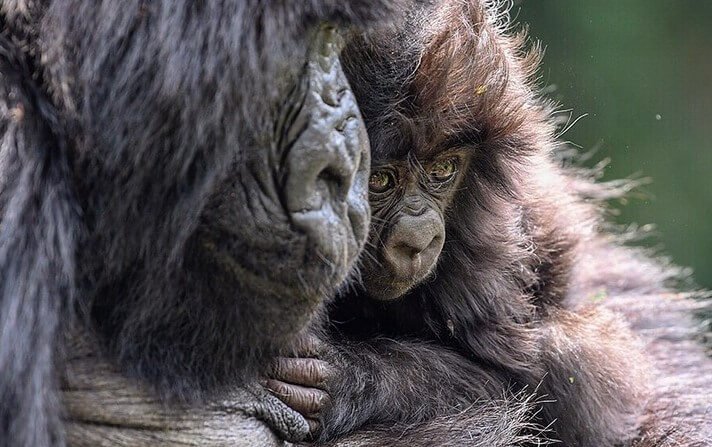
Uganda has two gorilla trekking parks. Most travellers book Bwindi without considering the second one. That is often the right decision, but it is rarely an informed one.
Mgahinga Gorilla National Park sits in the southwestern corner of Uganda, in the shadow of three Virunga volcanoes, and it protects one habituated gorilla family. One.
Eight permits per day, no alternatives if those fill up, and a landscape so different from Bwindi that comparing the two feels like comparing different experiences entirely. Which, in many ways, they are.
This guide is for travellers who have already decided on Uganda and are now working out which park to actually go to. Both deserve honest treatment.
Bwindi is where most people should trek, and there are specific and genuine reasons why Mgahinga deserves serious consideration before you default to the more famous option.
Key Takeaways
- Bwindi Impenetrable Forest holds approximately 19 habituated gorilla families across four sectors, giving it far more permit availability and a wider range of trekking experiences than any other park
. - Mgahinga’s single habituated family, the Nyakagezi group, means just 8 permits per day for the entire park – a scarcity that demands earlier booking but creates a more intimate atmosphere
. - Mgahinga adds golden monkey trekking to its offering, the only place in Uganda to do both in one visit, with no minimum age restriction on the golden monkey experience
. - The two parks offer fundamentally different landscapes: Bwindi is dense ancient equatorial rainforest; Mgahinga is open volcanic terrain with bamboo zones and panoramic Virunga views
. - Both parks are accessible from Kigali via the Rwanda border crossing, making either a viable short-trip option for travellers routing through Rwanda
.
Two Parks, One Subspecies

Before getting into the comparison, one thing is worth stating clearly.
- Both Bwindi and Mgahinga protect mountain gorillas of the same subspecies, Gorilla beringei beringei.
- The one-hour encounter rule is identical.
- The permit fee is the same: $800 per person through Uganda Wildlife Authority.
- The conservation model funding ranger patrols, veterinary care, and community programmes operates across both parks.
What differs is everything around the gorilla encounter:
- The forest you walk through to find them
- The landscape you sleep in the night before
- The number of other families you might be assigned to
- The secondary experiences available once the hour ends
Understanding those differences is the whole point of this guide.
If you are still weighing Uganda against Rwanda rather than choosing between Uganda’s two parks, the Uganda vs Rwanda gorilla trekking comparison covers that question in full before you come back here.
Bwindi Impenetrable Forest: The Breadth Argument
Bwindi Impenetrable National Park is the dominant gorilla trekking destination in the world, and its dominance is earned rather than merely marketed.
The park covers over 300 square kilometres of ancient equatorial rainforest, a UNESCO World Heritage Site that has remained largely intact for more than 25,000 years.
It holds roughly half the global mountain gorilla population, and the scale of that population translates directly into trekking options that Mgahinga simply cannot match.
a) Four Sectors, Multiple Experiences

Bwindi’s gorilla trekking is organised across four sectors, each with its own character, gorilla families, approach terrain, and access logistics.
1. Buhoma
On the park’s northwestern edge, this is the most established sector. The trail network is the best developed, the accommodation options are the most varied, and the approach road from Kampala via Kihihi is the most improved of the four.
Buhoma is where the park’s oldest habituated family, the Mubare group, has been tracked since 1993.
It is the natural choice for first-time trekkers, those with moderate fitness, and anyone building Bwindi into a longer Uganda circuit via Kibale or Queen Elizabeth.
A full picture of what awaits in this sector is on the Bwindi gorilla trekking page.
2. Rushaga
In the park’s south, this holds more habituated gorilla families than any other single sector.
That density of families creates the most flexible permit availability in Bwindi, and it makes Rushaga the most practical sector for travellers operating with a booking window of three months.
It is also the only sector in the world where the Gorilla Habituation Experience is available: a four-hour encounter with a partially habituated family, at a permit cost of $1,500, that offers something qualitatively different from any standard trek.
3. Nkuringo
This sits on Bwindi’s southwestern escarpment, offering views across to the Virunga volcanoes that feel almost competitive with Mgahinga’s own volcanic panorama.
The terrain here is the most demanding in the park, involving a steep descent and re-ascent that produces long trek days regardless of where the gorilla family has moved.
Nkuringo rewards those who want a harder, less-visited experience. It does not suit everyone, and the approach road demands serious 4WD capability in wet conditions.
4. Ruhija
Perched on Bwindi’s eastern rim at around 2,300 metres, this is the highest and most remote of the four sectors.
It sees fewer visitors than Buhoma and Rushaga, partly because the road from Kabale is rough and the altitude demands more physical activity, and partly because it is less prominent in the standard travel narrative around Bwindi.
For experienced trekkers who prioritise solitude over convenience, Ruhija offers a consistently quieter trail with permit availability that often surprises people who assumed all of Bwindi was fully booked.
The practical consequence of this four-sector structure is that Bwindi can accommodate different travellers in different ways.
- A couple arriving via Kigali for a two-day Bwindi trek slots naturally into Rushaga or Nkuringo.
- A family building a longer Uganda safari might approach through Buhoma after the Kibale chimpanzees.
- A solo traveller who left it late has the best chance of finding something available at Rushaga or Ruhija.
Mgahinga cannot offer this kind of itinerary flexibility, and that matters more for some travellers than others.
b) The Forest Itself

Bwindi’s ecological character is one of the most compelling things about it, and it is somewhat separate from the gorilla encounter at its centre.
The forest is dense, layered, loud at dawn, and genuinely immersive in a way that volcanic landscapes are not. You do not walk alongside Bwindi; you move through it, and it closes overhead within minutes of the gate.
The park holds over 350 bird species, including 14 Albertine Rift endemics. It supports populations of chimpanzees, forest elephants, and hundreds of butterfly species.
For naturalists and wildlife observers whose interest extends beyond the gorillas, Bwindi’s biodiversity is a significant draw in its own right.
The darkness and density of the forest also produce something that is harder to quantify but consistently reported by first-time trekkers: a sense of being inside somewhere ancient and specific, different from any other forest most of them have visited.
That quality does not appear in the brochure. It appears in the hour after the encounter, when people sit at the gate and find it difficult to describe what just happened.
Mgahinga Gorilla National Park: The Case for Scarcity
Mgahinga is the smaller, quieter, and more frequently overlooked of Uganda’s two gorilla parks. It is also, for the right traveller, genuinely the better choice.
Not because it is superior to Bwindi in the aggregate, but because it offers something specific that Bwindi does not:
- A more intimate encounter structure
- A completely different landscape
- A secondary primate experience that turns a single park visit into a two-species day.
1. One Family, Eight Permits

The Nyakagezi gorilla group is the only habituated family in Mgahinga. They are a large, stable family group with multiple silverbacks, and they have been accessible to trekkers for years.
But the single-family structure means something straightforward: when the eight permits for that day are gone, the park is full. There is no alternative family, no overflow sector, and no waitlist.
This creates a booking dynamic that is unlike Bwindi’s. On a proportional basis, Mgahinga’s permits are the scarcest in the Uganda system, and they should be treated with at least the same booking urgency as Buhoma during peak season.
If Mgahinga specifically is your goal, the gorilla permit availability guide and the Uganda gorilla trekking permits page are the places to start, and starting early is the only reliable strategy.
The scarcity, however, is also part of the appeal. Eight people per day is the cap everywhere in Uganda, but at Mgahinga, there is only ever one group in the forest at a time.
No other trekking parties are tracking other families in adjacent terrain, no background of human activity beyond your own group and the rangers. The solitude that Ruhija offers by virtue of low demand, Mgahinga builds into its structure.
2. The Volcanic Landscape

Mgahinga sits in the Virunga range, sharing the volcanic mountain chain with Rwanda’s Volcanoes National Park and the DRC’s Virunga National Park.
The three peaks visible from within the park, Muhavura, Gahinga, and Sabinyo, define the skyline in a way that is dramatically unlike Bwindi’s enclosed canopy.
The trekking terrain reflects this. Where Bwindi is dense and enclosed, Mgahinga is more open and elemental, with bamboo zones giving way to afromontane forest and, higher up, open volcanic slopes.
The gorilla family ranges within the forest zones rather than the open volcanic terrain, but the approach walk and the surrounding views belong to the volcano environment.
This landscape difference is not a consolation for the smaller gorilla programme. It is a genuine feature that some travellers respond to more strongly than anything Bwindi offers. The sight of the Virunga volcanoes at dawn from the park area is one of the most striking visual experiences in East African wildlife travel.
Travellers who have been to Rwanda’s gorilla park and trekked in the Virunga setting will find Mgahinga familiar in character. Those arriving from Bwindi will find it entirely different.
3. Golden Monkey Trekking: Mgahinga’s Defining Advantage

This is the experience that changes the calculus for many travellers, and it is underrepresented in most comparisons of the two parks.
Mgahinga is the only place in Uganda where golden monkey trekking is available.
The golden monkey (Cercopithecus kandti) is a striking, endemic primate found only in the Virunga Massif and the Albertine Rift, with vivid orange-gold colouring across the back and sides and a deep grey-black face and limbs.
They move in groups through the bamboo zones, are highly social, and display a physical playfulness during trekking encounters that is quite different from the composed gravity of a gorilla family.
The golden monkey trekking permit costs significantly less than the gorilla permit, and the experience operates under its own encounter rules with its own tracker team.
Critically, there is no minimum age restriction for golden monkey trekking, which means families with children under 15 who cannot participate in the gorilla trek have a genuine alternative available on the same day in the same park.
For travellers who want to combine both experiences in a single visit, the 5-day Mgahinga, golden monkeys and Lake Bunyonyi safari builds this combination into a structured itinerary.
The 3-day Mgahinga gorilla trekking package and the 1-day Mgahinga gorilla trek are the shorter options for those combining Mgahinga with a broader itinerary.
The golden monkey encounter is one of the most genuinely joyful wildlife experiences available in Uganda.
It receives a fraction of the attention that gorillas command, partly because it does not carry the same cultural weight and partly because it is not available in Bwindi.
That obscurity is, in practice, an advantage: you can often arrange golden monkey trekking with less advance notice than a gorilla permit, and the encounter lacks the self-consciousness that sometimes creeps into heavily marketed wildlife experiences.
Comparing the Two Parks Directly

| Factor | Bwindi | Mgahinga |
|---|---|---|
| Habituated gorilla families | ~19 across four sectors | 1 (Nyakagezi group) |
| Daily gorilla permits available | ~152 (standard) plus GHEX | 8 |
| Gorilla Habituation Experience | Yes, at Rushaga ($1,500) | No |
| Golden monkey trekking | No | Yes |
| Forest character | Dense ancient equatorial rainforest | Volcanic montane forest and bamboo |
| Sector options | Buhoma, Rushaga, Nkuringo, Ruhija | Single sector |
| Trek difficulty | Variable (moderate to strenuous by sector) | Moderate to challenging |
| Permit availability | Better overall; variable by sector | Tightest in Uganda |
| Booking lead time | 2 to 6 months depending on season | Treat as Buhoma minimum |
| Proximity to Kigali | 3 to 3.5 hours (southern sectors) | Approximately 2 to 2.5 hours |
| Altitude | 1,160 to 2,607m | 2,227 to 4,127m |
| UNESCO listing | Yes | No |
| Broader biodiversity | Exceptional (350+ bird species) | Strong but smaller park footprint |
Logistics of Getting to Each Park

Both parks are in southwestern Uganda and share similar access routes. From Kampala or Entebbe, the overland journey takes 8 to 9 hours, typically split across two days.
From Kigali, both parks are accessible via the Gatuna/Katuna border crossing in under three and a half hours, making either a practical choice for travellers routing through Rwanda.
Mgahinga is slightly closer to the Rwandan border than Bwindi’s southern sectors, which can be a marginal advantage on a very tight itinerary.
The gateway town for both parks is Kisoro, which sits between them and serves as the natural base for travellers who want to combine both in a single trip.
For a full breakdown of route options, road conditions by sector, and what the approach looks like from different entry points, the how to get to Bwindi guide covers the logistics in detail. The gorilla trekking from Kigali page is specifically relevant for travellers using the Rwanda entry route to reach either park.
Can You Do Both Parks on One Trip?
Yes, and for the right itinerary, it makes excellent sense. Bwindi and Mgahinga are approximately 35 kilometres apart, connected by a road through Kisoro town.
Spending one night near Rushaga or Nkuringo for a Bwindi gorilla trek and then moving to Mgahinga for golden monkey trekking the following morning is a natural two-day structure that requires no backtracking and adds meaningful depth to the primate experience.
The constraint permits. Each park’s gorilla permit must be booked independently through UWA, and the Mgahinga permit requires its own booking with the same urgency as any Bwindi sector.
If both parks are in your plan, secure both permits before confirming any other element of the itinerary.
Who Should Choose Bwindi

Bwindi is the right choice for the majority of gorilla trekking visitors, and the reasoning is practical rather than promotional.
The larger number of habituated families means more permit availability, which matters most for travellers with fixed dates who are booking within three to four months of travel.
The range of sectors means the experience can be matched to different fitness levels and itinerary structures. The forest biodiversity offers more for naturalists beyond the gorilla encounter.
And the four-sector structure makes Bwindi the anchor of Uganda’s longer safari circuits in a way that Mgahinga, with its single-sector focus, is not.
Bwindi is also where the Gorilla Habituation Experience lives.
For anyone whose primary interest is the deepest possible gorilla encounter rather than the most convenient one, Rushaga’s four-hour GHEX permit is available nowhere else, and it changes the nature of the experience substantially.
Choose Bwindi if you are on your first gorilla trek and want the widest range of options, if your permit window is inside three months and you need sector flexibility, if you are building a longer Uganda wildlife circuit, or if the GHEX is on your list.
Who Should Choose Mgahinga

Mgahinga is the right choice for a specific and coherent set of travellers, and describing those travellers honestly is more useful than a generic recommendation.
Choose Mgahinga if:
- You are travelling with children who cannot trek gorillas (the golden monkey experience fills that day meaningfully and without age restriction).
. - You have already trekked gorillas in Bwindi and want a structurally different experience in a different landscape.
. - The volcanic Virunga setting appeals more than the enclosed equatorial forest.
. - You want to combine two primate encounters in the same park visit, which is a day that most travellers who do it describe as one of the best of any Africa trip they have taken.
The 1-day gorilla trekking safari in Mgahinga works well as a standalone option for travellers arriving via Kigali who want a focused, shorter trip.
For those wanting the full Mgahinga picture, including both primates and the Lake Bunyonyi extension, the five-day itinerary is the natural choice.
One thing Mgahinga is not is a consolation prize for travellers who could not get Bwindi permits. Its differences from Bwindi are genuine and worth choosing on their own terms.
Going to Mgahinga specifically, because the volcanic landscape appeals or because the golden monkey combination makes sense for your group, produces a better experience than going because you ran out of options. The parks reward intentionality.
A Note on the Batwa Cultural Experience

Both parks carry Batwa heritage that is worth acknowledging. The Batwa people, the original forest dwellers of this region, were displaced from their forest homes when Bwindi and Mgahinga became national parks.
Batwa cultural experiences are available at both locations, offering an account of forest life and traditional knowledge from the Batwa community’s own perspective.
Mgahinga’s Batwa Trail is one of the most recognised cultural tourism experiences in southwestern Uganda. It is not peripheral to the park visit.
It sits at the intersection of conservation history and cultural debt in a way that makes it the most ethically complete day available at either park: gorilla trekking in the morning, Batwa Trail in the afternoon, with enough time left for the golden monkey option on a second day.
Whether you engage with the Batwa experience or not, understanding that both parks exist on land that was formerly home to this community, and that their displacement is part of the conservation story that gorilla trekking finances, adds a dimension to the trip that most travel guides skip. It is worth knowing before you go.
Frequently Asked Questions

1. Is Mgahinga or Bwindi better for a first gorilla trek?
Bwindi, for most first-time trekkers.
The wider permit availability reduces booking stress, the range of sectors can be matched to different fitness levels, and the forest environment at Bwindi has a biological richness that sets the experience in a specific ecological context.
That said, a first-time trekker who is also travelling with children under 15, or whose itinerary arrives naturally from the Kisoro direction, may find Mgahinga the more practical and equally rewarding option.
2. How do I book permits for Mgahinga specifically?
Through Uganda Wildlife Authority directly or through a licensed Ugandan tour operator with an active UWA relationship.
The process is the same as booking Bwindi permits, but the booking urgency is higher because only 8 permits are available per day.
The book gorilla permit page is the starting point, and the last-minute gorilla permits guide covers what to do if your window is already tight.
3. Can I combine Bwindi and Mgahinga gorilla trekking on the same trip?
Yes, and it is a natural combination given that the parks are about 35 kilometres apart through Kisoro. Each requires a separate permit booked independently.
A practical structure is one night near Bwindi’s southern sectors for the gorilla trek, followed by a transfer to Mgahinga for golden monkey trekking the next morning, with the Mgahinga gorilla permit on the third day if availability allows.
Your operator can build this as a custom arrangement through the plan a safari page.
4. What is the trek difficulty like at Mgahinga compared to Bwindi?
Mgahinga’s terrain sits broadly between Buhoma and Nkuringo in terms of difficulty.
The volcanic gradient adds elevation gain on some approach sections, and the altitude across the entire park (above 2,200 metres) means the air is thinner than at Bwindi’s lower sectors.
The terrain is more open than Bwindi’s dense interior, which makes navigation easier but removes some of the natural handholds that vegetation provides on steep sections.
More on the physical demands of gorilla trekking across all Uganda parks is in the how hard is gorilla trekking guide.
5. Are the gorillas at Mgahinga the same as the gorillas at Bwindi?
They are the same subspecies, Gorilla beringei beringei, but Mgahinga’s Nyakagezi group belongs to the Virunga mountain gorilla population, while Bwindi’s families belong to the genetically distinct Bwindi population.
The IUCN considers both populations part of the same subspecies, and the encounter experience is not meaningfully different on the basis of population genetics.
The family size, social structure, and behaviour of the Nyakagezi group are comparable to those of habituated families in Bwindi.

Choosing between these two parks is one of the more genuinely interesting planning decisions in Uganda travel, because the answer depends on specifics that vary by traveller rather than on one park being objectively superior.
If you want help working out which one fits your itinerary, group composition, and permit window, start a conversation with us here, and we will give you an honest recommendation based on your actual situation.