
Fewer than 1,100 mountain gorillas exist on Earth. Most people who share a forest describe it as the best hour of their lives.
Uganda makes it possible to follow that hour with tree-climbing lions, hippo-packed waterways, and some of Africa’s least-crowded game viewing, all within the same week.
Most travelers think of gorilla trekking and a game drive safari as separate trips. That assumption is worth questioning.
The combination works because Uganda’s geography enables it.
Bwindi Impenetrable Forest, home to roughly half of the world’s remaining mountain gorilla population, sits within a few hours of Queen Elizabeth National Park, one of Africa’s most biologically diverse reserves.
The road between them passes through some of the continent’s most dramatic scenery. Adding a wildlife safari to your gorilla trek isn’t a detour. It’s the natural extension of an already exceptional itinerary.
This guide walks through which parks pair most naturally, what both sample itineraries actually look like on the ground, and how to handle the logistics that most travelers underestimate.
Key Takeaways
- Uganda is one of the few countries where you can track mountain gorillas and do a classic game drive safari within the same trip, often within the same week.
. - The most natural pairing is Bwindi Impenetrable Forest with Queen Elizabeth National Park, roughly 2 to 3 hours apart via the Ishasha sector.
. - A secondary pairing is Bwindi with Murchison Falls National Park in the north, better suited to 8-plus-day itineraries or travelers willing to take a domestic flight between parks.
. - Your gorilla permit is the fixed anchor of any itinerary. Plan everything else around that date.
. - Six days is the practical minimum for doing both properly. Eight days is more comfortable, leaving room for chimpanzee tracking, a second gorilla trek, or gorilla habituation.
.
Combining Both Actually Makes Sense

The instinct to separate them is understandable. Gorilla trekking feels like its own pilgrimage, deserving its own trip. But Uganda’s geography makes a compelling counterargument.
Trekking in Bwindi’s forest puts you in the extreme southwest of the country, and Queen Elizabeth National Park, Uganda’s most visited wildlife reserve, wraps around much of the terrain between it and the main travel corridor north.
The Ishasha sector of Queen Elizabeth, where lions routinely climb trees, serves as the natural entry point from the south. You’re not rerouting to add the safari. You’re continuing in the most logical direction.
There’s an experiential logic to the pairing, too. The gorilla trekking experience is intimate and psychologically dense. The hour you spend with a gorilla family inside the canopy leaves most people quietly stunned.
A game drive in Queen Elizabeth the following morning operates in an entirely different register, vast and unhurried, with the kind of visual openness that gives your mind room to exhale.
Together, they create a contrast that makes each experience sharper. Separately, each is slightly less than what Uganda can actually offer.
For travelers still weighing whether gorilla trekking is worth it as a standalone experience, the answer is almost always yes. Adding a safari doesn’t compete with that; it completes it.
a) Bwindi and Queen Elizabeth National Park
Queen Elizabeth National Park covers nearly 2,000 square kilometers and holds more than 95 large mammal species, ranking among the highest species densities in any African park.
Lions, elephants, hippos, leopards, buffalo, and over 600 bird species all share the space.
Two experiences anchor most itineraries here: the Ishasha sector in the south, and the Kazinga Channel cruise.
1. Tree-Climbing Lions of Ishasha

Ishasha is one of the few places on earth where lions routinely climb trees. The behavior is unusual enough to draw travelers who’ve already seen lions in the Serengeti and Kruger and want something genuinely different.
The Ishasha lions, typically found draped across the branches of ancient fig trees, are photographically dramatic and behaviorally puzzling.
Researchers still disagree about why they do it, and that open question is part of what makes observing them feel less like wildlife tourism and more like witnessing something unresolved.
Beyond the lions, the sector holds significant populations of Uganda kob, topi, warthog, and buffalo. Elephant sightings are frequent along the Ishasha River, particularly in the early morning.
If you’re entering Queen Elizabeth from Bwindi, Ishasha is your natural entry point, which means meaningful game viewing begins almost the moment you leave the gorilla forest.
2. Kazinga Channel Cruise

The Kazinga Channel connects Lake George to Lake Edward, and its banks support one of Africa’s highest concentrations of hippos.
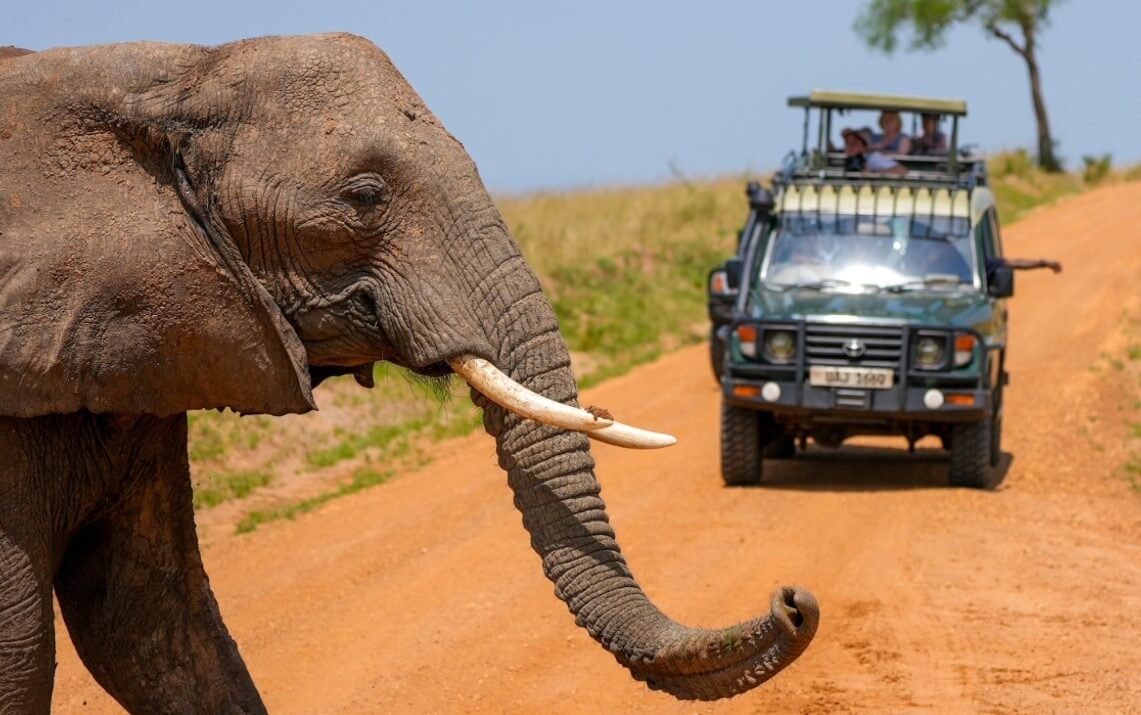
A boat safari here is fundamentally different from a land game drive. You move quietly at water level, past buffalo wading along the edges, pelicans tracking the boat’s movement, and hippos surfacing in pods of sometimes several hundred.
The animals seem largely unbothered by proximity. The closeness is remarkable.
For birders, the channel is exceptional year-round. African skimmers, pied kingfishers, goliath herons, and dozens of migratory species make it one of Uganda’s premier birding corridors.
It’s consistently the afternoon that surprises people who arrived thinking the gorillas would be the undisputed highlight.
3. Wildlife Diversity Beyond the Headlines

The Kasenyi Plains in northern Queen Elizabeth deliver productive lion and Uganda kob sightings year-round.
Leopards exist in significant numbers but remain selectively elusive, consistent with their behavior across the continent. Elephant herds are a near-daily sighting across multiple sectors.
Queen Elizabeth is also one of the few Ugandan parks where chimpanzee tracking is available, specifically in the Kyambura Gorge along the eastern rift wall, sometimes called the Valley of Apes.
Combining great apes in two separate forest ecosystems with a big game safari, all within a single trip, is genuinely rare globally.
Uganda is one of the only places where the geography makes it structurally possible within a week.
b) Adding Murchison Falls to the Route

For travelers with eight days or more, or those who specifically want the northern Uganda circuit, Murchison Falls National Park is a compelling third chapter.
Uganda’s largest protected area holds the most dramatic landscape in the country.
The White Nile narrows to a seven-meter gorge before exploding into the valley below, accessible both from a boat cruise at the base and from a short hike to the top of the falls.
Game viewing is excellent across the board, particularly for lions, elephants, Rothschild giraffes, and Nile crocodiles.
The Nile Delta boat cruise north of Paraa is one of Africa’s great river wildlife experiences.
The honest caveat is distance. Murchison sits several hours north of Kampala, and Bwindi is several hours southwest.
Connecting the two overland without a night in Kampala means two long driving days. A domestic flight between Bwindi and Murchison eliminates most of that friction, though it adds cost.
For most travelers pairing gorillas with a safari, Queen Elizabeth is the more practical first choice. Murchison rewards the trip when your schedule allows it.
For itineraries that cover both pairings in detail, our 8-day Uganda wildlife safari and 10-day primate and wildlife itinerary are the best starting points.
A 6-Day Gorilla Trekking and Safari Itinerary

Six days is the practical minimum for doing this combination justice. The structure below is built around a gorilla permit on Day 3, giving you two full days to reach Bwindi and three more for Queen Elizabeth after.
Day 1 — Arrive at Entebbe, drive toward Bwindi
Most international flights arrive at Entebbe Airport.
The drive southwest toward Bwindi takes 7 to 9 hours depending on your route, and most operators break it with an overnight stop in Kabale or at Lake Bunyonyi.
The lake sits at nearly 2,000 meters above sea level and is one of Uganda’s most serene landscapes. An evening there does you measurably good before a physical morning in the forest.
Day 2 — Rest at Lake Bunyonyi or arrive in Bwindi
A rest day before the trek isn’t wasted time.
The altitude, the travel fatigue, and the physical demands of the following morning all argue for it. If you’ve driven straight to Bwindi, use the afternoon for a guide briefing and orientation walk.
Understanding how demanding gorilla trekking can be before your permit day helps you manage the morning with clearer expectations.
Day 3 — Gorilla trekking in Bwindi Impenetrable Forest
Your permit day. You’ll be assigned a habituated gorilla family based on fitness and group size, briefed at the trailhead, and guided into the forest.
The trek varies from under an hour to a full half-day, depending on where the family has moved overnight.
Once you find them, you have one hour with the group, an hour that tends to feel simultaneously longer and shorter than it is.
Bwindi has four trekking sectors: Buhoma, Ruhija, Rushaga, and Nkuringo. Each offers different trail conditions, gorilla families, and lodge options.
Bwindi’s sectors explained covers the practical differences if you haven’t yet settled on which base to book.
Day 4 — Transfer to Queen Elizabeth via Ishasha
The drive from Bwindi’s southern sectors to Ishasha takes 2 to 3 hours. Most operators build an afternoon game drive in Ishasha into the transfer day. With reasonable timing, you can be watching tree-climbing lions by late afternoon.
Day 5 — Full day in Queen Elizabeth National Park
Morning game drive across the Kasenyi Plains or Mweya Peninsula, afternoon Kazinga Channel boat cruise.
This is consistently one of the most wildlife-dense single days on any Uganda itinerary, and it tends to surprise people who arrive expecting the gorillas to be the unchallenged peak.
Day 6 — Return to Entebbe, depart
The drive from Mweya to Entebbe takes 5 to 6 hours. Most international departures from Entebbe leave in the evening, which makes the timing comfortable with a lunch stop along the way.
This structure maps closely to our 6-day Uganda safari itinerary, which includes specific lodge recommendations and pricing across mid-range and premium tiers.
An 8-Day Gorilla Trekking and Safari Itinerary

Two additional days shift the experience noticeably. You can add a second gorilla trek, opt for gorilla habituation in Rushaga, include chimpanzee tracking in Kyambura Gorge, or simply move at a pace that lets each environment breathe.
Day 1 — Arrive Entebbe, overnight
Transfer to a lodge near Entebbe or in Kampala. An early start westward the next morning is far easier when you’re not navigating the city fresh off a long-haul flight.
Day 2 — Drive to Bwindi via Lake Bunyonyi
The route west through the Rift Valley escarpment takes most of the day. Overnight at Lake Bunyonyi, both practical and genuinely worth the stop.
Day 3 — Arrive Bwindi, afternoon walk or community visit
Settle in, meet your guide team, and spend the afternoon gently. Some lodges offer introductory nature walks or nearby village visits. Good preparation for the physical demands the next morning brings.
Day 4 — Gorilla trekking in Bwindi
The primary trek. Permit logistics, sector assignment, and briefing happen at the trailhead in the early morning.
For guidance on which sector suits your fitness level and travel style, the comparison between Bwindi’s trekking sectors is the right starting point.
Day 5 — Second trek or gorilla habituation, then transfer toward Ishasha
A second gorilla permit gives you a different family and a different section of forest.
Alternatively, gorilla habituation in Rushaga offers four hours with a family that’s still being accustomed to human presence.
The experience is longer and more physically demanding than a standard trek, and for many travelers, it becomes the more meaningful of the two encounters. In the late afternoon, begin the transfer toward Queen Elizabeth.
Day 6 — Ishasha sector and southern Queen Elizabeth
A full day in Ishasha. Tree-climbing lions in the morning, open grassland game drives in the afternoon across terrain that sees fewer visitors than the northern sectors.
Day 7 — Kazinga Channel cruise and Kyambura Gorge chimpanzee tracking
Morning boat cruise on the Kazinga Channel. Afternoon chimpanzee tracking in the Kyambura Gorge.
The Kyambura chimp trek is shorter than a full Kibale Forest experience, but it completes what is genuinely one of the most primate-rich single days available in Africa.
Day 8 — Return to Entebbe, depart
Five to six hours back east. Most Entebbe evening departures leave enough time for a comfortable afternoon arrival at the airport.
Our 8-day Uganda wildlife safari follows this structure closely. For travelers who want to extend further into northern Uganda, the 10-day primate and wildlife safari adds Murchison Falls to the route.
Planning the Logistics
1. Gorillas First or Safari First

The cleaner sequence is gorillas first, safari after, and there are two clear reasons for it.
Your gorilla permit is issued for a fixed date and functions as the one non-negotiable anchor in the entire itinerary. Building around a fixed starting point is structurally simpler than embedding it in the middle.
The second reason is physical: gorilla trekking demands more from you than a game drive, and most people bring sharper energy to it earlier in a trip.
The sequence does shift if you’re flying in from Kigali rather than Entebbe. Bwindi is significantly closer to the Rwandan border than to the Ugandan capital, and arriving from Kigali can cut your approach drive from 8 hours to under 2.
Our 2-day gorilla trek from Kigali is the most efficient way to structure that entry point.
For a broader comparison of what changes when you base the trip in Rwanda versus Uganda, the Uganda vs Rwanda gorilla trekking guide covers permit costs, forest conditions, and overall experience side by side.
2. Securing Your Gorilla Permit

Uganda gorilla permits cost $800 per person, per trek. They aren’t something to approach casually if you have specific dates in mind.
During peak season (June through September and December through February), permits in popular sectors like Buhoma and Rushaga can book out months in advance.
The Uganda Wildlife Authority manages allocations directly, and availability shifts frequently.
A full breakdown of how permits work, what’s included, and how to secure one is in our gorilla permit guide.
If you’re working with a compressed timeline, last-minute gorilla permits do surface occasionally, particularly in shoulder seasons, though availability is genuinely unpredictable.
Checking current permit availability early in your planning process is always the safer move.
3. When to Go

The short dry season runs from June through August.
The long dry season covers December through February. Both are popular for gorilla trekking and game drives, and for consistent reasons: trails are drier, vegetation is lower, and savannah sightings are cleaner on open ground.
Uganda’s rainy seasons, though, are often wetter in name than in experience. The gorillas don’t move seasonally; the forest is always green, and the animals are always there.
Rains tend to arrive in the late afternoon more often than not, by which point most morning treks are long finished.
For a detailed monthly breakdown across all sectors, the best time for gorilla trekking covers the full picture.
4. What to Pack

The gorilla trek and the game drive have genuinely different gear requirements.
For the forest: long trousers and long sleeves (vegetation stings and scratches), proper hiking boots with ankle support, garden gloves, and a rain cover for your camera.
The gorilla trekking packing guide covers this comprehensively. For the safari, requirements relax considerably: breathable neutral layers and a pair of binoculars go a long way.
Nothing bright-colored enters the gorilla forest, and no flash photography either. Your guides will walk you through the protocol on the morning of the trek.
What This Trip Costs

Gorilla trekking and safari in Uganda is a meaningful financial commitment. The permit alone is $800 per person.
When you factor in accommodation (mid-range lodges run $200 to $400 per night; high-end forest camps often exceed $600), transport, park entry fees, and activity costs, a well-structured 6-day trip typically runs between $3,000 and $6,000 per person, depending on accommodation tier.
Eight days with premium lodging can go higher.
The full gorilla trekking cost breakdown is a useful reference before you start budgeting. It also helps to understand why gorilla trekking is priced at what it is.
A significant portion of Uganda Wildlife Authority revenues is channeled into conservation programs that directly fund ranger patrols, veterinary interventions, and community benefit sharing.
The mountain gorilla population has grown steadily since the 1980s, from a documented low of around 620 individuals in 1989 to over 1,000 today.
That recovery didn’t happen by accident, and the permit structure is a direct mechanism behind it. For more on the research underpinning that work, the Dian Fossey Gorilla Fund is worth reading.
A Brief Note on Ethics

It’s a question worth asking plainly. Gorilla trekking operates under strict protocols: one hour per visit, one group per habituated family per day, with minimum distancing rules enforced by trained guides throughout.
The science broadly supports well-managed habituation as a conservation tool, and the ethical framework around gorilla trekking is more nuanced than either critics or promoters typically allow.
The baseline argument is fairly straightforward: communities living near gorilla habitat benefit economically from tourism, which creates tangible local incentives to protect the forest rather than convert it for agriculture.
That feedback loop has held for decades, and the population recovery reflects it.
Travelers who engage with that reality, by choosing operators with genuine conservation ties and by respecting protocol in the field, participate in something meaningful beyond the experience itself.
FAQs

1. Do I need a visa to visit Uganda?
Yes. Most nationalities can obtain a Uganda e-visa online before travel. A few are eligible for a visa on arrival. The Uganda visa requirements page covers the application process, costs, and eligible nationalities in detail.
2. Is Uganda safe for tourists?
Yes, within the main tourism circuits. Bwindi, Queen Elizabeth, and the corridors between them are well-established, with robust tourism infrastructure and regular international visitor traffic. A fuller breakdown of safety considerations is available on the Uganda safety page.
3. How physically demanding is gorilla trekking?
More demanding than most people expect, but rarely as hard as they fear. Treks range from under an hour to a full half-day through dense, often steep terrain. Most reasonably fit adults manage it comfortably with the right footwear and a good night’s sleep behind them.
The gorilla trekking difficulty guide gives an honest assessment, including what’s available for travelers who want porter support.
4. Can I enter Uganda from Kigali and still do this itinerary?
Yes, and it’s a popular starting point. The Kigali-to-Bwindi crossing takes under two hours, and a 2-day gorilla trek from Kigali makes an efficient entry before continuing into Uganda for the safari extension.
5. How far in advance should I book my gorilla permit?
At a minimum of three to six months ahead, if you have specific dates during peak season. Earlier is always safer. If your schedule is flexible, there’s more room to work with.
Check current permit availability early and reach out to us so we can hold dates while you finalize your plans.
A well-structured gorilla and safari combination tends to stay with people. Both experiences are genuinely singular, and the contrast between them does something that neither could accomplish alone.
Browse our Uganda safari options to see full itineraries across different durations and budgets. Or if you’re ready to anchor your trip, secure your gorilla permit, and we’ll build the rest of the itinerary around it.