
Most travellers budget exactly one day for Bwindi. They arrive the afternoon before, trek in the morning, and leave by noon. In doing so, they spend nearly an entire day of travel to reach one of Earth’s most extraordinary places, then see roughly two percent of what it offers.
Bwindi Impenetrable National Park covers 331 square kilometres of ancient Afromontane rainforest, one of the oldest and most biodiverse on the planet.
It shelters half the world’s mountain gorillas, 350 bird species, 120 mammals, and 14 distinct vegetation zones stacked across elevations that range from 1,400 to 2,607 metres.
The gorilla encounter is extraordinary, as anyone who’s done it will tell you. But it’s also one hour long. The forest is still there for the rest of the day.
This guide covers the full range of things to do near Bwindi: the hikes, birding trails, cultural visits, and nearby destinations that most itineraries leave out and that most travellers, once they’ve experienced them, wish they’d known about before they booked.
Key Takeaways
- Bwindi has six named hiking trails ranging from a two-hour riverside walk to a full-day summit ascent at Rwamunyonyi Peak (2,607m).
. - With 350 species and 23 Albertine Rift endemics, Bwindi consistently ranks among Africa’s top five birding destinations.
. - The Batwa cultural experience is one of Uganda’s most ethically significant tourism encounters, and one worth approaching with some historical context.
. - Lake Bunyonyi sits about two hours from Bwindi’s southern sectors and offers canoeing, swimming, island visits, and a particular stillness most travellers need after the intensity of the forest.
. - Adding even one or two nights to a standard Bwindi stay unlocks a completely different category of experience.
.
Forest Hikes That Most Visitors Never Walk

The gorilla trek takes you into the forest in pursuit of a specific family.
The hiking trails offer something different: unstructured movement through Bwindi, following rivers, ridgelines, and forest paths without a single destination anchoring the day.
That distinction matters more than it sounds, because the two experiences read differently once you’re inside the trees.
There are six established trails in the park, most originating from the Buhoma sector. They range in duration from two hours to a full day and vary considerably in difficulty.
None of them requires a gorilla permit, only the standard park entry fee, which makes them accessible to travellers who’ve already trekked and want a second morning in the forest without repeating the experience.
Before choosing a trail, it helps to understand how the four sectors of Bwindi compare, since trail availability depends partly on where you’re based.
1. The Munyaga River Trail and the Waterfall Walk

The Munyaga River Trail is the most accessible hike in Buhoma. It follows the river from the park headquarters through forest-edge habitat, turns at the Bizenga Creek junction, and returns inside two hours.
It’s a good option for a post-trek afternoon or for travellers who want consistent bird encounters without a demanding climb. Primate sightings along this stretch are routine.
The Waterfall Trail branches off the Buhoma-Nkuringo route and follows the River Ivi to a 33-metre cascade plunging into a narrow rock gorge.
The hike takes around three hours through dense mid-altitude canopy, with regular colobus monkeys, red-tailed monkeys, and L’Hoest’s monkeys visible overhead.
For travellers curious about what the forest interior feels like before committing to the full gorilla trekking experience, this trail gives a very honest preview.
2. The Rushura Hill Trail and the View That Earns It

The Rushura Hill Trail climbs from Buhoma headquarters through terraced farmland to the highest viewpoint in the northern sector at roughly 1,915 metres.
On a clear morning, you can see Lake Edward, the Rwenzori Mountains, the Virunga Volcanoes, and the green sea of Bwindi canopy stretching in every direction.
The ascent takes three to four hours and involves a real climb, though nothing requiring specialist fitness. \The views from the top are the kind that rearrange your sense of the region’s scale: the Albertine Rift visible as a physical fact, not a name on a map.
Standing there, the idea of pairing Bwindi with a broader Uganda safari starts to feel less like a logistics question and more like an obvious response to the landscape in front of you.
3. The Bamboo Trail and Rwamunyonyi Peak

This is the most demanding hike Bwindi offers, and also the one that stays with people longest.
The Bamboo Trail starts from the Ruhija sector, climbing steadily through 14 distinct vegetation zones before reaching Rwamunyonyi Peak at 2,607 metres, the highest point in the park. The full ascent takes six to seven hours.
The summit delivers a 360-degree panorama that few visitors to southwestern Uganda ever see. Lake Bunyonyi glints far below. The Virunga chain lines the southern horizon. Bwindi’s canopy stretches north and west without interruption.
The birding along the bamboo zone approaching the peak is exceptional: several Albertine Rift endemics are reliably encountered here that are difficult to find on the lower trails.
Because the trail begins in Ruhija, travellers doing this hike typically base themselves there or make an early start from Buhoma, roughly an hour’s drive away.
If you’re weighing up where to stay in Bwindi with trail access as a priority, Ruhija gives the most direct connection to both the Bamboo Trail and the Mubwindi Swamp.
Birding in Bwindi

Uganda has over 1,090 recorded bird species, nearly half of all species found across the African continent.
Bwindi holds 350 of them within a single national park, including 23 species endemic to the Albertine Rift. That figure represents roughly 90% of Uganda’s Albertine Rift endemics concentrated in one location.
For dedicated birders, a skilled guide can identify more than 100 species in a day.
For casual observers, the forest offers near-constant movement:
- Sunbirds at the canopy edge
- Hornbills crossing clearings
- Weavers and flycatchers through the understorey.
A full guide to birding in Bwindi is worth reading before you go, but the short version is this: even travellers who have never done a birding safari tend to come away surprised by how much is happening in the trees.
The gorilla trek itself passes through excellent bird habitat, and most guides, given a question, will stop and identify what they hear.
The Best Birding Trails by Sector

The Mubwindi Swamp Trail in Ruhija is widely considered the finest birding route in the park.
It descends into a highland marsh that functions as the most reliable site in Africa for the African green broadbill, a species with a restricted Albertine range.
Grauer’s rush warbler and Carruthers’s cisticola are also consistently recorded here. The Grauer’s rush warbler, listed as vulnerable on the IUCN Red List, is one of over a dozen threatened species that Bwindi’s forest actively protects.
Note that the Mubwindi Swamp Trail requires advance authorization from the Uganda Wildlife Authority; plan this with your operator before arrival.
The Munyaga River Trail and the main Buhoma forest trails are strong options for general forest birding, particularly in the first two hours after dawn.
Ruhija and Buhoma are considered the two best sectors for Albertine endemics overall. Travellers with a serious interest in the regional checklist make a good case for spending at least one night in each.
The Batwa Cultural Experience

Before Bwindi was gazetted as a national park in 1991 and 1992, the Batwa pygmies lived inside the forest.
They had done so, according to most anthropological accounts, for more than 60,000 years, surviving as hunter-gatherers in a relationship with the ecosystem that left virtually no degradation trace.
When the park boundary was formalized, they were removed without consultation or compensation and resettled on the forest’s edge.
This history is not incidental to the cultural experience on offer.
The Batwa trail is partly a tourism product and partly an act of cultural transmission by a community whose way of life was abruptly ended by the same conservation logic that now attracts visitors from around the world.
That context doesn’t make the visit uncomfortable; many travellers find it adds a seriousness and depth that a performance-only format couldn’t achieve.
But arriving with some awareness of the Batwa people’s history in Uganda changes how you receive what you see.
What the Experience Actually Involves

The experience is led by Batwa community members and takes place in forested land adjacent to the national park, typically running around three hours.
Guides demonstrate traditional hunting techniques, medicinal plant identification, honey-gathering practices, and how temporary forest shelters were constructed.
Cultural performances involving drumming and dance usually close the visit.
It’s a genuinely absorbing few hours. The demonstrations are specific enough to be instructive, and the guides tend to speak candidly about what the eviction meant and what it continues to mean for Batwa families today.
Whether the revenue reaches the community directly varies by operator, so it’s worth confirming with whoever you book through.
Ethical travel in this region isn’t only about whether gorilla trekking itself is ethical: it also extends to how well the surrounding communities are woven into the economics of the visit.
The Batwa trail at Mgahinga is a related but distinct experience, run by the Mgahinga Batwa on the volcanic slopes near Kisoro.
Travellers visiting Mgahinga Gorilla National Park often pair it with golden monkey trekking for a full cultural and wildlife day.
Village Walks and Community Tourism in Buhoma

The Bakiga are the farming community surrounding Bwindi’s northern edge, and the Buhoma area has developed a structured village walk that makes a compelling half-day addition to any multi-night stay.
The walk typically runs three hours and visits craft-making cooperatives, a traditional healer, local brew-making operations, and the community hospital project that has been running as a tourism-funded initiative for over two decades.
What distinguishes this from a generic cultural excursion is the specificity.
A good guide will introduce you to individuals by name, explain the economics of the terrace farming visible on every hillside, and contextualize the relationship between the village and the park boundary it shares.
That relationship is not straightforward. Conservation created restrictions that fell disproportionately on the people closest to the forest, and the better village guides are candid about it.
Walking through Buhoma with that awareness in mind produces a different kind of afternoon than simply admiring the scenery.
The Gorilla Habituation Experience

This is the most immersive gorilla encounter available anywhere in Africa, and the distinction from a standard trek is more significant than it might appear on paper.
Regular gorilla trekking gives you one hour with a fully habituated family.
The habituation experience gives you four, alongside a team of researchers still in the process of acclimatizing a semi-wild group to human presence.
The difference isn’t merely quantitative.
With four hours in proximity to a gorilla family, you observe feeding sequences, social hierarchies at work, play behaviour among juveniles, and the slower rhythms of gorilla life that a one-hour slot can only partially capture.
You see a silverback’s morning settle into rest. You see mothers navigate their infants through the undergrowth. The researchers working beside you can answer questions that a standard trek briefing doesn’t have time to address.
The habituation experience is only available in the Rushaga sector, where two families are currently in the programme.
Permits cost $1,500 per person and group sizes are tightly limited. For anyone weighing this against a standard trek, the full breakdown in our guide to gorilla habituation vs trekking covers what to expect from each.
For a structured itinerary built around the experience, the 3-day gorilla habituation safari handles the logistics in a sequence that works well.
Lake Bunyonyi

Roughly two hours south of Bwindi’s southern sectors, Lake Bunyonyi sits in a volcanic crater at nearly 2,000 metres, ringed by terraced hillsides and scattered with 29 islands.
The name translates as “place of many little birds,” and the lake holds over 200 recorded species.
Most travellers use it as a wind-down day between wildlife activities, which makes sense: Bwindi’s physical and emotional intensity leaves most people wanting to sit by water and do very little.
But Bunyonyi has its own activities, and a day here has more texture than a simple rest stop.
What to Do on the Lake

Canoeing between the islands is the most engaging way to spend a morning.
Akampene, known as Punishment Island, carries a disturbing local history: the Bakiga once abandoned unmarried pregnant women there, leaving them to die.
Hearing that story told on the water by a local guide is a different experience from reading it in a guidebook, and it says a great deal about the social pressures that structured life in the Kigezi highlands for centuries.
Swimming is genuinely possible here, one of the very few places in Uganda where it is.
Lake Bunyonyi is crocodile- and hippo-free, and the risk of bilharzia is minimal, which means you can enter the water without reservation. The temperature is cool but manageable at altitude.
Early-morning birding from a dugout canoe, with herons, egrets, and grey crowned cranes working the shallows around reed-fringed islands, is a particular pleasure for those who’ve already been to Bwindi and want to stay in that register of the trip.
For travellers building around both destinations, the 3-day Bwindi gorilla trek and Lake Bunyonyi itinerary covers the logistics in a sensible sequence.
A fuller look at how Lake Bunyonyi fits into a gorilla safari is worth reading when you’re planning the combination.
A Batwa community also lives on one of the lake’s islands, descended from people displaced from Echuya Forest Reserve rather than Bwindi, but part of the same wider dispossession story.
Visiting them here adds another layer to the Batwa thread that runs through any serious trip to southwestern Uganda.
Mountain Biking Through the Bwindi Highlands
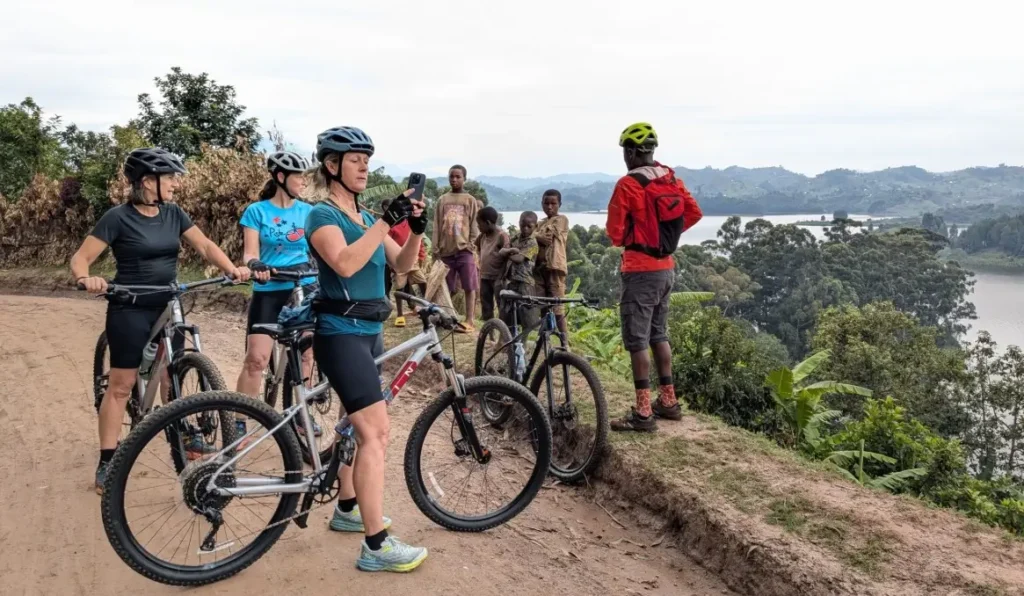
The “Ride for a Woman” project, based at Buhoma Community Rest Camp, runs a guided 13-kilometre mountain bike trail to the Ivi River.
The round trip takes six to seven hours and climbs through forest edge and community farmland, with regular bushbuck sightings and a good chance of encountering colobus and red-tailed monkeys.
The income from the hire and guiding fees goes directly to local women.
The terrain is genuinely demanding: the hills around Buhoma are steep in the way that only makes sense once you’re on them.
But for travellers who want an active half-day outside the forest, this is one of the more distinctive options in the area.
You reach places that vehicles don’t go and that most visitors never see, which is its own quiet kind of reward.
Extending Your Trip Beyond Bwindi

There’s a logical geography to the southwestern Uganda circuit, and the distances are more forgiving than they look on a map.
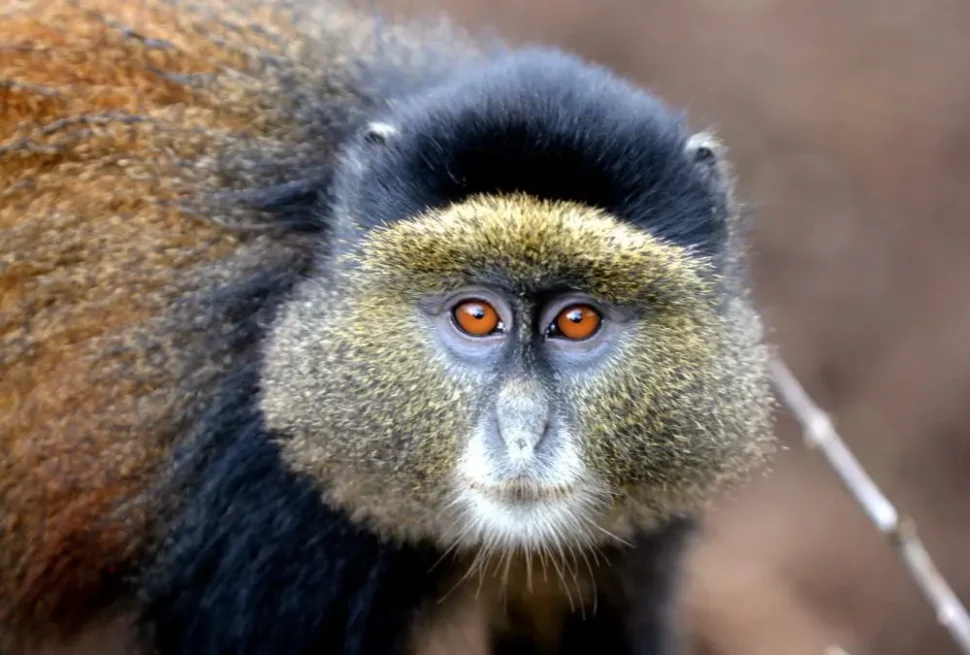
Mgahinga Gorilla National Park sits roughly an hour from Bwindi’s southern sectors. It’s home to the Nyakagezi gorilla family and one of Africa’s best golden monkey experiences.
The golden monkeys of the Virunga bamboo zone are extraordinary animals, acrobatic and vivid in a way that contrasts sharply with gorillas, and golden monkey trekking at Mgahinga can be arranged as a standalone morning.
The 5-day Mgahinga, golden monkeys, and Lake Bunyonyi safari builds all three into a coherent loop.
Queen Elizabeth National Park lies three to four hours north and offers a completely different ecosystem:
- Open savannah
- Tree-climbing lions in the Ishasha sector
- Channel boat safaris on Kazinga Channel
- Large-mammal sightings that the forest can’t provide.
It’s the natural next stop for travellers who want to contrast the enclosed intensity of Bwindi with something more expansive. The 8-day Uganda wildlife safari combines both parks in a sequence that covers the full ecological range.
Farther north, chimpanzee trekking in Kibale Forest rounds out any primate-focused itinerary in a way that makes Uganda genuinely unmatched in East Africa.
Loud, chaotic, and entirely different in character from gorilla trekking, Kibale delivers a primate encounter that surprises most people who’ve assumed gorillas would be the harder act to follow.
The 10-day Uganda primates and wildlife safari covers the full sequence without feeling rushed.
If Murchison Falls National Park is on your radar, the longer 6-day Uganda safari integrates the north without adding excessive driving time.
A Note on Staying Longer

The single most consistent regret among travellers who visit Bwindi is not having stayed longer.
- One night is logistically sufficient for the gorilla trek and nothing else.
- Two nights open up hiking, birding, and community visits.
- Three nights change the character of the trip from a wildlife excursion into something that feels like genuine immersion.
Getting to Bwindi takes eight to ten hours by road from Kampala. That journey deserves a more generous stay at the other end.
The best time to visit Bwindi is worth knowing before you commit to dates, though the park rewards visits year-round in ways that most seasonal guides don’t fully capture.
For anything beyond a one-night gorilla permit stop, the most useful starting point is checking gorilla permit availability early, since the number of permits per day is fixed and the best dates fill months in advance.
If you’re building an itinerary from scratch, our safari planning service starts with your specific priorities and works from there. No templates, no standard packages applied to questions that don’t fit them.
FAQs

1. What activities can I do in Bwindi besides gorilla trekking?
The main options include:
- Guided forest hikes along six named trails
- Birdwatching across 350 species (including 23 Albertine Rift endemics)
- Batwa cultural experience
- Bakiga village walks in Buhoma
- Mountain biking via the community-run “Ride for a Woman” project
- Gorilla habituation experience in Rushaga.
Lake Bunyonyi, about two hours from the southern sectors, adds canoeing, swimming, and island exploration to any itinerary.
2. Do I need a special permit for Bwindi’s hiking trails?
Most hiking trails require only the standard park entry fee, not a gorilla permit.
The exception is the Mubwindi Swamp Trail in Ruhija, which requires advance authorization from the Uganda Wildlife Authority.
It’s worth confirming trail access and fees with your operator before arrival, since conditions and requirements occasionally change.
3. How different is the gorilla habituation experience from a standard trek?
A standard gorilla trek gives you one hour with a fully habituated family.
The habituation experience, only available in the Rushaga sector, gives you four hours with a group still being acclimatized to human presence, alongside working researchers.
The permit costs $1,500 per person compared to $800 for a standard trek, and group sizes are smaller. The longer duration reveals behaviours and interactions that a one-hour window can’t.
4. Is Lake Bunyonyi worth adding to a Bwindi trip?
For most travellers, yes. It sits about two hours from the southern sectors of Bwindi and offers a complete change of pace: canoeing, swimming in bilharzia-free water, island visits, and morning birding from the water.
The combination of gorilla trekking and a day or two on the lake works particularly well as a three- or four-night itinerary.
5. How do I make sure the Batwa experience is genuinely benefiting the community?
The key questions to ask your operator are whether the Batwa community directly controls the experience and receives the revenue, rather than acting as performers in something organized by an outside party.
The Dian Fossey Gorilla Fund’s broader conservation model offers useful context for understanding how community benefit and wildlife protection can be aligned, or misaligned, in practice.

Thinking about how to use more of your time in southwestern Uganda?
Build the trip around what actually matters to you on our safari planning page, or secure your gorilla permit while dates are still available.