

Your clothing choices on a gorilla trek are not purely practical.
They affect the animals you came to see, the insects that will share the trail with you, your safety on steep and slippery terrain, and whether a three-hour walk through dense tropical forest leaves you energised or miserable.
Getting this right requires more than packing a pair of hiking boots and hoping for the best.
The good news is that gorilla trekking clothing is not complicated. The requirements are specific, the reasoning behind each one is sound, and once you understand why the rules exist rather than just what they are, the choices become obvious.
This guide covers everything from your boot sole to your rain hood, including the colour question that generates more confused forum threads than almost any other gorilla trekking topic.
Key Takeaways
- Long trousers and long sleeves are mandatory for gorilla trekking, not a recommendation — they protect against insects, vegetation cuts, and sun exposure on exposed sections of trail
. - Neutral colours (khaki, olive, brown, grey, muted green) are strongly recommended; black and dark blue should be avoided because they attract certain insects and can produce unpredictable responses in gorillas
. - Waterproof, ankle-supporting hiking boots are the single most important piece of equipment for the trek; trail runners and casual shoes are inadequate for Bwindi’s terrain
. - A rain poncho is essential regardless of season, because forest weather changes without notice and wet clothing on a long descent is genuinely unpleasant
. - Gardening gloves cost almost nothing and make steep, vegetation-heavy sections significantly more manageable and safer
.
Clothing Matters More Than You Think

Most adventure travel clothing advice is practical but stakeholder-neutral. Wear the wrong thing on a city walking tour, and you end up with blisters. Wear the wrong thing on a gorilla trek, and the consequences are more varied.
Inappropriate colours can agitate a habituated gorilla family during the encounter, shortening your hour or triggering a stress response in animals that an entire regulatory framework is designed to keep calm.
The wrong footwear on a wet descent in the Nkuringo sector does not just produce discomfort; it produces twisted ankles on terrain where the nearest medical facility is a very long drive away.
And inadequate insect protection on a forest trail where safari ants are an ambient fact of life is something you will not make the mistake of twice.
The clothing requirements for gorilla trekking were developed through experience. Following them is not conformity. It is preparation.
The Non-Negotiables

1. Long Trousers
Long trousers are mandatory on a gorilla trek, and unlike some rules that exist primarily on paper, this one is enforced and matters practically.
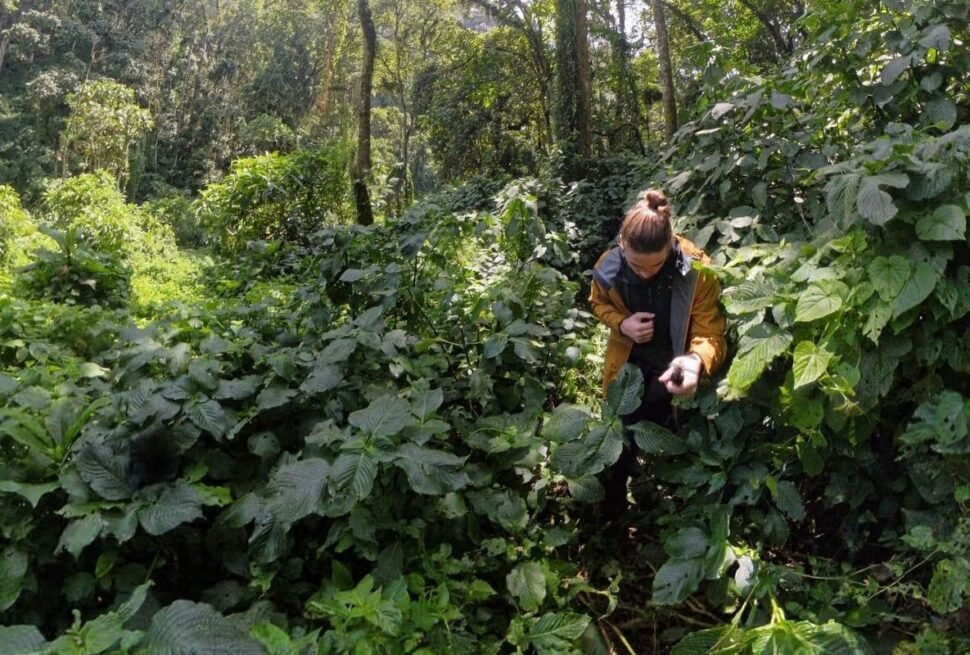
Bwindi Impenetrable Forest earns its name. The trail pushes back.
Vegetation presses in from both sides on narrower sections, and on steep descents, you will frequently be grabbing at plants, kneeling on roots, or pushing through undergrowth that a machete would handle more efficiently than bare skin.
Long trousers prevent the cuts, scrapes, and plant-contact irritations that exposed legs accumulate over a two-to-five-hour trek.
They also provide meaningful protection against insects. Safari ants, which move in dense columns across forest trails and respond badly to being disturbed, will bite exposed skin with a speed and coordination that is genuinely alarming.
Tsetse flies in lower-altitude sections prefer dark, warm skin to covered, lighter-coloured fabric. Mosquitoes, while not the primary concern at Bwindi’s higher altitudes, are present.
The material matters as much as the length. Lightweight, quick-drying fabrics (nylon or polyester blends, not cotton) manage moisture effectively in humid conditions.
Cotton trousers absorb sweat and rainwater and stay wet, which becomes a temperature and chafing problem on the return walk.
Zip-off trousers that convert to shorts are a reasonable compromise for the journey to and from the park, but on the trek itself, the trouser leg stays on.
Tuck your trousers into your sock tops at the ankle. This is the single most effective defence against safari ants, which enter clothing from the ground up.
2. Long Sleeves
The same reasoning applies to your upper body. Long sleeves are mandatory and serve the same layered purpose: vegetation protection, insect barrier, and sun protection on open ridge sections before the canopy closes overhead.
A lightweight, long-sleeved shirt in a technical fabric is ideal. The shirt should be breathable enough to manage exertion over several hours of hiking but substantial enough to resist vegetation snagging.
Merino wool is excellent for temperature regulation and natural odour resistance. Synthetic moisture-wicking fabrics are a practical, more affordable alternative.
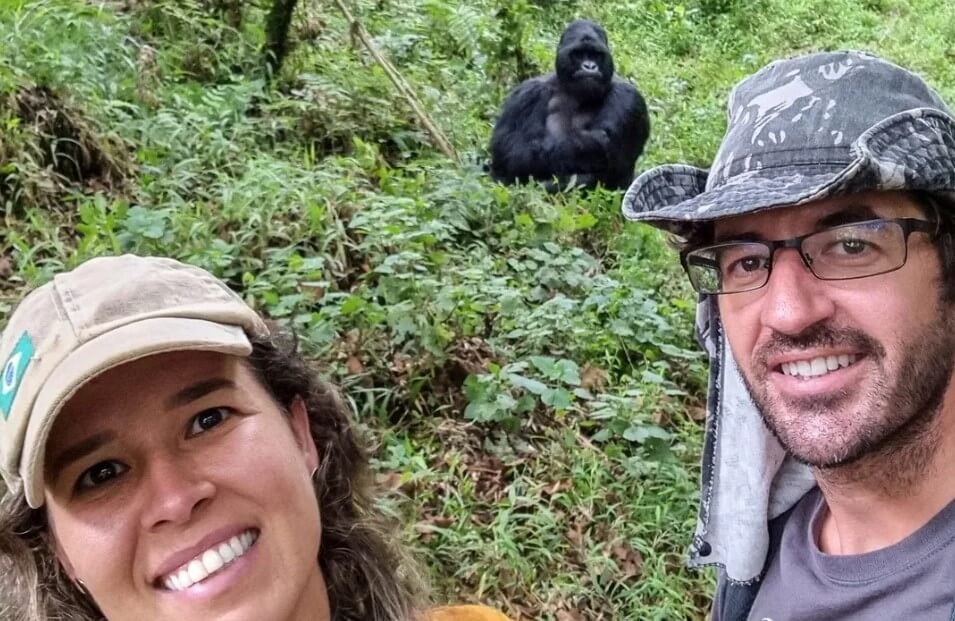
Avoid anything with prominent logos, bright patterns, or white fabric. The gorillas’ response to high-contrast patterns is unpredictable enough that neutral, plain-coloured clothing is the clear choice.
Colour: The Black Question Answered Directly

This topic generates disproportionate confusion online, so a direct and complete answer is worth giving.
The recommended colours for gorilla trekking are neutral and muted: khaki, olive, dark green, brown, tan, grey, and similar earth tones.
These colours serve two purposes simultaneously. They provide natural camouflage within the forest environment, reducing the visual contrast between trekkers and the surrounding vegetation.
And they attract fewer insects, particularly tsetse flies, which show a documented preference for dark colours, especially blue and black.
Can you wear black gorilla trekking? The practical answer is that you should not, and most rangers will actively discourage it if they notice it at the gate briefing.
The gorilla’s concern with black clothing is not that gorillas are inherently threatened by dark-coloured fabric. It is subtler than that.
Habituated gorillas have learned to tolerate the specific profile of a small group of quiet humans in muted clothing at a respectful distance.
Deviations from that established profile, including unusually high contrast colours, can register as novel and potentially threatening stimuli.
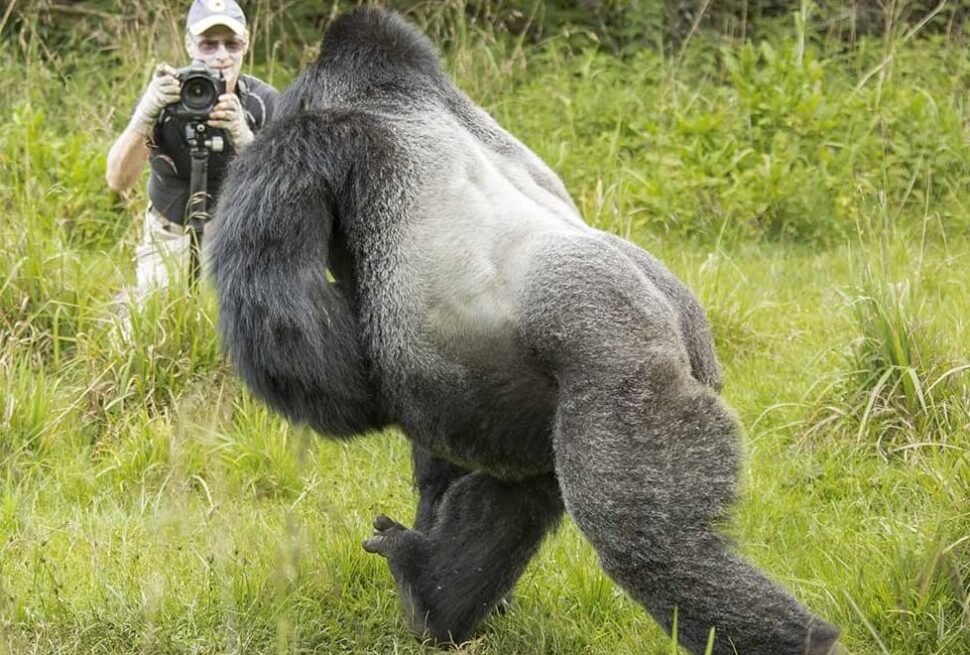
A silverback that responds to something unexpected in the group’s appearance with a threat display is not acting irrationally. He is doing exactly what a silverback is supposed to do.
Dark blue carries a similar caution. Military colours like camouflage green are fine for the vegetation-blending purpose, but check UWA’s current guidance at the gate if your specific item is strongly patterned, as some rangers apply the pattern restriction broadly.
The simplest summary: dress in the colours of the forest floor. Khaki, brown, olive, and muted green are universally appropriate. Black, bright blue, white, red, and orange should stay in your luggage.
Footwear: Where Most People Get It Wrong
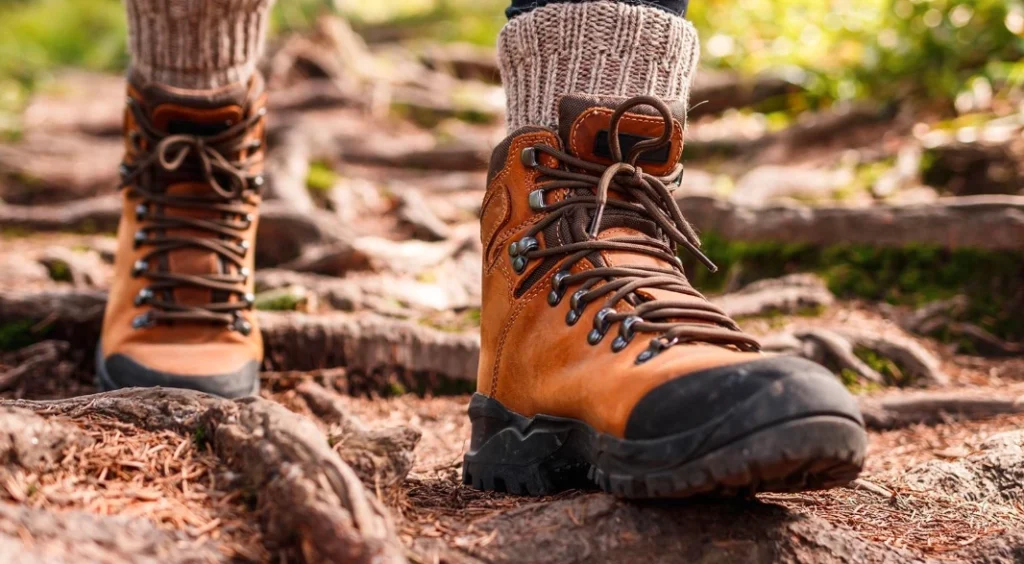
The boot decision matters more than any other single equipment choice on a gorilla trek. Most injuries on the trail are ankle-related, and most ankle injuries happen because trekkers wear inadequate footwear for the terrain.
a) What Bwindi’s Terrain Actually Demands
Bwindi Impenetrable Forest involves a combination of conditions that few other hiking environments match simultaneously.
Exposed roots crossing the trail at ankle height, clay soil that becomes skating-rink slippery when wet, steep descents where the natural tendency is to rush, dense undergrowth that hides uneven ground, and stream crossings where the stepping stones may or may not be stable.
These conditions exist in every sector, with Nkuringo and Ruhija adding significant gradient to the list.
Trail runners, even technical ones, are insufficient because they lack ankle support and their soles do not grip wet clay in the way that proper hiking boot lugs do.
Casual walking shoes, sandals, and anything with a flat sole are inappropriate at any sector in any season.
They are not prohibited, exactly, but rangers have seen what happens to trekkers who wear them on a long descent in the rain, and they will tell you at the briefing.
b) What to Look For
A proper gorilla trekking boot has four characteristics that matter on the trail.
1. Ankle support
A mid-height boot that wraps and supports the ankle joint is the minimum. High-cut boots offer more protection on very uneven terrain. Low-cut hiking shoes, however technical, do not protect the ankle in the way the terrain requires.
2. Waterproofing
Gore-Tex lining or equivalent waterproof membrane. Forest trails at Bwindi and Mgahinga are wet even in dry season. Stream crossings happen. Rain arrives without notice. Wet feet over a long trek produce blisters and thermal discomfort that are entirely avoidable with the right boot.
3. Aggressive lug sole
Deep rubber lugs that grip on clay, roots, and wet rock. The sole of your boot is the interface between you and the terrain. A thin or shallow-patterned sole provides minimal grip on the steeper, wetter sections that define the difficult parts of any Bwindi trek.
4. Broken in before arrival
This is not a feature of the boot itself but a condition of its use that is worth stating plainly. New boots on a long trek produce blisters. Wear your trek boots on at least three or four substantial walks before your safari. A boot box that opens for the first time in your Bwindi lodge room is a problem waiting to happen.
c) Gaiters
Lightweight gaiters worn over the boot and lower trousers are useful in two specific ways: they keep mud and small debris out of the boot collar, and they provide an additional barrier against safari ants entering from the boot-trouser gap.
They are not mandatory, and many experienced trekkers skip them, but if your trousers do not tuck cleanly into your sock tops, gaiters fill that gap effectively.
Gloves: The Underrated Essential

Gardening gloves. Specifically, lightweight cotton or synthetic gardening gloves with a grip texture on the palm and fingers, available from any hardware or garden store for under $5.
They sound unglamorous, and they are. They are also one of the most practically useful items on a gorilla trek, particularly at Nkuringo and Ruhija, where steep sections require grabbing vegetation for stability.
Without gloves, those grabs mean plant sap on your hands, cuts from sharp stems, and stinging plants that the ranger navigates past with professional familiarity while you discover the hard way that not all Bwindi vegetation is benign.
They also protect your hands when you fall, which at some point in the trek, particularly on a long day at a challenging sector, is a matter of when rather than if. A palm caught on a root hurts less through a glove than it does through bare skin.
Bring a pair. They weigh almost nothing. They will earn their place on the trail within the first hour.
Rain Gear: Mandatory Regardless of Forecast

Bwindi receives high rainfall year-round, including in the dry season. The forest generates its own microclimate, and conditions that look stable at 7 am at the gate can produce rain by 10 am without the forecast having suggested anything of the kind.
This is not dramatic weather unpredictability. It is a tropical forest behaving like a tropical forest.
A packable rain poncho or waterproof rain jacket is essential.
The poncho has one advantage over the jacket in a forest environment: it covers your day pack without requiring a separate rain cover, which simplifies the gear equation when rain arrives quickly, and you need to protect your camera and phone as well as yourself.
Whatever you choose, it should pack small enough to carry in your day pack from the gate without adding meaningful weight.
The rain gear you leave at the lodge because you did not want to carry it is the rain gear you will wish you had at the top of a Nkuringo descent in a downpour.
Layering for Temperature

Bwindi’s altitude creates temperature ranges that surprise first-time trekkers expecting equatorial heat throughout. Early mornings at the gate are cool, sometimes genuinely cold, particularly at Ruhija above 2,300 metres.
Once you are moving, exertion raises body temperature quickly, and layers need to come off. When you stop at the encounter site and stand still for an hour, the temperature drops back.
The practical approach is to start the trek with a light fleece or midlayer over your long-sleeved shirt and to remove it within the first thirty minutes of walking.
Carry it in your day pack or tie it around your waist for the approach. Have it available again for the encounter, particularly at the higher sectors in the early morning.
Avoid down insulation for the midlayer. Down loses its insulating properties when wet, and in a humid forest environment, it will get wet. A synthetic fleece or merino wool midlayer maintains warmth when damp and dries faster than down.
The Day Pack
A small, comfortable day pack carries everything you need from gate to encounter and back. The right size is between 15 and 25 litres, large enough to carry water, snacks, rain gear, a camera, and your insulating layer without becoming a structural burden on the trail.
Keep it light. Everything in the pack that is not serving a specific purpose is the weight you carry for several hours.
A porter carries your pack for you if you hire one, which at $20 to $30 is one of the better decisions the morning offers, but even with a porter, a bloated pack creates an unwieldy load on narrow trail sections.
Padded shoulder straps matter more than most packs suggest in their marketing. Thin nylon straps cut into the shoulders quickly on a long descent. A hip belt, even a simple one, distributes weight off the shoulders during steep sections.
Carry your camera, phone, and any electronics in a waterproof bag or dry sack inside the pack. Forest humidity permeates conventional camera bags, and rain-exposed electronics inside a non-waterproof pack are an expensive lesson.
A simple dry sack costs very little and eliminates the risk entirely.
Gorilla Trekking Clothing by Sector

Different sectors have slightly different practical emphases, worth knowing before you pack.
- Buhoma has the most established trail and the most forgiving terrain. Standard mid-cut boots and a single rain layer are sufficient for most conditions here.
. - Rushaga has variable terrain across its range of gorilla family locations. Prepare for mud in wet season and bring gaiters if you trek between March and May or October to November.
. - Nkuringo is the sector where footwear matters most. The steep descent to and ascent from the encounter zone demands maximum boot grip and ankle support. Do not arrive here in anything less than a proper hiking boot.
. - Ruhija is the altitude sector. Cold morning temperatures make the midlayer and warm hat essential rather than optional.
The sector also receives more mist and lower-lying cloud than the others, which means your rain gear works harder here than anywhere else in the park.
.
For the full picture on each sector and what the trek involves physically, the gorilla trekking experience guide and the post on how long gorilla trekking takes cover the terrain and duration variables in detail.
The is gorilla trekking safe post addresses the physical risk factors, including the footwear-related ones, directly.
What to Wear for the Journey to the Park

The trek clothing above is optimised for the forest. The journey to Bwindi, whether from Kampala, Entebbe, or Kigali, is a different environment and a long one.
The overland drive from Kampala takes 8 to 9 hours, typically split across two days. The Kigali entry route is shorter at 3 to 3.5 hours but still involves a border crossing and a final approach on unpaved mountain roads.
Comfortable, casual travel clothes that you can change out of at the lodge the evening before the trek are the sensible approach.
Keep your trek boots accessible in your main bag rather than packed in the centre of a suitcase.
You will want to put them on at the lodge and wear them around the grounds the evening before if they have not had much breaking-in time, just to reinforce the fit before the morning.
Full transport and logistics are covered on the how to get to Bwindi page and the gorilla trekking from Kigali guide for those arriving via Rwanda.

FAQs About Gorilla Trekking Attire
1. Can I wear black on a gorilla trek?
You should not. Black clothing attracts tsetse flies and certain biting insects more strongly than neutral colours, and dark colours can produce unpredictable responses in habituated gorilla families during close encounters.
Rangers will advise against it at the gate briefing.
Pack neutral earth tones, khaki, olive, brown, grey, and muted green, and leave black clothing in your lodge room on trek day.
2. Are hiking boots really necessary, or can I wear trail runners?
Proper hiking boots are strongly recommended over trail runners for all four Bwindi sectors and for Mgahinga.
The terrain involves wet clay, exposed roots, and a steep gradient that trail runners, however technical, do not handle as safely as a mid-cut hiking boot with ankle support and an aggressive lug sole.
At Nkuringo and Ruhija specifically, trail runners increase the ankle injury risk meaningfully.
If you are already committed to trail runners and cannot change before your trip, be conservative on steep sections and hire a porter to free your hands for balance.
3. Does it matter what colour my rain poncho is?
Yes, to a degree. A neutral-coloured rain poncho (grey, olive, dark green, tan) is preferable to a brightly coloured one.
Bright yellow or red emergency ponchos worn during the gorilla encounter introduce the same colour-stimulus concern as bright clothing. Neutral rain gear is widely available and is the practical choice.
4. What should I do if I forget something essential at home?
Kampala has outdoor and camping gear shops where basics can be sourced, though the selection is limited compared to international outdoor retailers.
Gardening gloves, rain ponchos, and basic hiking gear are available in larger Ugandan towns. If you realise you are missing something significant after you have arrived in Uganda, ask your operator before the trek day.
More specific logistics are covered on the FAQs page, or you can reach us directly via the contact page.
5. Should I bring trekking poles?
They are optional but genuinely useful, particularly on steep descent sections at Nkuringo and Ruhija. Most airlines count poles as sports equipment in checked luggage.
If you do not have poles, a porter’s steadying hand on difficult sections provides similar practical support. Hire a porter first; consider poles as an additional layer rather than a substitute.
Getting your clothing and gear right is one of the few parts of the gorilla trekking experience you can fully control. The gorillas’ location on the day, the weather, and the length of the walk are the forest’s decision. What you carry into it is yours.
Plan your full gorilla safari here, and we will make sure every other logistical detail is handled before your alarm goes off at 5 am.